
Robotic missions to Mars and advances in space tourism dominated the space activities of 2021. But in 2022, the moon is likely to stand out, as companies and governments launch various moon-bound spacecraft.
Most of those missions revolve around Artemis, NASA’s multibillion dollar effort to return astronauts to the moon later in the decade and conduct routine science missions on its surface in preparation for farther treks to Mars (a far more ambitious endeavor that will likely not happen in this decade). But before astronauts make the moonshot, a series of rocket tests and science missions without humans will need to be completed.
2022 is the year for those initial steps toward the moon. Two new rockets central to NASA’s lunar plans will launch to space for the first time, each with more power than the Saturn 5 rocket from the Apollo program. And other countries are expected to join the march to the moon as well.
NASA’s Gigantic Moon Rocket Debut
After years of development delays, NASA’s Space Launch System, or S.L.S., could make its first journey to space — without any humans — as early as March 2022.
The mission, called Artemis 1, will mark the first in a series of flights under NASA’s Artemis program by S.L.S., NASA’s centerpiece rocket system for getting moon-bound astronauts off Earth. For Artemis 1, S.L.S. will launch from NASA’s Kennedy Space Center in Florida to send a capsule named Orion around the moon and back, rehearsing a trajectory that will be performed by Artemis 2, the subsequent mission that is scheduled to carry astronauts sometime in 2024. The third mission, Artemis 3, will result in a moon landing.
Like any major space mission, Artemis 1 has been delayed several times. It was initially planned for 2020, then pushed to various times throughout 2021 because of development challenges and setbacks caused by the pandemic. NASA blames the most recent delay to March 2022 on the need to investigate and replace a faulty internal computer controlling one of the rocket’s four main engines.
SpaceX’s Next Starship Test
Central to NASA’s efforts to return humans to the moon is SpaceX’s Starship, which will be used as a human lunar lander in roughly 2025. It will be the agency’s first astronaut mission to the moon’s surface since 1972. Designed as a fully reusable rocket system, Starship also stands at the center of Elon Musk’s ultimate goal of ferrying humans to Mars and will be crucial to SpaceX’s revenue-generating satellite launch business.
But first, Starship must reach orbit. That test flight, also with no people on board, could happen sometime in mid-2022.
Mr. Musk, SpaceX’s chief executive, had hoped to launch Starship to orbit in 2021. But a protracted Federal Aviation Administration review of the environmental impact of SpaceX’s launch site in Texas and development delays with the company’s new Raptor engines have postponed the test flight. The F.A.A. review is expected to finish in late February and determine whether deeper environmental reviews will be necessary, or whether SpaceX can resume Starship launches.
A successful orbital test will be a key step in NASA’s moon program. Astronauts launching atop the Space Launch System inside the Orion capsule will rendezvous with and transfer to Starship above the moon to descend the rest of the way to the lunar surface. Starship would later liftoff from the moon, then transfer the astronauts back to Orion for the journey home to Earth.
NASA-Funded Moon Robots
Three robotic moon landers under a NASA program are scheduled to make their way to the lunar surface in 2022 — if development goes as planned.
Intuitive Machines, a Houston-based company, and Astrobotic, based in Pittsburgh, are each aiming to send small lunar landers carrying various scientific payloads to the moon by the end of 2022. Their landers were developed under NASA’s Commercial Lunar Payload Services program — part of the agency’s effort to rely on private companies for sending cargo and research instruments into space with the hopes of stimulating a commercial market.
Intuitive Machines’ Nova-C lander, a six-legged cylindrical robot, is expected to launch on SpaceX’s Falcon 9 rocket in early 2022 carrying a dozen payloads to the lunar surface. One of the instruments on board will measure the plume of lunar dirt kicked up during Nova-C’s landing, an experiment that could help engineers prevent messy lunar landings in the future. The lander will also deploy a small rover built by Spacebit, a British company. In the fourth quarter of 2022, the company could also send a second mission to the moon’s surface.
Astrobotic’s Peregrine lander is a boxy, four-legged lander with an onboard propulsion system that will ease itself onto a basaltic plain on the sunlit side of the moon’s northeastern quadrant carrying 14 research payloads. The company says Peregrine will be ready for launch aboard United Launch Alliance’s new Vulcan rocket in the middle of 2022.
But whether it launches on time is dependent on when the rocket will be ready to fly. Vulcan’s debut has been held up by the engine supplier for the rocket, which is Blue Origin, Jeff Bezos’ space company. Its new BE-4 engines have yet to be delivered.
Testing a Complex Lunar Orbit
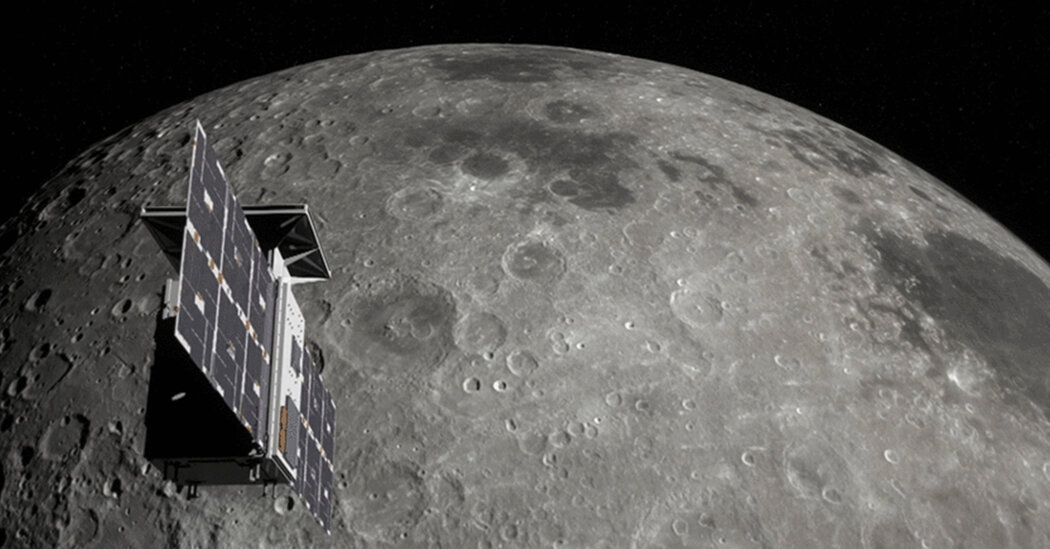
Rocket Lab, which builds rockets for small launches, is poised to send in March 2022 a microwave-size satellite, or CubeSat, for NASA called CAPSTONE from the company’s launch site in New Zealand.
The satellite will study an orbit around the moon that a future space station called Gateway, being developed by NASA and other space agencies, will reside in sometime in the next decade.
CAPSTONE will also test new navigation technology designed to calculate a spacecraft’s position relative to other spacecraft. Traditionally, satellites use onboard cameras to determine their whereabouts relative to star formations or the apparent position of the sun. Instead, CAPSTONE will try to glean its position in space by communicating with NASA’s Lunar Reconnaissance Orbiter, an imaging satellite launched in 2009.
South Korea’s First Moonshot
The Korea Pathfinder Lunar Orbiter, a box-shaped satellite, will be South Korea’s first foray to the moon as the country aims to bolster its technical know-how for conducting missions in space.
Led by the Seoul’s space agency, the Korea Aerospace Research Institute, the spacecraft carrying six main tools is scheduled to launch in August 2022 on SpaceX’s Falcon 9 rocket and arrive in lunar orbit by December. It will spend a year surveying the moon’s geology and examine from afar the chemical composition of lunar dirt.
The satellite will also carry a Lunar Terrain Imager, which will survey potential landing sites for a subsequent South Korean robotic lunar lander mission.
Even More Global Visitors
Lunar robots from three other countries will also try to make their way to the moon in 2022.
The Luna-25 lander, possibly launching in mid-2022, will mark Russia’s first moon landing since 1976, when the Soviet-era Luna-24 lander collected lunar samples to return to Earth. The lander will study the lunar soil and test technologies for future Russian moon landings.
India plans to send the Chandrayaan-3 lander and rover to the moon in the third quarter of 2022, attempting its third moon mission after the lander-rover bundle from India’s Chandrayaan-2 mission crashed in 2019.
A Japanese space company, ispace, intends to send its Mission 1 lander to the moon sometime in the second half of 2022. If the landing is successful, it will deploy a pair of rovers. One, a small four-wheeled robot named Rashid, is built by the United Arab Emirates. Another smaller robotic explorer built by Japan’s space agency is the size and shape of a basketball. It can transform into a rover after deployment, dividing itself in two and using its halves as wheels to rove around and study lunar dirt.