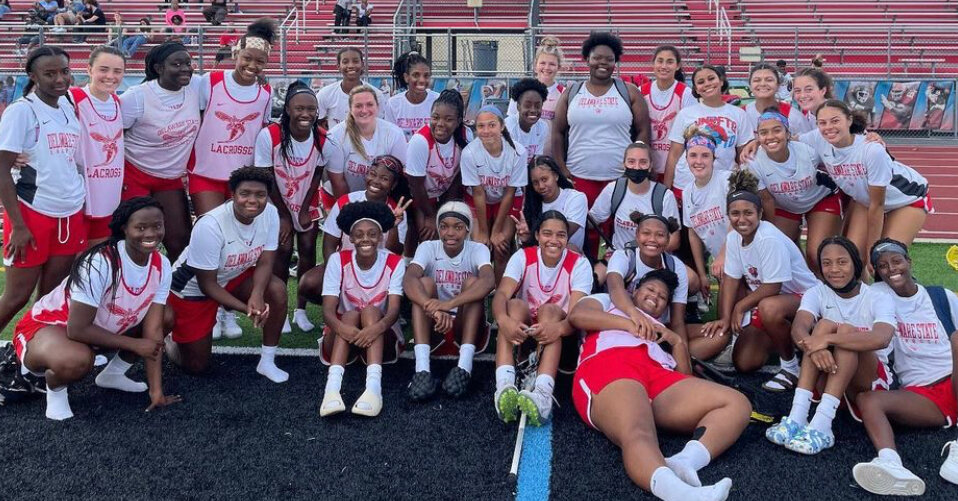

At first, Pamella Jenkins, the head women’s lacrosse coach at Delaware State University, wasn’t worried when Georgia sheriff’s deputies pulled over her team’s bus.
Her team, around 70 percent Black and representing a historically Black college with roots that stretch to the 1890s, had been enjoying the trip home after playing in a tournament in Florida. They were doing nothing wrong. The team’s chartered bus was not speeding as it eased north on Interstate 95. It made sense when she heard a deputy tell the driver that he had the bus in the left lane and needed to be in the right.
But it was not long before the mood shifted in a way that feels all too familiar — a mood I can relate to as an African American who once played college sports and plied the same Georgia interstates while competing in the low levels of professional tennis.
Suddenly Jenkins’s team was being accused of having drugs on board. More deputies arrived. A drug-sniffing dog circled. Jenkins, who is Black, shared her athletes’ feelings: shock, fear, anger and frustration.
Video footage, which contradicted the sheriff’s account of the stop, shows a group of white deputies rifling through luggage. One of them took a package and asked whose it was. When the player responded that it was hers and didn’t know what was inside because it was a gift from family, the deputy met her with suspicion. Jenkins said the deputy found nothing more than a jewelry box inside.
“I’m sitting there, and I’m trying to stay calm, but at that moment, I’m so upset and scared and frustrated at what is happening to us,” Jenkins said of the April 20 incident in a phone interview this week.
“Unfortunately,” she said, “these situations can escalate.” And then the worst can happen. So she led by example and kept her stress under wraps. Her athletes followed suit.
The deputies did not find drugs. The driver — who, no surprise, just so happened to be Black — did not receive a traffic citation. An officer came aboard and said the team could go.
Think about what they went through.
Think about all Black athletes crisscrossing America for competitions, from youth basketball and football teams to college players. Some travel alone. Some with teams. Some in small groups. If you think that fear of encounters like this is not part of the mix, think again.
I have my own stories. If you’ve read my columns for a while, you may know that I was once a serious tennis player, one of the few Black nationally ranked juniors in the 1980s — a starter on a top-ranked team at the University of California, Berkeley. After college, I played for a few years in the minor leagues of professional tennis, traveling to every corner of America and good parts of the globe.
I was profiled by the police after playing in one of those tournaments in the early 1990s, when another Black player and I had made the doubles final at an all-white country club in Birmingham, Ala. To say that we were an astonishing sight to the club members — and to the all-Black grounds crew that cheered us at every match — would be the mother of all understatements. We lost, but we were jubilant. We’d made a statement by going as far as we did.
But while driving our rental car to the next event, set to be held in Augusta, Ga., we were pulled over by a highway patrolman in the rural stretch between Birmingham and Atlanta. I remember his wide-brimmed hat and his invasive questioning. What were we doing in this car? Where were we going? The next thing I knew, he was looking through our bags.
Why were we pulled over and searched? My partner had been driving well within the flow of traffic. We were just two young Black guys in a shiny rental. It didn’t help when the patrolman asked for our identification and saw we were from California.
It has been three decades, so I don’t recall all the details about what took place next, but somehow, the deputy hauled my partner off to the local, small-town police station. About an hour later, my partner walked out. As I remember it, he didn’t get so much as a ticket. He was unscathed but shaken. I drove the rest of the way.
That wasn’t the only time I was profiled during my short time at the basement level of pro tennis. The worst instance came in Europe in 1992, when I traveled from Paris to London after playing in France. At London’s Heathrow Airport, customs officials pulled me out of the line and began asking pointed questions.
They asked, sternly and accusingly, why I was in Europe playing tennis. Prove it, they said.
I stood helplessly beside them as they rifled through my tennis bags. They found clothing, rackets and my journal, which they read with a seemingly voyeuristic interest. Then they led me to a windowless room and left me there without saying when they would be back. I wasn’t alone in that room. I was with about a dozen Black travelers from African countries.
I sat for one hour, then two, then three. After eight hours of confinement, a guard came in and let me go. He never apologized.
There is an unseen burden Black people carry long after such encounters. It’s a shroud. You question yourself. “What just happened? Did I do something wrong?” You struggle to make sense of what just took place. “Was that officer, that shopping mall security guard, that customs agent, really just doing their job? Or was I treated this way because of my skin color?”
The uncertainty is its own terror.
We are left with doubt, rage and tears. We become well versed in stuffing emotions deep down and moving on. Or at least we try. .
And now, through no fault of their own, the young Delaware State lacrosse players must deal with this kind of pain.
After the stop, Jenkins said, the trip home was unusually quiet and even somber. Shock does that.
The full force of the incident did not hit for days, until a player wrote a story about it in the campus newspaper and word of what happened began to spread.
“It was re-traumatizing all over again, reliving the whole thing,” Jenkins said. “And that’s when we realized, ‘Whoa, this was really bad.’”