


LVIV, Ukraine — In the arched dining hall of a former boarding school in Lviv, Kamila Horbachova and other teenage girls set out dishes, as younger children scrambled into seats and then tucked into dinners handed out by the cafeteria staff.
These displaced children from eastern Ukraine — most of whose parents were unable to leave critical jobs like those in hospitals or the military — endured a fraught escape, narrowly missing a Russian bombardment, and fleeing their hometowns to take refuge on the other side of the country.
“I was very worried that we were leaving without our parents, by ourselves,” Kamila, 14, said, adding that when she boarded the train alone, “it was horrible for me.”
Now the children are navigating a strange new reality: They go to school and have movie nights, reclaiming something of a normal childhood, even as they frantically call their parents daily to make sure they are still alive.
“It was just a miracle that we were saved,” said Anna Palova, a soft-spoken 14-year-old with pink hair and manicured nails. “I just want this war to be finished and return home to my parents.”
These 20 children are living with six teachers in the Mriya or “Dream” School — a former convent turned boarding school turned shelter. It is one of the many examples of how this war has uprooted the lives of children.
Most of Ukraine’s children, up to two-thirds according to estimates from the United Nations, have had to leave their homes at some point since Russia invaded. Many left with their mothers, but some, like these children, could not. They are finding a new community with one another after being placed in the care of their teachers and sent some 800 miles west to Lviv.
These children already knew the perils of war. Their home city, Toretsk, is just five miles from the front line between the separatist-held portion of the Donetsk region and the area held by Ukrainian troops. The city was captured by Russian-backed separatists in 2014 before Ukrainian forces retook it later that year.
Just walking to school was hazardous. A 2017 UNICEF report found that the majority of child casualties in the region were from mines and other explosives left behind by combatants.
But in recent months, the city was constantly bombarded by Russian forces and living conditions deteriorated.
The education department organized buses to evacuate students from the city. Some, like this group, ended up in Lviv, where more than 75,000 children from elsewhere in Ukraine have come since the start of the war, according to the regional government.
Kamila, 14, was in first grade when the conflict in the east began and said she had grown accustomed to the sounds of gunfire and occasional shelling. But as sporadic clashes turned to a steady onslaught, the already unstable situation worsened. The electricity went out, and then the water. Kamila’s parents, unable to leave because of key jobs in mining, got her out of the city the only way they could. They hoped it would save her life.
Better Understand the Russia-Ukraine War
When she looked at her phone midway through the journey, she saw the news that the very train station she had stood in the day before had been bombed.
“It just happened that we left earlier,” Kamila said, her face drawn as she said she thanked God daily that they escaped with their lives.
“It was very frightening,” said Oleh Cherkashchenko, 28, one of the teachers looking after the children. “The children understood — they have been living in a state of war for eight years. They know what loss is, what death is.”
Bringing the students to Lviv has allowed the teachers to also escape the war while continuing their work. Those with their own children were able to bring them, ensuring their safety as well.
Nazarii Petriv, who works for Lviv’s city government in the department of humanitarian policy and coordinates programming at the school, moved into the building in February.
He said the teachers and staff were doing their best to provide support and care for children whose needs are complex: They range in age from toddlers to teens, are far from home and have witnessed the worst of war.
“They have experienced a lot of suffering in their lives,” he said.
It hasn’t always been easy to find support. The children need food, supplies and clothes. But their needs are not just physical. With support from UNICEF the school has been able to bring in two local psychologists to help the children begin to grapple with the mental and emotional toll of the war. Joe English, a communications specialist from UNICEF who spent time in Ukraine earlier this year, said that unaccompanied children “are among the most vulnerable of the vulnerable.”
“The psychosocial impact the war is having on children is staggering, and it is often parents and caregivers who are the first responders in terms of identifying and responding to children’s suffering,” he said. Unaccompanied children “do not have that basic comfort of parental care,” he added.
Olha Stadnyk, 34, an art teacher whose two daughters are among the children living at the boarding school, spoke of their resilience, but like her fellow teachers, she is beginning to realize just how long the war may go on. Western military analysts and leaders have warned that it could continue for years as Russia tries to wear Ukraine down.
There are other challenges. Many things can feel foreign here, including the Ukrainian language. In Toretsk, Russian is the mother tongue. An estimated one in three Ukrainians speaks Russian at home, according to researchers, including many from the country’s east as a result of centuries of Russian dominance there.
But amid the war, Russian-speaking Ukrainians are switching to Ukrainian as a show of defiance and are encouraging others to do the same, with the government moving to ban some Russian movies, books and music. At the school, the children are taught in Ukrainian, and Russian is discouraged.
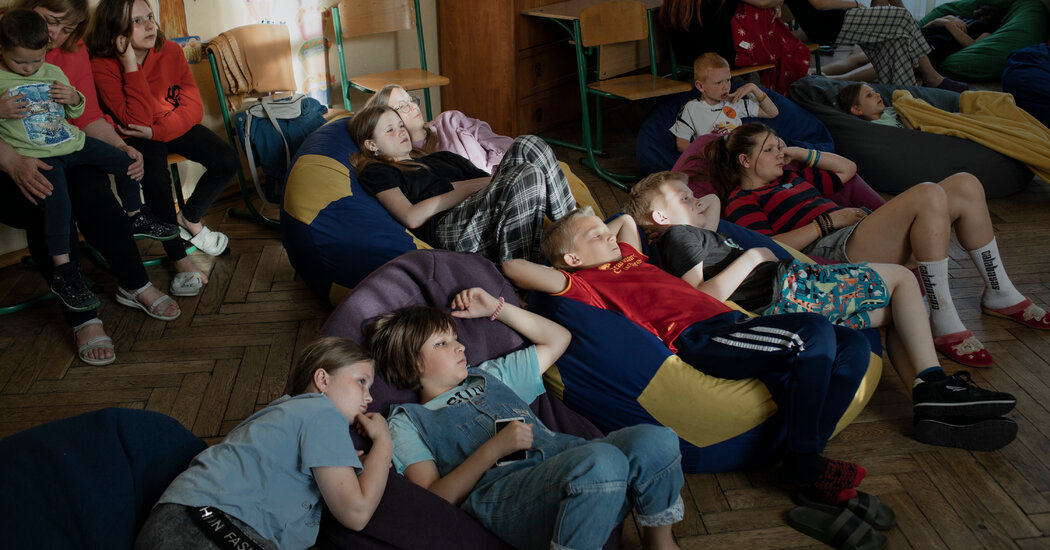
Still, the children have embraced the changes, teachers say. They play soccer in the small field outside and take field trips to the zoo. On a recent evening, the children curled up on beanbags and snuggled next to each other as they watched the animated movie “Inside Out” in Ukrainian on a large screen.
Some were sleepy after a long day spent kayaking in the sun, their eyelids hanging heavy and new freckles peeking out from their skin. In Lviv, the world around them has turned from harrowing to ordinary, and there are hours, even whole days, when they have the chance to just be children again.
Ivan Shefer, a 12-year-old boy with bright blond hair, described the difficulties he had coming here alone. He knew just one older girl on the bus who was from his school. Like most of the children, he has a phone and speaks with his family back home nearly every day, a connection that shrinks the miles between them.
“At first I was a bit shy, but now it’s OK,” he said, a small smile spreading across his face as he described getting good at soccer and making friends with the other children.
But he misses his mother and other family members left behind in eastern Ukraine.
“I am just waiting for the moment I can go back home,” he said.

