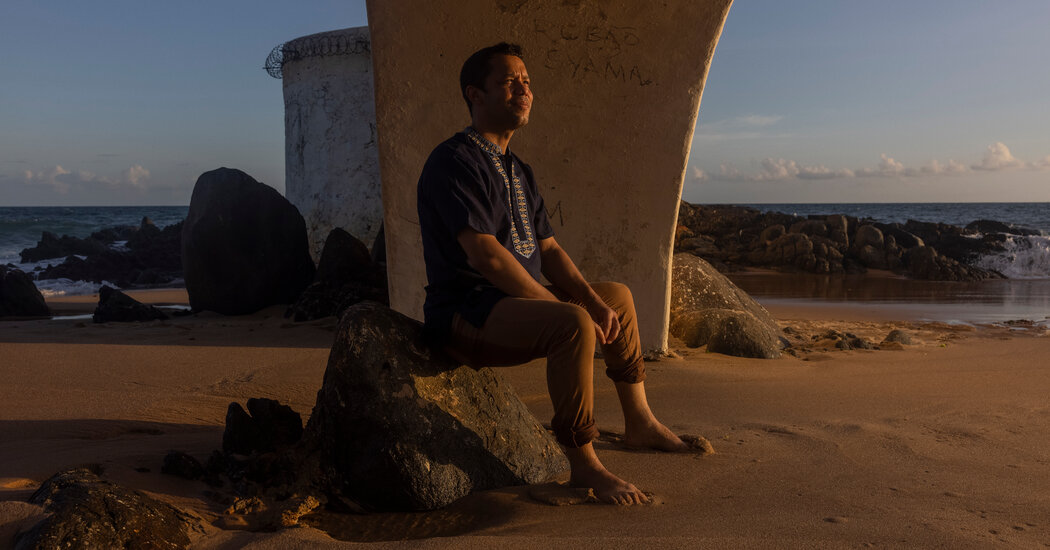

RIO DE JANEIRO — Itamar Vieira Júnior, whose day job working for the Brazilian government on land reform took him deep into the impoverished countryside, knew next to nothing about the mainstream publishing industry when he put the final touches on a novel he had been writing on and off for decades.
On a whim, in April 2018, he sent the manuscript for “Torto Arado,” which means crooked plow, to a literary contest in Portugal, wondering what the jury would make of the hardscrabble tale of two sisters in a rural district in northeastern Brazil where the legacy of slavery remains palpable.
“I wanted to see if anyone saw value in it,” Mr. Vieira, 42, said. “But I didn’t have much hope.”
To his astonishment, “Torto Arado” won the 2018 LeYa award, a major Portuguese-language literary prize focused on discovering new voices. The recognition jump-started Mr. Vieira’s career, making him a leading voice among the Black authors who have jolted Brazil’s literary establishment in recent years with imaginative and searing works that have found commercial success and critical acclaim.
“Torto Arado” was the best-selling book in Brazil in 2021, with more than 300,000 copies sold to date. The previous year, that distinction went to Djamila Ribeiro’s “A Little Anti-Racist Handbook,” a succinct and plainly written dissection of systemic racism in Brazil.
Mr. Vieira and Ms. Ribeiro, 41, are part of a generation of Black Brazilians who became the first in their families to get a college degree, taking advantage of programs enacted by President Luiz Inácio Lula da Silva, who governed Brazil from 2003 to 2010.
The two are among the highest profile figures of a literary boom that includes contemporary writers and authors who are experiencing posthumous acclaim that eluded them when their seminal works were initially published.
“Writers from marginalized communities have been producing important work for decades,” said Fernanda Rodrigues de Miranda, a literature professor in São Paulo, “but they had trouble getting visibility.”
For her doctoral dissertation, Ms. Rodrigues, who is Black, compiled all of the published novels she could find written by Black women from 1859 to 2006.
She was stunned by the literary quality of novels that had gathered dust in drawers, having never been widely read or discussed. And she concluded that the few authors who found commercial and critical success were creatively circumscribed by white literary gatekeepers.
The starkest example is Carolina Maria de Jesus, whose memoir, “Child of the Dark,” was a literary sensation when it was published in 1960. The book, a compilation of diary entries by Ms. Jesus, a single mother of three, offers a raw account of daily life in a São Paulo slum where dwellers picked through garbage for food and slept in shacks patched together with slabs of cardboard.
The book’s success enabled Ms. Jesus — who died in 1977 — to buy a house in a better neighborhood. But publishers showed little interest in her subsequent works, which were commercial flops.
“White readers had a lot of curiosity about Black lives, but they wanted to read stories about fragility,” Ms. Rodrigues said. “Authors wanted to write about other issues, other facets of their identity. They were interested in writing about love, about humor, about searching for a meaningful and fulfilling life,” she said.
An opportunity to showcase new literary talent arose in 2012 with the creation of a literary festival in Rio de Janeiro started as part of an ill-fated effort to restore security in favelas — poor, working-class communities frequently controlled by drug-trafficking gangs.
While the efforts to improve security largely failed, the literary festival thrived and endures today, said Julio Ludemir, one of its founders.
“It showed that there are readers living in favelas, which until then had been deemed impossible,” he said. “But it also showed that there were writers.”
The festival kick-started the careers of several authors, including Geovani Martins, 30, who attended a writing workshop at the festival while he was living in Vidigal, a favela that clings to a mountainside hovering over some of Rio de Janeiro’s most expensive neighborhoods.
His debut — “The Sun on My Head,” a collection of short stories published in 2018 — became a best seller in Brazil and has been translated into several languages. Its tales of adolescent angst, sparkling with slang, often take place in communities where young lives are hemmed in by racism and the violence fueled by the drug trade.
Mr. Martins’ success notwithstanding, until recently Black authors had a hard time getting book deals from mainstream Brazilian publishers, Ms. Ribeiro said. She set out to upend how the industry approached these young writers by curating a series of books in 2017 dedicated to Black authors.
It included inexpensive titles, priced at less than $4. Book events were held in outdoor public places, which attracted large crowds. Covers included photos of the authors, and the writing tended to be accessible.
Ms. Ribeiro, who studied philosophy, said that when she wrote and marketed books, she thought of her mother, who, like her grandmother, had worked as a maid and did not have a college education.
“I always want to write in a way that my mother would understand,” she said. “I felt a calling to be generous enough to write in the same accessible way that generous authors before me wrote, because otherwise you only legitimize the power spheres of those who are privileged.”
The formula worked exceptionally well. One of Brazil’s top publishers approached Ms. Ribeiro in 2018 to write a book about Black feminism, which became a mainstream hit.
“We wanted to democratize reading, and it was a major success,” Ms. Ribeiro said. “There was an unmet demand from a part of the population that wanted to see itself represented.”
Mr. Vieira, a geologist, managed to use his day job at Brazil’s land reform agency, where he has worked since 2006, to do field research. He studied the politics and power dynamics that shape the lives of rural workers, including some who toil in conditions analogous to modern-day slavery.
That experience, he said, made the characters in his novel more layered and their fictional hometown, Água Negra, which means black water, feel authentic.
“Readers tell me they see themselves reflected in the story,” he said, “which is in many ways a story about how our society came to be.”
Mr. Vieira says a major reason Black Brazilian writers are making their mark, writing and publishing on their own terms, is because of a shift in how race and racism are being discussed in the country today.
“For many years, Brazil tried to whiten its population and people avoided speaking about race in Brazil,” he said. “In the last decades, the Black rights movement and the study of structural racism has clarified our role in society.”
Many Black writers are still struggling to figure out how they fit within it. Pieta Poeta, 27, a Black transgender man from Belo Horizonte, made waves by winning a 2018 national slam poetry festival.
But he has had to self-publish his poetry books, including the most recent: “Do You Still Wanna Yell at Me?” — an exhortation, he said, for readers to imagine what it is like to be a Black, transgender person in today’s Brazil.
He said his work had gotten darker in recent years — and he writes under a pen name — reflecting the political turbulence and social upheaval that has rattled Brazil since the election in 2018 of Jair Bolsonaro, a right-wing president known for his divisive, and often offensive, messaging.
“To be Brazilian means one is either constantly paralyzed by fear or constantly having to cry foul,” he said.
And yet, his work has an undertone of resilience, if not outright hope, as reflected in his short poem “Autocide”:
I wanted to die.
but it wasn’t a death wish per se
It was an absence of life
And no sense of how long things
take
to stop hurting so deeply.
Of the time it takes for our backs
To bear the world, its weight.
Lis Moriconi contributed reporting.