

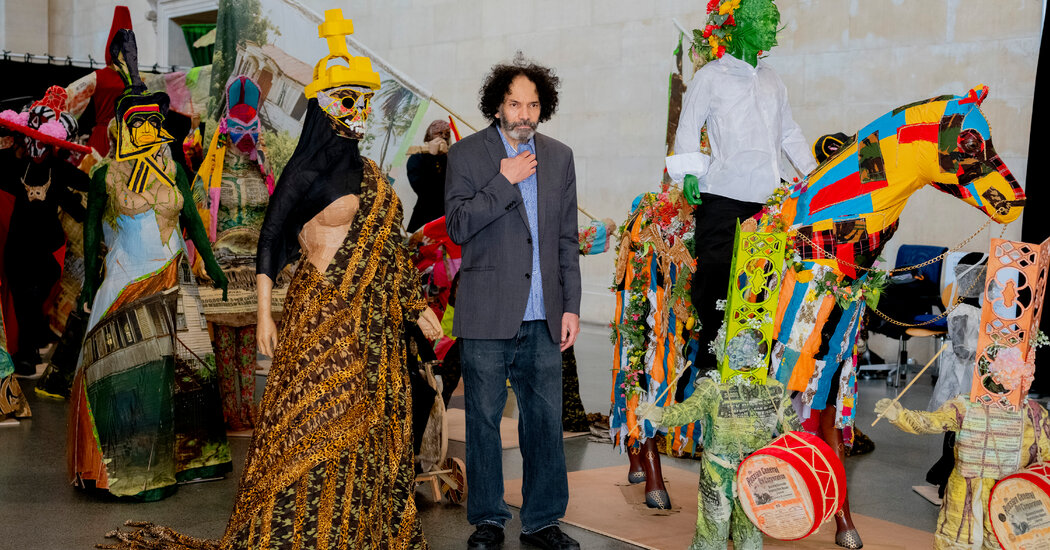

LONDON — On a recent morning, a cavernous studio in south London was a vista of ordered chaos. Elaborate headdresses covered several tables, a jumble of cardboard cutout body parts lay heaped on a palette and boxes overflowed with leopard-print fabrics, fake fur and gaudy fake jewelry. Sewing machines whirred and hammers banged.
Calmly supervising the mayhem was Hew Locke, a British-Guyanese artist renowned for his visually dazzling assemblages that explore global power structures and the legacy of colonialism by riffing on symbols of sovereignty, from coats of arms and trophies to weaponry and public statuary.
With Locke looking on, an assistant attached a plastic rider to a life-size model horse, and another tinkered with a mannequin’s wheelchair; nearby, two imposing cardboard figures in patchwork skirts were arranged to look like they were hauling a treasure chest. “They’ve all got their little stories,” said Locke of the motley throng of figures that filled the space.
Locke, 62, had created 140 of these human-size figures, plus five horses, for a major sculptural commission at Tate Britain, which he has envisioned as an exuberant cavalcade down the museum’s neoclassical central gallery. Conceived with lavish theatricality but on a human scale, the work, called “The Procession” and on view through Jan. 22, 2023, feels part religious pageant, part carnival, part danse macabre.
“The whole thing is like a massive poem,” Locke said in an interview ahead of the show. “There’s a lot of very dark stuff: colonialism, history, politics. But that’s irrelevant,” he added. “The really important thing is that it must look exciting. It must look colorful. It mustn’t be boring.”
The work is installed throughout the two grand colonnaded halls flanking an octagonal room that make up the Duveen Galleries, as the museum’s 300-foot spine is known. Since 2000, the Tate museum group has commissioned an artist every year to respond to the space.
Implicit in the invitation is the need for spectacle. The artist Fiona Banner memorably suspended a fighter jet there in 2010, and, in 2014, Phyllida Barlow filled it with teetering structures, bursting containers and colossal stacks of wood and debris to recreate the bustle and danger of a commercial dock.
“When I was asked, I was really excited,” Locke said. “And then the excitement turned into fear, because I saw this as a space that could eat a career.”
In a 40-year practice engaged with themes of empire, globalization and migration, the Tate Britain exhibit is a milestone for Locke, who, like many artists of color, was long excluded from prestigious museum commissions here. Alex Farquharson, Tate Britain’s director, said in an interview that there were “intense ambiguities” in Locke’s flamboyant yet unsettling procession. “I would say this is linked to a Latin American, Caribbean idea of magic realism, which is about the convergence of reality, history, myth and the imaginary,” he said. “It’s an updated magic realism, taking these ideas into new terrain in the medium of installation art.”
“Hew is an incredible maker,” said Courtney J. Martin, the director of the Yale Center for British Art in Connecticut, which will give Locke a show in 2024. “I don’t think that we talk enough about his skill and his craftspersonship, his ability to put disparate objects together to make a whole that is cohesive,” she added.
Locke got his first big break in 2000 with an installation at London’s Victoria and Albert Museum titled “Hemmed in Two,” a sprawling cardboard structure like a ruined paddle steamer crossed with a Mughal palace. The multilayered piece, covered with bar codes and shipping labels suggesting global trade routes, marked Locke’s embrace of cardboard as a staple of his practice. The material still features heavily in “The Procession,” often left crudely unfashioned.
“It seemed instinctive not to have everything perfect. I’m a big fan of meticulous imperfection,” said Locke.
Around 2002, he began producing perhaps his best known series: sculptural reliefs of Queen Elizabeth teeming with flea-market bric-a-brac, and plastic flowers and toys. Locke said he intended those works to be an exploration of ideas about Britishness and nationhood. (In the interview, he declined to describe himself as either a royalist, or a republican.) Locke has continued to develop the theme, festooning cheap historical busts of British royals with fake gold and colonial war medals to reflect on the burden of history.
The baroque excess in Locke’s work often belies “the suggestion of something sinister,” said Kobena Mercer, a professor of art history and the humanities at Bard College. “I think that’s informed by the Caribbean aesthetic of masquerade: What appears to be very jovial and festive is actually concealing something that is potentially a threat.”
Locke was born in Edinburgh in 1959 to a Guyanese father and English mother, both of whom were artists. (He and his father, Donald Locke, both feature in the exhibition “Life Between Islands: Caribbean-British Art 1950s — Now.,” running concurrently at Tate Britain through April 3.) Locke’s family emigrated to Guyana in 1966 as the former British colony gained independence. “I remember seeing the bank note being designed and seeing a country being born,” Locke said.
He recalled living through Guyana’s growing pains as the South American nation — a melting pot of Indians, Africans, Amerindians, Chinese and Europeans — became a cooperative republic, then a socialist republic. Later, Venezuela backed an uprising in a disputed border area of Guyana it has long claimed. These formative experiences ignited a passion for international relations: If he were not an artist, Locke said, he would have been a historian or worked for the United Nations.
Locke returned to Britain in 1980 to study art, but Guyana’s vibrant culture had an enduring impact. “It’s an amazing country. If I don’t go there every few years, I go quite strange in the head. I need it,” Locke said.
Around that time, artists of African and Asian descent were starting to mobilize in Britain to empower Black voices and challenge media stereotyping. Locke was not closely involved in what became known as the British Black Arts Movement, but his work became more political, he said, after hearing artists who were speak while he was studying at Falmouth School of Art, in Cornwall, southern England.
Locke later lived in a London squat, where he met his wife, Indra Khanna, an artist and curator. During the 1990s he earned a master’s degree at the Royal College of Art and for some years renounced color in his practice, which he said was to prevent clichéd misreadings of his work as “exotic.” With conceptual art in ascendance, Locke’s intricate drawings of royals and rococo cardboard structures were on the wrong side of institutional trends, passed over in favor of the Young British Artists.
Locke’s eclectic practice, by contrast, was resolutely international: a mash-up of pop culture, religion, art and world affairs, influenced, he said, by discussions with artists from Cuba, India and China. He has created a suspended flotilla of boats for the Pérez Art Museum in Miami; dressed museum mannequins onboard a former British navy battle cruiser in carnivalesque outfits; and ornately decorated photos of public statues representing morally dubious dignitaries in the United States and Britain. The Tate installation reprises the core strands of his oeuvre and has “a retrospective vibe,” Locke said.
Underpinning the whole is a medley of images digitally printed on fabric in which the procession’s figures have been dressed. These images include photographs of Locke’s earlier artworks, as well as Benin bronzes, decrepit Guyanese houses, colonial bank notes and sugar plantation workers (a reference to the sugar fortune on which Tate was founded, Locke said).
Images of obsolete share certificates that Locke has painted on — such as a bond issued by the Confederate States of America, or stock certificates for the Jamaican Trading Company and the owner of a Nigerian gold mine — appear on banners, flags and robes, illustrating flows of money and power across territories and epochs.
But Locke’s figures are not just specters of history. Russia’s invasion of Ukraine is referenced in a figure dressed in the yellow and blue of Ukraine’s flag, who wears a replica of a Crimean War medal. Locke intersperses darkness with joy throughout the installation, he explained, because “we need uplift. I need to look at my work and not feel depressed.”
Surveying the installed work at Tate Britain a few days before its March 22 opening, the artist himself seemed overwhelmed by its vast scale. “This is a bloody lot of work!” he said.
It had been too much for him to manage alone, he added. Khanna, his wife, stepped in midway to deal with supply obstacles she said had been caused by Brexit and the pandemic, and she helped recruit assistants over Zoom to bring the work together. “Without Indra, the project would not have happened,” Locke said.
In the gallery, there was no trace of these myriad production challenges, only the hallucinatory spectacle of the multitude. Drummer boys, Spanish infantas and stilt walkers all march inexorably onward like a feverish apparition. Where are they going?
“Into the future,” said Locke. “I could see them almost walking through the whole place and disappearing beyond that door, just dematerializing into something else.”

