

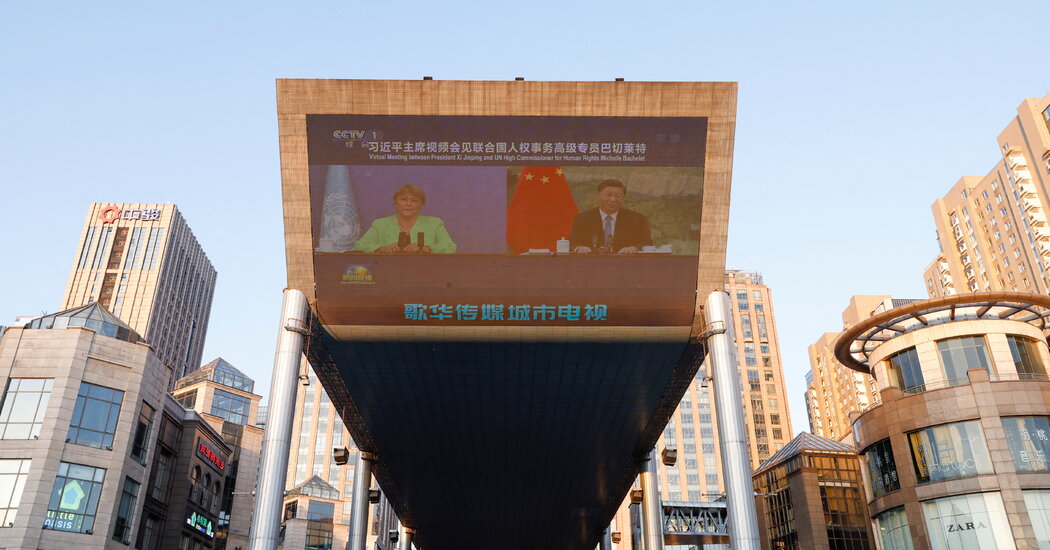

The news was given prime placement in Chinese state media: The United Nations’ human rights chief, on her long-awaited visit to the country, had spoken with China’s leader, Xi Jinping. An article plastered across the website of Xinhua, the state news agency, relayed Mr. Xi’s declaration that the Chinese people were enjoying “unprecedented” rights. Then the article quoted the U.N. official, Michelle Bachelet.
“I admire China’s efforts and achievements in eradicating poverty, protecting human rights and realizing economic and social development,” she said, according to Xinhua.
But within hours, Ms. Bachelet’s office issued a rebuttal. It pointed to “her actual opening remarks,” which made no mention of admiring China’s record on rights.
It was a stark illustration of the narrative battle over the visit by Ms. Bachelet, the first U.N. high commissioner for human rights to visit China since 2005. When Ms. Bachelet first proposed visiting, she described it as a chance to independently examine China’s rights landscape, especially in the far western Xinjiang region, where scholars and human rights groups say one million or more Uyghurs, Kazakhs and members of other predominately Muslim groups have been held in indoctrination camps.
But as the trip unfolded this week, it instead became fresh material for China’s propaganda about the region.
The government, before agreeing to allow Ms. Bachelet’s tour, which includes Xinjiang, insisted that the visit be “friendly.” Chinese officials have threatened Uyghurs overseas who asked Ms. Bachelet to seek information about their relatives. Even Ms. Bachelet has privately acknowledged the challenge of securing meetings free from official surveillance.
What Ms. Bachelet is able to see, and what she says about it, could have major implications for attempts to hold China accountable for its alleged abuses. Critics say a highly choreographed tour would only lend legitimacy to the government’s denials of wrongdoing in Xinjiang.
“This visit is already being used by China as propaganda to conceal its ongoing, heinous crimes,” said Mehmet Tohti, executive director of the Ottawa-based Uyghur Rights Advocacy Project.
In recent years, the Chinese authorities have vastly expanded the police presence in Xinjiang, destroyed mosques and rounded up religious leaders and intellectuals. Residents have been enlisted in work programs that experts say can amount to forced labor. The United States has labeled the repression as genocide. Chinese officials have denied the accusations, saying their sweeping campaign in Xinjiang is aimed at guiding Uyghurs and other minorities away from religious extremism.
On Tuesday, a consortium of media outlets, including the BBC, reported on an extensive cache of internal Chinese police files that further detailed the extent of the repression in Xinjiang. The documents, obtained by the scholar Adrian Zenz, include orders for guards to shoot to kill escapees who refuse to stop, as well as a speech by a top security official, delivered in a closed meeting, that cited orders from Mr. Xi to expand detention facilities.
Thousands of photographs in the cache show some of those who have been held in the mass detention program. The youngest photographed detainee is 15, the oldest 73. One woman’s eyes well with tears, another indication that the camps are much more coercive than the vocational training programs the authorities have portrayed them as being.
A Chinese government spokesman dismissed the materials as “anti-China forces’ smearing.” Ms. Bachelet, who is not being accompanied by reporters on her trip, did not immediately address the new evidence.
Ms. Bachelet had requested access to China since taking office in 2018, citing the “deeply disturbing” allegations of abuses against Uyghurs. But Chinese officials refused any visit that was framed as an investigation. In December, a spokesman for Ms. Bachelet’s office said that although talks had stalled, a separate report on conditions in Xinjiang, also years in the making, would be published within weeks; he added that the office had “identified patterns of arbitrary detention and ill-treatment.”
But the report was not released. Then, in March, Ms. Bachelet’s office unexpectedly announced that she had secured a visit for May.
Her office did not disclose the terms of the trip, which ends Saturday, including who she would meet and under what circumstances. Even the exact dates were not announced until three days before her arrival.
In the absence of information, competing narratives about the trip have emerged. Uyghurs overseas, Western governments and human rights groups have warned that Ms. Bachelet risks becoming a tool for Beijing’s efforts to whitewash its crackdown.
China has portrayed the trip as a chance for Ms. Bachelet to view Xinjiang unencumbered by Western biases, and to see the success of its efforts to promote the region’s economy while preventing terrorism and religious extremism.
Xu Guixiang, the spokesman for Xinjiang’s regional government, dismissed the allegations of genocide, forced labor and internment camps. “If they want to see these things, they should go to the U.S.,” he said at a news conference.
China has also made more coercive efforts to control the narrative.
Kalbinur Gheni, a Uyghur who lives in Virginia, said security officials threatened her family in Xinjiang after she made an online appeal to Ms. Bachelet. She had called on her to investigate the case of her sister, Renagul, who she believes is serving a 17-year prison sentence for religious activities, including praying at their father’s funeral, although no official notice of her conviction has ever been provided.
The Latest on China: Key Things to Know
Discontent among the population. The Chinese government’s censorship and surveillance, which the pandemic has aggravated, are pushing a small but growing group of Chinese to look for an exit. Younger Chinese in particular are embracing the view that they might need to flee the country in the pursuit of a safer and brighter future abroad.
Ms. Gheni said that after she posted her message on Twitter, Chinese officials contacted her on the WeChat platform. “They said, ‘Yesterday we visited your mom. She is not doing well. She is sick, you need to think about her. You put her in this kind of situation,’” Ms. Gheni said.
Her mother called and pleaded for her to stop. A brother in Xinjiang, whom she hadn’t heard from in years, also messaged to urge her not to criticize the government. Ms. Gheni said she believed the warnings were the result of threats to her relatives from Chinese officials worried about bad publicity during Ms. Bachelet’s visit. “I think they just want to shut me up,” she said.
Ms. Bachelet herself has revealed little. On the first day of her visit, she hosted a call with representatives from dozens of countries, including many Beijing-based diplomats. Several people raised concerns about her degree of access, according to three people on the call, who asked for anonymity to discuss the private conversation.
Ms. Bachelet reassured participants that she could read between the lines of what she saw, the people said. She said she had arranged some meetings independently of the government, though she did not elaborate, citing safety concerns. And she said she would visit a detention center, though she did not say whether that had been arranged by the government.
Ms. Bachelet’s few public comments have been largely nonconfrontational. Her opening remarks to Mr. Xi, as shared by her office, did not raise concerns about China’s rights record. When the official United Nations account on Weibo, a Chinese social media platform, shared news of her visit, it quoted Foreign Minister Wang Yi as saying Ms. Bachelet would see a “Xinjiang region where peace and stability are maintained, and people of all ethnicities live in harmony.”
When Ms. Bachelet’s office clarified her comments to Mr. Xi, it did not specify that it was contradicting Xinhua, citing only “widely reported remarks.”
Activists and diplomats acknowledged that it was unknown what Ms. Bachelet, or her office’s report, would eventually say. Overseas Uyghur activists have met with Ms. Bachelet and shared their experiences.
Philip Alston, a former U.N. Human Rights Council special rapporteur on extreme poverty and human rights, said it was crucial for Ms. Bachelet to engage with China, even given the limitations on access.
“China is not any other country. It’s a huge player,” Mr. Alston said during an online discussion on Friday. “At a certain point, it’s really essential to be more realistic.”
But China’s growing global might could also shape what is said about that engagement.
China in recent years has exercised considerable influence on the Human Rights Council, which works closely with the commissioner’s office, said Yaoyao Dai, a political science professor at the University of North Carolina at Charlotte who studies Chinese propaganda. If the report ends up being positive, China can hail it as vindication.
And if not, she continued, China can dismiss the commissioner’s office as a tool of its enemies. “Either way, state media has the strategy to respond,” she said.
Joy Dong contributed research.

