


Long before theme parks began sprouting from Orlando’s swamps, Florida’s freshwater springs were among the area’s main attractions.
Indigenous Americans made use of the springs for thousands of years before Spanish conquistadors arrived in the 1500s. The conquistadors’ reports of clear water gushing from cavernous holes in forest floors fueled myths about the existence of the Fountain of Youth.
A few hundred years later, when sulfur springs were believed to have therapeutic properties, White Sulphur Springs, on the banks of the Suwannee River, became one of Florida’s first commercial tourist attractions. By the early 1900s, the debut of glass-bottomed boats gave tourists a fish’s-eye view of Florida’s springs, and the pristine underwater landscapes attracted early filmmakers. Dozens of movies and television shows were filmed underwater at Silver Springs, a group of springs in Marion County, alone, including “Sea Hunt” and “The Creature From the Black Lagoon.”
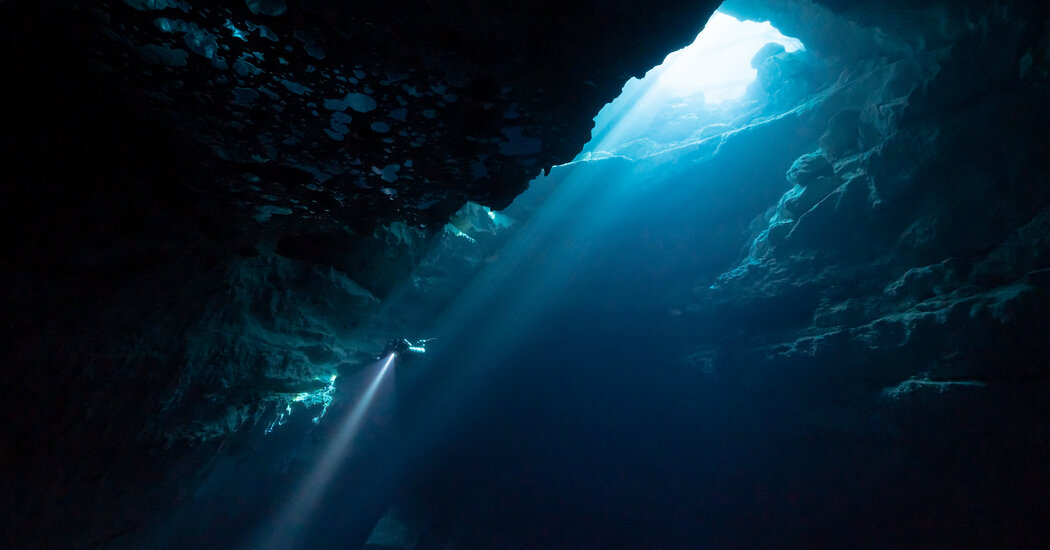
Florida has the densest collection of freshwater springs on the planet. Every day, the state’s more than 1,000 freshwater springs collectively discharge billions of gallons of groundwater to the surface. Springs provide critical habitat for aquatic animals, including the iconic Florida manatee, and anchor Florida’s inland water-based recreation industry. Visitors from around the world come to Florida’s springs to fish, kayak, tube, swim and scuba dive through the miles of underwater caves that connect springs to the aquifer and pipe water to the surface. Springs tourism injects cash into rural economies across the state.
And yet, despite their fundamental role in the state’s tourism industry, Florida’s springs are at the center of a slow-motion environmental tragedy.
Over the last several decades, a combination of development, population growth, climate change, overpumping of the aquifer and pollution from agriculture and sewage have wreaked havoc on Florida’s springs. Many springs show significantly reduced water flow. Others have stopped flowing entirely.
Kissengen Spring was one of the first recorded casualties. More than 20 million gallons of water a day once poured from Kissengen Spring into the Peace River. The spring sported dive platforms and bathhouses and was used as a resort by members of the military during World War II.
Between the 1930s and the 1950s, water flow from the spring gradually reduced to a trickle. In the early 1960s, the spring stopped flowing entirely. A United States Geological Survey report revealed that groundwater pumping between the 1950s and 1975 lowered groundwater levels by a staggering 60 feet. Once the elevation of the water in the aquifer feeding the spring dropped below the elevation of the spring vent, the water stopped flowing.
Steadily declining water tables also choked off the water supply to White Sulphur Springs, one of Florida’s first tourist attractions, which stopped flowing for the first time in 1977.
At the same time aquifers were being depleted, pollution from septic tanks, sewage, farm fertilizers and confined animal feeding operations have flooded springs with excess nutrients, fueling algae blooms in springs across the state. The white, sandy bottoms and waving thickets of eelgrass featured in films from the 1940s and 1950s have been replaced by thick mats of green, hairy algae, which blanket all underwater surfaces. Without eelgrass, the foundation of healthy springs, the ecosystems around springs are collapsing.
At Silver Springs, so much algae has accumulated that volunteer scuba divers remove it by hand. Every month, members of the Silver Springs Professional Dive Team descend to scrub algae off the bottom of the glass bottom boats so visitors can see the old underwater movie sets, which the divers must also clean.
The State of Florida officially recognized that most of Florida’s springs were in trouble more than two decades ago, when, in 2001, Jeb Bush, then the governor, signed legislation creating the Florida Springs Initiative. The program provided the first of several subsequent pools of money for research, monitoring, education and landowner assistance to reduce the flow of sewage and fertilizer into springs and address declining spring flows.
Data collected as a result of the initiative have allowed scientists to track the inexorable decline of Florida’s springs in excruciating detail. Importantly, these data show that efforts to protect springs have so far been ineffective, as nutrient pollution has continued to increase.
While many springs are in decline, ongoing restoration work in the spring-fed Crystal River, on Florida’s Gulf Coast, shows that some damage can be reversed. Crystal River is the second largest spring group in the state of Florida. Decades ago, Crystal River’s gin-clear visibility made it a famous destination for fishing and scuba diving. In the 1960s and 1970s, however, development, dredging of canals for boat-based communities and pollution triggered a cascade of events that caused the river’s eelgrass beds to collapse and be replaced with blankets of algae in subsequent decades. Crystal River’s famous visibility deteriorated until it rarely exceeded 10 feet.
Over the last six years, the community organization Save Crystal River and the aquatic restoration company Sea & Shoreline have used a combination of state and federal funding to remove more than a quarter billion pounds of algae and nutrient-rich muck from the bottom of Crystal River and plant more than 350,000 eelgrass plants.
As the replanted eelgrass beds have expanded, they’ve improved visibility and now even support a year-round population of Florida’s most famous vegetarians: manatees.
The successful eelgrass replanting project hasn’t solved all of Crystal River’s problems. Sea level rise and groundwater pumping continue to reduce the flow of water to Crystal River’s springs, and the water that comes out continues to get a little saltier. While there’s clearly still work to do, steady improvements in water clarity and a growing manatee population are supporting a thriving ecotourism industry and show what can be accomplished when state governments and local communities work together and draw upon scientific data to save their springs.
Jason Gulley is an associate professor of geology at the University of South Florida, dive instructor and an environment, science and expedition photographer based in Tampa, Fla. You can follow his work on Instagram.

