


Weeks before the 2020 presidential election, the conservative broadcaster Glenn Beck outlined his prediction for how Election Day would unfold: President Donald J. Trump would be winning that night, but his lead would erode as dubious mail-in ballots arrived, giving Joseph R. Biden Jr. an unlikely edge.
“No one will believe the outcome because they’ve changed the way we’re electing a president this time,” he said.
None of the predictions of widespread voter fraud came true. But podcasters frequently advanced the false belief that the election was illegitimate, first as a trickle before the election and then as a tsunami in the weeks leading up to the violent attack at the Capitol on Jan. 6, 2021, according to new research.
Researchers at the Brookings Institution reviewed transcripts of nearly 1,500 episodes from 20 of the most popular political podcasts. Among episodes released between the election and the Jan. 6 riot, about half contained election misinformation, according to the analysis.
In some weeks, 60 percent of episodes mentioned the election fraud conspiracy theories tracked by Brookings. Those included false claims that software glitches interfered with the count, that fake ballots were used, and that voting machines run by Dominion Voting Systems were rigged to help Democrats. Those kinds of theories gained currency in Republican circles and would later be leveraged to justify additional election audits across the country.
The new research underscores the extent to which podcasts have spread misinformation using platforms operated by Apple, Google, Spotify and others, often with little content moderation. While social media companies have been widely criticized for their role in spreading misinformation about the election and Covid-19 vaccines, they have cracked down on both in the last year. Podcasts and the companies distributing them have been spared similar scrutiny, researchers say, in large part because podcasts are harder to analyze and review.
“People just have no sense of how bad this problem is on podcasts,” said Valerie Wirtschafter, a senior data analyst at Brookings who co-wrote the report with Chris Meserole, a director of research at Brookings.
Dr. Wirtschafter downloaded and transcribed more than 30,000 podcast episodes deemed “talk shows,” meaning they offered analysis and commentary rather than strictly news updates. Focusing on 1,490 episodes around the election from 20 popular shows, she created a dictionary of terms about election fraud. After transcribing the podcasts, a team of researchers searched for the keywords and manually checked each mention to determine if the speaker was supporting or denouncing the claims.
In the months leading up to the election, conservative podcasters focused mostly on the fear that mail-in ballots could lead to fraud, the analysis showed.
At the time, political analysts were busy warning of a “red mirage”: an early lead by Mr. Trump that could erode because mail-in ballots, which tend to get counted later, were expected to come from Democratic-leaning districts. As ballots were counted, that is precisely what happened. But podcasters used the changing fortunes to raise doubts about the election’s integrity.
Election misinformation shot upward, with about 52 percent of episodes containing misinformation in the weeks after the election, up from about 6 percent of episodes before the election.
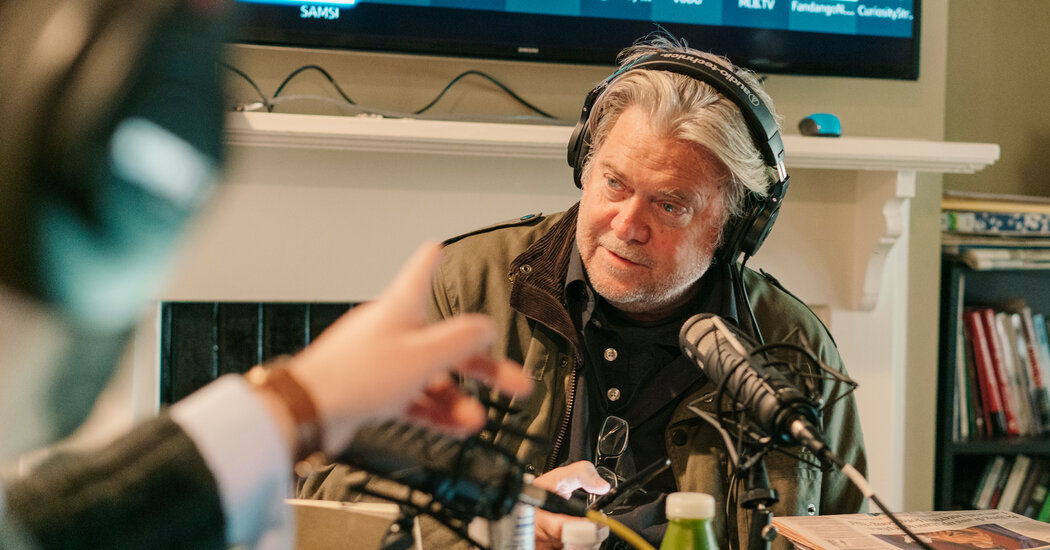
The biggest offender in Brookings’s analysis was Stephen K. Bannon, Mr. Trump’s former adviser. His podcast, “Bannon’s War Room,” was flagged 115 times for episodes using voter fraud terms included in Brookings’ analysis between the election and Jan. 6.
“You know why they’re going to steal this election?” Mr. Bannon asked on Nov. 3. “Because they don’t think you’re going to do anything about it.”
As the Jan. 6 protest drew closer, his podcast pushed harder on those claims, including the false belief that poll workers handed out markers that would disqualify ballots.
“Now we’re on, as they say, the point of attack,” Mr. Bannon said the day before the protest. “The point of attack tomorrow. It’s going to kick off. It’s going to be very dramatic.”
Mr. Bannon’s show was removed from Spotify in November 2020 after he discussed beheading federal officials, but it remains available on Apple and Google.
When reached for comment on Monday, Mr. Bannon said that President Biden was “an illegitimate occupant of the White House” and referenced investigations into the election that show they “are decertifying his electors.” Many legal experts have argued there is no way to decertify the election.
Sean Hannity, the Fox News anchor, also ranked highly in the Brookings data. His podcast and radio program, “The Sean Hannity Show,” is now the most popular radio talk show in America, reaching upward of 15 million radio listeners, according to Talk Media.
“Underage people voting, people that moved voting, people that never re-registered voting, dead people voting — we have it all chronicled,” Mr. Hannity said during one episode.
Key Figures in the Jan. 6 Inquiry
Claims about voter fraud came not just from Mr. Hannity but also his guests, including the pollster John McLaughlin, who shared a private exchange he had with Mr. Trump.
In the exchange, according to Mr. McLaughlin’s on-air account, Mr. Trump said that the election was stolen.
“Yeah,” Mr. McLaughlin said to the president. “I said it yesterday on Hannity radio.”
“Keep saying it,” Mr. Trump replied.
Mr. McLaughlin went on to say during the podcast: “This election, easily, was stolen and these drop boxes and the Dominion Systems — their voting system — are definitely the culprits.”
Claims about Dominion Voting Systems were debunked and internal Republican memos showed officials in Mr. Trump’s re-election campaign knew the claims were false. Dominion later filed a number of lawsuits against people and media companies who pushed the conspiracies.
Representatives for Mr. Hannity, Mr. McLaughlin and Mr. Beck did not comment when reached about the findings.
Apple’s podcast guidelines say the company does not allow podcasts that “may lead to harmful or dangerous outcomes.” Apple declined to comment.
Spotify did not immediately comment on the research.
The lack of moderation on podcast apps is particularly complicated for Alphabet, the parent company of Google and YouTube. The video streaming site cracked down on videos about election fraud, the conspiracy theory QAnon, and vaccine misinformation, prompting some podcast episodes hosted there to be removed. But the same episodes remained accessible on Google’s Podcasts app. Mr. Bannon’s show was removed from YouTube shortly after Jan. 6, for instance, but the podcast remains available on Google’s Podcasts app.
Google has argued that its Podcasts app more closely resembles a search engine than a publishing service because no audio is hosted by the company. A Google spokesman, Farshad Shadloo, said the app simply “crawls and indexes audio content” hosted elsewhere and that they have “policies against recommending podcasts that contain harmful misinformation, including misinformation about the 2020 U.S. elections.”

