

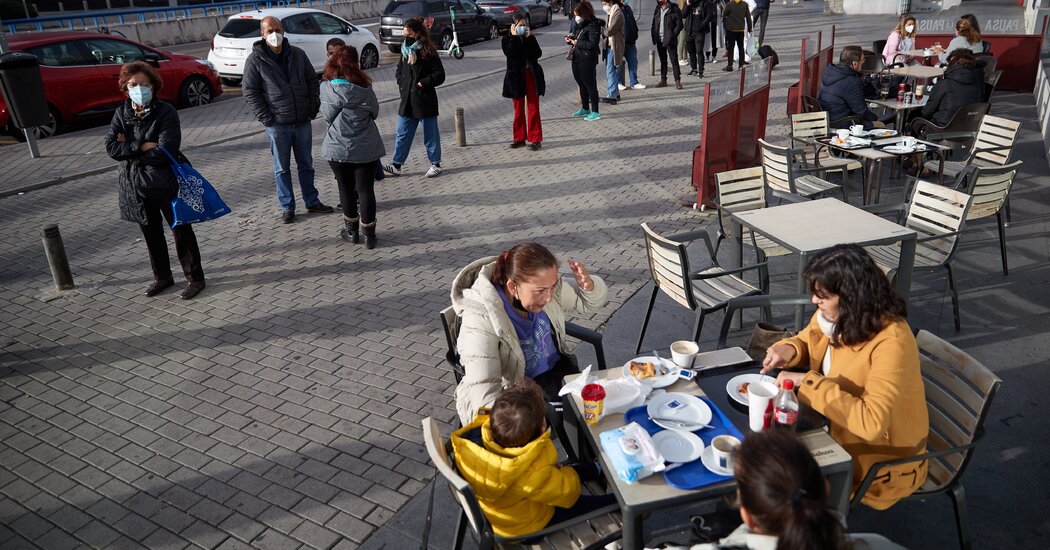

MADRID — Covid-19 infections were rising all across Spain, but the message from the country’s leader was clear: The government was not entering 2022 with the restrictions of 2020.
“The situation is different this time, and because of that, we’re taking different measures,” Pedro Sánchez, the prime minister, said this week, adding that he understood his people had grown impatient with the pandemic and that he was “fully aware of the fatigue.”
Across Europe, that fatigue is as palpable as the dampened Christmas spirit. The fatigue of another named variant of the coronavirus and another wave of infections. The fatigue of another grim year watching New Year’s Eve gatherings get canceled or curtailed, one by one.
But along with the exhaustion, another feeling is taking root: that the coronavirus will not be eradicated with vaccines or lockdowns, but has become something endemic that people must learn to live with, maybe for years to come.
“We’re tired, we’re inoculated and it’s not going anywhere,” said Caroline Orieux, who, despite surging Covid cases, had visited Paris with her nephews and nieces for a few days of vacation.
This week, the rough outlines of how Europe might manage its latest outbreak were taking shape, at least for now, driven by everything from politics to people’s desperation to move on, especially at Christmas. Full lockdowns have mainly given way to less intrusive — and less protective — measures.
Spain kept a light touch, issuing limited new requirements on Thursday, like mandating masks outdoors and increasing the vaccination drive.
Even Italy, which suffered a particularly cruel first wave, introduced new rules on Thursday that were far less rigid than those imposed during its worst days, shortening the time frame that health passes remained valid, making third shots indispensable; banning large outdoor events until the end of January; and opting for an outdoor mask mandate.
“Vaccines are and remain a fundamental weapon,” said Roberto Speranza, Italy’s health minister.
Beyond that, there is growing evidence that the new variant is more mild, at least for those who are vaccinated. Three studies — in South Africa, England and Scotland — all suggested that while the variant is more contagious, it likely results in a more mild illness.
And vaccines appear to be doing their jobs — reducing the risk of severe disease and hospitalization, according to recent studies.
Still, not everyone agrees with a scaled-down approach to fighting the virus, and it remains unclear if that notion will survive the possible Omicron crush of hospitalizations that many scientists fear. Even if most cases are mild, they argue, Omicron’s quick-fire spread could still lead to huge caseloads and overwhelming hospital admissions.
Antoine Flahault, the director of the Institute of Global Health in Geneva, said France’s strategy — which went little beyond health passes and had stopped short of imposing stricter measures like bar closures — was nowhere near what was needed to stave off a wave of Omicron cases.
“I think it’s not the most successful one from a health perspective, but also from a social and economic perspective,” he said, noting that a surge of new infections could disrupt health services as well as the country’s manufacturing and supply capacities.
Giovanni Maga, the director of the Institute of Molecular Genetics at Italy’s National Council for Research, noted that while hospitalizations were five times lower than they were last year — largely thanks to vaccines — that does not mean that the country is out of the woods.
“As Omicron is more infectious, contagions will rise,” he said.
Yet as the pandemic drags on, scientists are often losing out to politicians. And in the political and economic calculus that has become the core of public health messaging for weeks now, the Christmas season has loomed large.
Switzerland recently backtracked on travel restrictions to try to salvage a winter tourism season that is a cornerstone of its economy. In late November, it issued quarantine orders for travelers from Britain, the Netherlands and other countries where Omicron had spread — only to remove them, even as cases rose.
On Monday, the country also removed a requirement that travelers test after arriving, though it still requires negative tests before travel.
Asseghid Dinberu, the marketing director of the Victoria Hotel in the Swiss ski resort of Villars, said the Christmas season was feeling like “a lucky escape,” with only six of the hotel’s 138 rooms still vacant for Christmas Day, and the hotel fully booked for New Year’s.
“I’m glad that Switzerland has finally opted for a very pragmatic approach that will allow us to benefit economically compared to other countries,” he said.
Germany is coming out of a dramatic fourth wave that began in November, and although it is bracing for a wave of Omicron infections, government officials have played down the possibility of a surge in infections around Christmas gatherings. Many see that as an attempt to spare Germans from restrictions before their most important holiday.
“At the moment, we are in a strange interval,” Chancellor Olaf Scholz said Tuesday at a news conference. “The measures we put into place at the end of November are working.”
However, just before Mr. Scholz and state governors met to hammer out new measures this week, the Robert Koch Institute, Germany’s equivalent of the Centers for Disease Control and Prevention, called for strict lockdown measures to start immediately. The government did not adopt the measures.
The many conflicting messages have caused confusion among Europeans pining for the ease of Christmases past. Some carried on despite pangs of anxiety.
The Coronavirus Pandemic: Key Things to Know
“I worry a bit because we don’t know much about Omicron,” Susanne Sesterer, 63, a retiree in Hanover, Germany, said on Thursday as she was doing her last shopping before Christmas. “But how much worse can it get?”
Others were giving up.
Dorotea Belli, a 42-year-old Italian who has had two vaccine doses, said she would not go to a family gathering for Christmas and instead stay home in Rome. Many of her colleagues had tested positive for the virus, she said, and her children, 4 and 1, are not eligible for vaccination.
“They and I will miss my parents very much,” she said. “But I don’t want to bring Covid around, and even if my husband and I are vaccinated, who knows?”
Spain’s calculus on new restrictions is not only factoring in the all-important holidays, but also legal barriers that emerged after measures taken by the government in 2020.
In July, Spain’s Constitutional Court ruled that the government did not have the authority to impose the lockdown measures that began in March 2020, which restricted Spaniards from leaving their homes except for essential trips like food shopping. Instead, the judges said, the measures required a full parliamentary vote, which few see passing with a majority in the future given how controversial the previous restrictions were.
“The government has its hands tied now,” said Luis Galán Soldevilla, a law professor at the University of Córdoba.
Spain’s lighter measures announced on Thursday received criticism from some sectors, like the Spanish Society of Public Health and Health Administration, a group that includes many health professionals.
“These measures don’t help much,” said Ildefonso Hernández, the group’s spokesman, saying limiting capacity indoors would be more effective. “It makes no sense that people walk the street with a mask and then take it off when they enter a bar.”
In Madrid, residents were charging ahead with their Christmas plans, despite the rising caseload and risks.
Fernando Sánchez, 55, a taxi driver, lost his mother and brother to Covid-19 six months ago. Nevertheless, he was unwilling to cancel his Christmas plans, which this year take place at the home of his in-laws, much as they had before the pandemic.
Antonio Jesús Navarro, 33, a software engineer, had been looking forward to spending Christmas with his girlfriend, who had traveled to Spain for the holidays from the United States. The two had not seen each other since before the pandemic began.
But then Mr. Navarro learned he had come into contact with someone who had tested positive for the coronavirus. The couple were isolating until he could get his own test results. He said he was frustrated with public messaging on how to stay safe from Omicron.
“Is an antigen test acceptable?” he said by telephone. “What happens if there are no symptoms?”
Hours later, Mr. Navarro called back to say he and his girlfriend had tested positive for Covid-19.
Nicholas Casey and José Bautista reported from Madrid, and Constant Méheut from Paris. Reporting was contributed by Raphael Minder from Geneva; Gaia Pianigiani from Rome; Christopher F. Schuetze from Hanover, Germany; and Léontine Gallois from Paris.

