

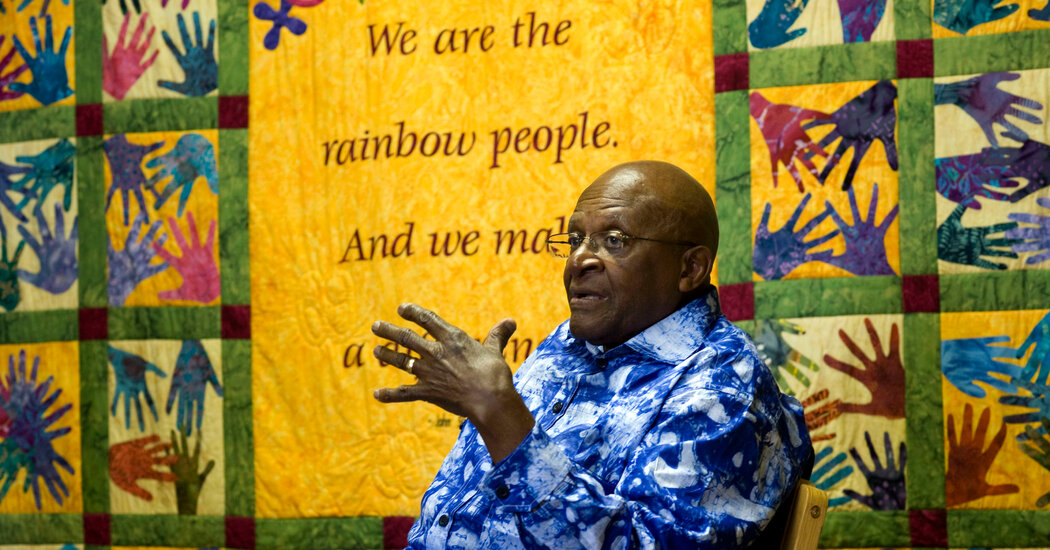

Long after he led the nonviolent struggle against apartheid, Archbishop Desmond M. Tutu, who died Sunday at 90, continued to serve as South Africa’s moral compass, even if it meant criticizing two institutions central to his life: his church and the former liberation movement.
Though he formally retired from public life in 2010 — promising to quietly sip tea with his wife and visit his grandchildren — Archbishop Tutu remained a powerful advocate for what he saw as right and fair, including a host of causes like social and climate justice.
He also stood against corruption and lack of accountability under the African National Congress, and against discrimination, calling out the Anglican Church for not taking a stronger stance for gay rights.
“If God, as they say, is homophobic, I wouldn’t worship that God,” he told the BBC in 2007 after the election of the first openly gay Episcopal bishop in the United States led the Anglican Church to grapple with the issue.
Gay rights later became a personal cause for Archbishop Tutu.
When his daughter Mpho Tutu, an Anglican priest, married a woman, her longtime partner, Marceline van Furth, in 2015, he was publicly supportive. When their marriage led the church to revoke her license, and to her leaving the priesthood, he also supported her choice.
Still, Archbishop Tutu remained loyal to the church, said Dr. Mamphela Ramphele, a former anti-apartheid activist who spoke on Sunday on behalf of the family.
Although he was saddened by the church’s rules, Dr. Ramphele said, Archbishop Tutu followed them at his daughter’s wedding.
“He was not allowed to bless them, and he followed the precepts of the church at their marriage,” Dr. Ramphele said.
Archbishop Tutu also used his post-church platform, mainly the Desmond and Leah Legacy Foundation, to speak out against “adaptation apartheid,” the growing divide between rich and poor countries in responding to climate change.
Through the foundation, he added his voice to the calls for climate justice and accountability from governments and big business.
Last year, he met with former Vice President Al Gore in Cape Town to discuss divestment from fossil fuels. And his foundation invited the Ugandan climate justice activist Vanessa Nakate to deliver a lecture in his name, alongside Christiana Figueres, the executive secretary of the United Nations Framework Convention on Climate Change.
In a video message before the lecture, Archbishop Tutu called environmental destruction “the human rights challenge of our time.”
Over the years, he also lent his name to other causes, including the promotion of social cohesion, which is the focus of the Desmond Tutu Peace Center, and to H.I.V. research.
At the height of the H.I.V./AIDS epidemic, when South Africa’s public health response was marred by inconsistency and malaise, Archbishop Tutu’s name helped a research center in Cape Town raise its profile, allowing it to become one of the leading institutions of its kind.
Toward the end of apartheid in the early 1990s, it was Archbishop Tutu who coined the phrase “the rainbow nation” to describe the optimism of a multiracial South Africa. But in later years, he did not temper his criticism of the new government or the African National Congress.
While he enjoyed a close friendship with the party’s leader and South Africa’s first Black leader, President Nelson Mandela — the two men famously made fun of each other’s sartorial choices — Archbishop Tutu was critical of Mr. Mandela’s successors. He was particularly vociferous in his disappointment in President Jacob Zuma, who resigned in 2018 and whose administration was tarnished by corruption scandals.
Indeed, in 2011, Archbishop Tutu was openly incensed when the South African government under Mr. Zuma refused to grant the Dalai Lama a visa to attend Archbishop Tutu’s 80th birthday celebrations.
“Our government, representing me — representing me — says it will not support Tibetans who are being oppressed viciously by the Chinese,” Archbishop Tutu said in a news conference, visibly angry.
The South African government, believed to be currying favor with the Chinese government, denied a visa to the Tibetan spiritual leader three times, in 2009 and again in 2014, when he was to attend a summit meeting of Nobel laureates alongside Archbishop Tutu.
Archbishop Tutu’s critiques of the governing African National Congress continued, and in 2013, he said that he would not be voting for the party because it had failed to deliver on its promise of social justice.
His rift with the former liberation movement was also evident later that year when Mr. Mandela died. The government at first snubbed Archbishop Tutu, despite his prominence and their relationship, but then invited him to speak at the public memorial service.
This past May, in one of his last public appearances, Archbishop Tutu received his coronavirus vaccine shot in the hope that it would encourage others to do the same while dispelling misinformation, which has hampered vaccine uptake in South Africa.
“All my life I have tried to do the right thing and, today, getting vaccinated against Covid-19 is definitely the right thing to do,” he said after getting the jab, adding that it was also a “wonderful” chance to get out of the house.
“Believe me, when you get to our age,” he said, “little needles worry you far less than bending over does.”

