

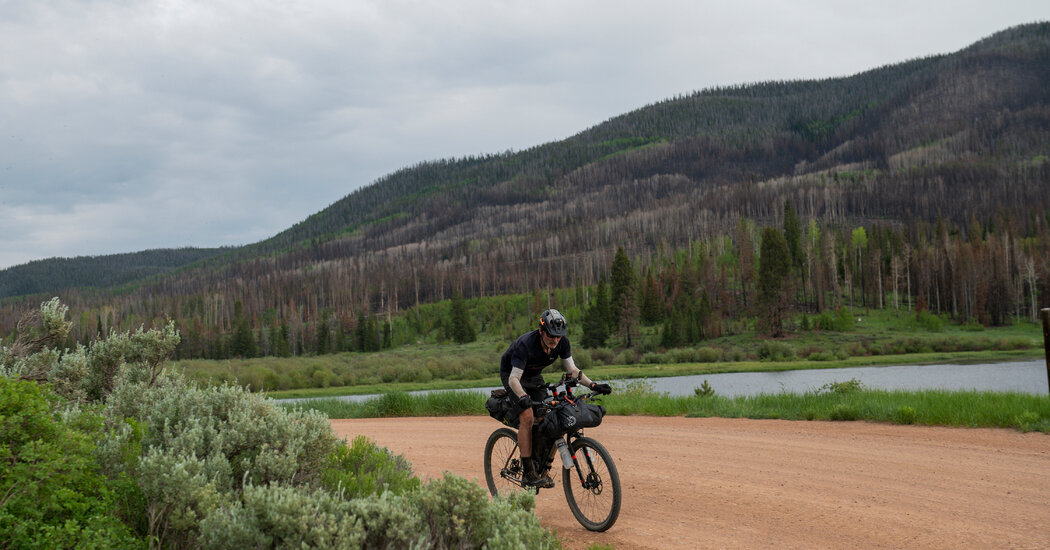

Kevin Latta pushed his bike forward, following the Bull River down a ridge in the Canadian Rockies. The tire tracks from riders ahead of him had disappeared.
He searched for a shallow place to cross. But after just one step, the swollen river swept Latta and his bike downstream. Gripping the bike in one hand, he swam one-armed, dragging his gear through the churning current. He reached for a tree branch and hoped it would hold.
Two days before, about 200 cyclists had gathered in Banff, Alberta, to start the Tour Divide, an ultra-endurance event in bikepacking — backpacking by bike — that extends all the way to the U.S. border with Mexico. Some riders are professional athletes, others simply recreational cyclists with an interest in the extreme. There is no entry fee and no prize — only the glory of surviving one of the most grueling solo competitions in the world.
“It’s like the Wild West,” said Matthew Lee, a cyclist and organizer of the race — or “disorganizer,” as he calls himself.
The route twists through almost 2,700 miles of the Continental Divide’s alpine peaks, woodlands, picturesque towns and deserts. Most riders see bikepacking alone through the Rockies as a personal challenge, a transcendent test of their fortitude rather than a competition against others. But in recent years, extreme weather has become one of their most dangerous adversaries as they race against flash floods, landslides, driving winds and wildfires.
This year’s Tour Divide was supposed to mark a return to normal. The race was canceled in 2020 amid the coronavirus pandemic and shortened in 2021 because of pandemic-related border closures. But nothing about the race this year has been normal.
When it began on June 10, the cyclists knew that trouble might await them toward the finish: Wildfires were raging across hundreds of thousands of acres in New Mexico, the final state on the route. The fires were fueled by one of New Mexico’s driest spring seasons on record and by warmer temperatures linked to human-caused climate change. One of the fires, the state’s largest ever, was a prescribed burn that blazed out of control.
Near the start line on the morning of their departure, riders lamented that they would have to divert around some of the New Mexican scenery they had anticipated, like Gila National Forest. “It is what it is,” conceded Sofiane Sehili, an ultra-endurance racer from Paris.
Sara McDermott, who had arrived from Big Sky, Mont., said she had learned to plan for wildfires because of their inevitability on the course. “It feels claustrophobic,” she said. “I get a sore throat right away and a headache.” She and the other riders carried buff masks to cover their faces for riding through smoky conditions. Most planned to abandon the race if the smoke became too thick in Colorado or New Mexico.
A chorus of cheers erupted when the riders set off, startling magpies, crows and squirrels in the nearby forest. Bear bells jingled down the hill. Shoes snapped into pedals and bikes whizzed by.
The morning sky was blue and brisk. Only the nearby Bow River, muddy and swift with spring snowmelt, foreshadowed the dangers to come.
Airlifted out
Before the riders made it out of Canada, rain and snowstorms intercepted their path. The conditions complicated Latta’s encounter with the Bull River.
When Latta pulled himself out, he realized that his broken GPS device had sent him 10 miles bushwhacking in the wrong direction. “It didn’t occur to me that I was off the route,” he said. “I just thought this was the continuing sadism of the 2022 Tour Divide.”
Inching back up the ridge, “I was literally moving my bike 10 feet at a time,” Latta said. “And I would say, ‘OK, I’m going to go to that rock, then rest.’” When he spotted a tree that wasn’t covered in snow, he leaned his bike against its trunk and fell asleep, exhausted.
The storm was part of a particularly wet June in Fernie, British Columbia, which had more than five inches of rain, 20 percent above the average, according to Armel Castellan, a meteorologist for Environment and Climate Change Canada. Record-breaking rains last winter and the subsequent erosion also made rivers more prone to flooding, Castellan said.
Once he reached a road, Latta caught a ride to Fernie from a forest service truck. The Tour Divide has few rules, but because Latta accepted the assistance, he voluntarily disqualified himself. Yet he was still determined to finish what he had started and ride the rest of the route to Mexico.
The 15 cyclists airlifted out were not so lucky. “They tried to push their bikes for six or seven hours through wet snow,” said Simon Piney, the head of search and rescue in Fernie. “Bike riders aren’t well equipped to get through those types of conditions.” Eleven cyclists were treated for hypothermia and four for trauma, he said.
“From a rescue perspective, this stretched our resources considerably because of the flooding in the valley,” Piney said, adding, “We’re happy that nobody died.”
Paul Anson, a cyclist from Britain, was one of the airlifted riders, though his circumstances were unique: His bear spray canister exploded, causing him to swerve and hit a rock. “Seven broken ribs are a tough price to pay,” Anson said.
The conditions farther along the course were no better. The same weekend, destructive flooding and mudslides caused by record rain and melting snow forced the closure of Yellowstone National Park, which the Tour Divide route skirts as it meanders through Montana, Idaho and Wyoming. And the threat of wildfires still loomed farther south.
Increasing dangers
The Tour Divide has had a free-for-all nature since the Adventure Cycling Association first mapped the route in the 1990s. “The spirit of the event has always been anti-establishment,” said Lee, the race organizer. This approach has fostered a tight-knit community among the cyclists.
“I love that it belongs to us,” said Alexandera Houchin, who holds the women’s record on a single-speed bike: 18 days 20 hours 26 minutes. “The ultra-endurance community is like my family.”
“It’s become ceremony for me,” added Houchin, who is an Anishinaabe citizen of the Fond du Lac Band of Lake Superior Chippewa. “And I think that’s something a lot of my Indigenous brothers and sisters can relate to. I just want more Native people riding.”
The fastest riders finish the Tour Divide in just over two weeks. For others, the grueling trek can take two months. To save time, many sleep four to six hours a night in a sleeping bag shell called a bivouac sack.
Riders have always faced dangers on the Tour Divide, including bears, blisters, dehydration and smoke inhalation. A cyclist was killed in a collision with a truck during the race in 2010. Last July, a violent grizzly bear attack occurred in a Montana town where many bikepackers camp.
The effects of climate change have only increased the danger.
During last year’s race, flames lined the horizon as Sarah Swallow, a Tour Divide competitor, headed toward the Yampa River. It was the third day of Colorado’s Muddy Slide Fire, and smoke shrouded the sun in a pulsing fluorescent shade of orange. Swallow pushed up one last hill, needing to reach the river before local officials closed the crossing. Her only other option was to detour onto a long, busy highway, and that was time she couldn’t afford to lose.
The smoke billowed as Swallow made it across a dam. The road closed behind her. Helicopters flew in search of more water as residents evacuated.
“In the time that it took me to ride past the fire, the winds picked up and I watched it go from a really small thing of smoke to 50 times bigger,” Swallow recalled. “The smoke plume followed me. When I was camping that night, it rained ash.” She is not competing in the Tour Divide this year, partly, she said, because of the extended fire season.
Leighton White, a firefighter in Steamboat Springs, Colo., fought the blaze that Swallow raced against. He is also a former Tour Divide rider. “Around 2009, you could see the exponential growth of dead trees” along the route, he said, noting how shorter winters and longer dry seasons have led to the explosion of bark beetle populations whose nests weaken lodgepole pines, turning entire mountainsides brown and killing young saplings.
Fire has dashed many dreams on the Tour Divide in recent years. Lael Wilcox, who in 2015 set the Tour Divide women’s record of 15 days 10 hours 59 minutes, attempted an individual time trial last August to try to beat Mike Hall’s record of 13 days 22 hours 51 minutes. (Hall, who set the record in 2016, was fatally struck by a car in an Australian race the next year.)
But as Wilcox began her attempt, smoke from nearby wildfires permeated the air almost from the start. “It was just awful,” Wilcox said. “I mean, you’re in this beautiful place and you can’t even see the mountains because it’s a layer of white.” Four days in, Wilcox was forced to leave the course. Her lungs were shutting down from the smoke.
The planet’s warming climate has extended the wildfire season in the American West, increasing the risk from larger, more frequent blazes. “We are no longer waiting for climate change to happen,” said Kira Minehart, a doctoral student at Oregon State University’s College of Forestry, who rode a section of the Tour Divide two years ago. “It is right here and now.”
As snowpack declines in many places, Minehart said, the consequences can be dire for Tour Divide riders, who prefer to filter water along the way instead of carrying gallons of water that can slow them down. It can also be catastrophic for the landscape, since snowpack can help mitigate wildfires.
Jalen Bazile, a founder of the Black Foxes, a collective of Black cyclists, emphasized the importance of training and preparation to avoid making panicked decisions in unfamiliar environments. Riding the Tour Divide in 2017, Bazile had to reroute 300 miles to avoid a Montana wildfire. Bikepacking, he said, “forces us to really take inventory of who we are and what we’re capable of.”
A triumphant finish
Sehili, the racer from Paris, crossed from Colorado into New Mexico in first place, just as the Southwest’s monsoon season arrived to help extinguish the raging fires. The winds that cyclists had been riding against for nearly two weeks — winds that had whipped up flames across the desert — now brought torrential rain. The risk of heavy rainfall and more dangerous flooding after wildfires has been exacerbated by global warming, a recent study found.
Thunder silenced the cicadas, and the humid air was filled with the spicy-citrus scent of the creosote bush. Soon, Sehili and his bike were covered in what he called “New Mexico death mud.”
Andy Leveto, a rider from Bellingham, Wash., welcomed the rain — “my first shower in a week.” But his goal of riding through the Polvadera Mesa, which he had heard was a “beautiful, gorgeous, kind of rough and unrelenting section,” was spoiled by a detour put in place because of the wildfires. Leveto would finish the race fifth.
Sehili came close to breaking Hall’s course record, crossing the finish line in Antelope Wells, N.M., at 11:36 p.m. on June 24, after more than 14 days on his bike. He was greeted by a group of fans and friends. Somehow, after thousands of miles, he found the strength to lift his bike above his head for a photo.
To break the record someday, Sehili said he would need to pick a different date for an independent time trial because June has become too unpredictable with its fires, floods and winds. “In 2019 I was caught in the biggest June snowstorm in the history of Colorado,” he said. “I feel like anything can happen. So yes, definitely climate change. You can see it on this race.”
After taking some selfies, Sehili and the group gathered at Jeffery Sharp’s bike ranch. At the property’s entrance, a bicycle shrine adorned with artwork, raw turquoise stones, sun-weathered bike shoes and a placard engraved with “Mexico” greets visitors.
Everyone went to the main room, where a laptop tracked the other racers. Two chiropterologists researching local bats baked pizza while a ranch hand named Jimbo made sure everyone had drinks. Sehili sat for an interview with the “Bikes or Death” podcast while he held an ice pack on his leg.
“I think this might hurt,” said Mallory Davies, one of the bat researchers, who had a first aid kit and helped Sehili bandage an injury. “I don’t think so,” Sehili said. “I’m a bikepacker.”
Sehili laughed when asked whether the heavy rain was good luck for the race because the storms helped put out some wildfires. He said that in the hierarchy of bad conditions, the worst is riding into 45-mile-per-hour winds.
In recent years, racing the Tour Divide has been as unpredictable as a wildfire in New Mexico or destructive floods in Yellowstone. Some of the bikepackers still on the route may yet encounter new fires or other hazards.
Ultimately, the Tour Divide is like most ultra-endurance races: If you make it to the end, you’ve won.

