

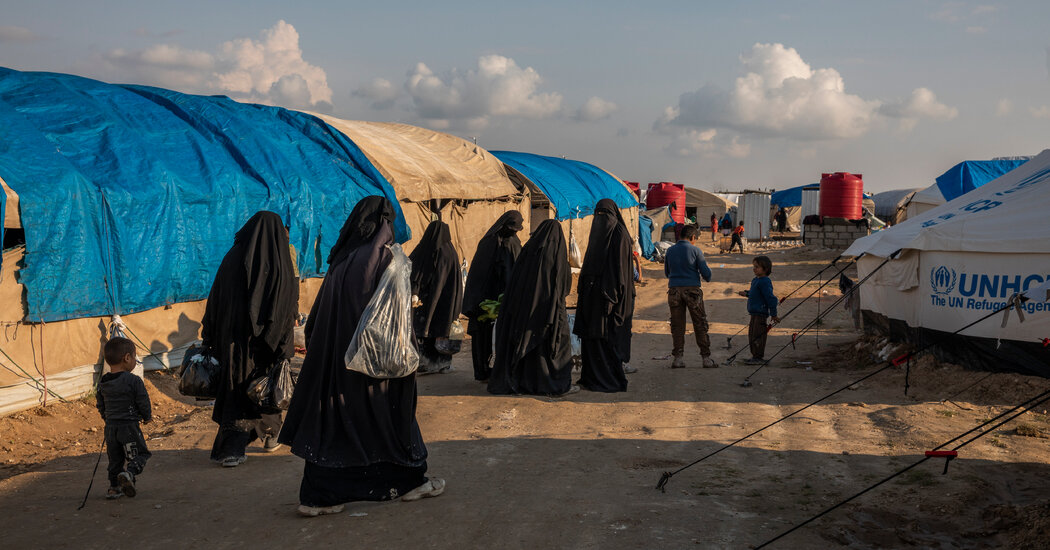

PARIS — France brought home 16 wives of jihadists from sprawling detention camps in northeastern Syria on Tuesday, breaking with a policy that for years had ruled out repatriating and trying adult women who had left to join the Islamic State.
The women were accompanied by 35 children — some traveling with their mothers, others who are orphans — in what was the largest such group repatriated in one go by France as the government responded to mounting pressure to shift its approach.
France had long resisted calls by rights groups and security experts to repatriate adult women, saying that it considered them “fighters” who should be tried where they were accused of committing crimes, in Syria and Iraq.
Even as such local trials proved impossible, France stuck to its position and refused to bring home not only adults but also most children, repatriating only a few dozen over the course of three years, following a piecemeal approach that came to contrast with most of its European neighbors.
The French Foreign Ministry said in a statement on Tuesday that welfare services had taken care of the children and that the mothers had been turned over to the judicial authorities. The women — all are French, except for two who have French children, the authorities said — are expected to be charged in connection with joining the Islamic State.
Marc Lopez, the stepfather of a woman who is still detained with her four children in a camp, said, “It’s a total policy change.”
“I hope that the others will follow this summer, because there’s no reason to let a situation that has been going on for years rumble on,” he added, referring to French citizens still at camps.
International organizations, including the United Nations, along with lawyers and politicians, had urged France to rethink its approach, pointing out the deteriorating living and security conditions in the camps.
On Tuesday, Julien Odoul, a lawmaker and spokesman for the National Rally, the far-right party of Marine Le Pen, posted on social media about the repatriations. “Bringing them back to France is a crime against the security of our people,” he wrote.
The Lasting Effect of Syria’s Civil War
After a decade of fighting, many Syrians wonder if their country can be put back together.
About 165 children and 65 women of French nationality are still stranded in the fetid, disease-ridden detainment camps run by Kurdish forces in northeastern Syria, where they are in a state of legal limbo.
Letta Tayler, a senior counterterrorism researcher at Human Rights Watch, said that more than 1,000 European citizens had been brought home since 2019, when the Islamic State lost its last foothold in Syria.
Repatriations in other European countries have accelerated since the beginning of the year, recognizing the dismal security and living situation in the camps, with countries like Belgium and Germany bringing home more than 90 children and their mothers.
By contrast, France had not taken back any of its citizens since January 2021, following a case-by-case approach that limited repatriation to orphans and children whose mothers agreed to let them go.
Adult women, the French authorities have long said, should be tried in Syria or Iraq. But trying them locally has proved impossible — the Iraqi government has ruled out doing so, and the Kurdish administration that is detaining them in Syria is not internationally recognized.
The repatriation on Tuesday of the 16 women, aged 22 to 39, suggested that France was now willing to take a different approach.
Ms. Tayler, of Human Rights Watch, urged the country to repatriate all its citizens and to prosecute them as appropriate. “Surely it can provide due process to women who have already said they are willing to serve prison time if they are brought home,” she said.
Ludovic Rivière, the lawyer of a woman who was brought home on Tuesday, said “the French position had become ridiculous, dangerous and indefensible.”
Living conditions in the Kurdish-run camps have deteriorated sharply over the months, giving greater urgency to repatriations and prompting the United Nations Committee on the Rights of the Child to criticize France.
“France has violated the rights of French children detained for years,” the committee said in a statement in February, adding, “The children are living in inhuman sanitary conditions, lacking basic necessities including water, food and health care, and facing an imminent risk of death.”
Understanding Syria’s Civil War
An enduring conflict. The Syrian war began 11 years ago with a peaceful uprising against the government and spiraled into a multisided conflict involving armed rebels, jihadists and others. Here is what to know:
Last year, about 10 Frenchwomen at the Roj camp in northeastern Syria, where most European families were detained, staged a hunger strike to protest the squalid living conditions and France’s refusal to bring them home for trial.
A few months later, another Frenchwoman, also detained in Roj, died of health complications, despite her lawyer’s repeated appeals to the French authorities to bring her back for treatment for severe diabetes.
She left behind a 6-year-old daughter who was among those repatriated to France on Tuesday, according to the United Families Collective, a group of families that has been campaigning for repatriations.
Most security experts and rights groups have argued that leaving European citizens in the camps incurs greater risks than bringing them home, because they could join a resurgent Islamic State in the region.
In January, ISIS fighters attacked a prison in northeastern Syria in an operation that Kurdish officials said was meant to free jihadist prisoners before moving on to try to take control of nearby areas, including Al Hol camp, where hundreds of relatives of Islamic State fighters are held. Kurdish-led forces regained full control of the prison after a 10-day battle, foiling the militants’ broader operation.
Given the terrorism-related trauma in France, repatriating Islamic State families en masse carried a political risk that Mr. Macron had long seemed unwilling to take. His government’s move last year to toughen its legislation against Islamist extremism seemed to signal a hardening of that stance.
In early 2019, a plan to repatriate at least 160 citizens, including adults, was called off at the last minute. Officials said conditions in the camp had become too volatile, but lawyers and rights groups said that the French government had aborted because of a fear of negative political consequences.
As repatriation efforts were underway on Monday morning in the Roj camp, near the border with Turkey, a detained Frenchwoman, whose lawyer, Mr. Rivière, asked for her to remain anonymous because of safety reasons, said that she felt more optimism.
In audio messages sent to The New York Times, the woman said that the local authorities had first focused on identifying French orphans that they would bring back. But she said that they had also told some mothers, to their surprise, that they might be leaving soon, too.
“That gives me some hope,” the woman said.
On Tuesday morning, she was in France.

