

We collect cookies to analyze our website traffic and performance; we never collect any personal data. Cookie Policy
Accept
NEW YORK DAWN™NEW YORK DAWN™NEW YORK DAWN™
Notification Show More
Font ResizerAa
  • Home
  • Trending
  • New York
  • World
  • Politics
  • Business
    • Business
    • Economy
    • Real Estate
  • Crypto & NFTs
  • Tech
  • Lifestyle
    • Lifestyle
    • Food
    • Travel
    • Fashion
    • Art
  • Health
  • Sports
  • Entertainment
Reading: Hear the Weird Sounds of a Black Hole Singing
Share
Font ResizerAa
NEW YORK DAWN™NEW YORK DAWN™
Search
  • Home
  • Trending
  • New York
  • World
  • Politics
  • Business
    • Business
    • Economy
    • Real Estate
  • Crypto & NFTs
  • Tech
  • Lifestyle
    • Lifestyle
    • Food
    • Travel
    • Fashion
    • Art
  • Health
  • Sports
  • Entertainment
Follow US
NEW YORK DAWN™ > Blog > Technology > Hear the Weird Sounds of a Black Hole Singing
Hear the Weird Sounds of a Black Hole Singing
Technology

Hear the Weird Sounds of a Black Hole Singing

Last updated: May 7, 2022 9:00 am
Editorial Board Published May 7, 2022
Share
SHARE
00SCI BLACKHOLE SOUND cover facebookJumbo

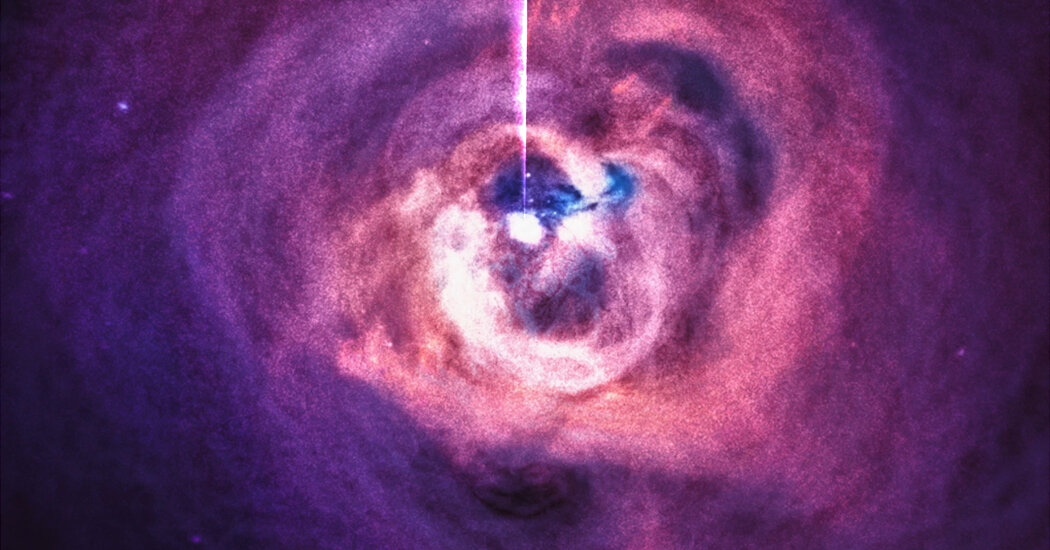
In space you can’t hear a black hole scream, but apparently you can hear it sing.

In 2003 astrophysicists working with NASA’s orbiting Chandra X-ray Observatory detected a pattern of ripples in the X-ray glow of a giant cluster of galaxies in the constellation Perseus. They were pressure waves — that is to say, sound waves — 30,000 light-years across and radiating outward through the thin, ultrahot gas that suffuses galaxy clusters. They were caused by periodic explosions from a supermassive black hole at the center of the cluster, which is 250 million light-years away and contains thousands of galaxies.

With a period of oscillation of 10 million years, the sound waves were acoustically equivalent to a B-flat 57 octaves below middle C, a tone that the black hole has apparently been holding for the last two billion years. Astronomers suspect that these waves act as a brake on star formation, keeping the gas in the cluster too hot to condense into new stars.

The Chandra astronomers recently “sonified” these ripples by speeding up the signals to 57 or 58 octaves above their original pitch, boosting their frequency quadrillions of times to make them audible to the human ear. As a result, the rest of us can now hear the intergalactic sirens singing.

Through these new cosmic headphones, the Perseus black hole makes eerie moans and rumbles that reminded this listener of the galumphing tones marking an alien radio signal that Jodie Foster hears through headphones in the science fiction film “Contact.”

As part of an ongoing project to “sonify” the universe, NASA also released similarly generated sounds of the bright knots in a jet of energy shooting from a giant black hole at the center of the humongous galaxy known as M87. These sounds reach us across 53.5 million light-years as a stately succession of orchestral tones.

Yet another sonification project has been undertaken by a group led by Erin Kara, an astrophysicist at the Massachusetts Institute of Technology, as part of an effort to use light echoes from X-ray bursts to map the environment around black holes, much as bats use sound to catch mosquitoes.

All this is an outgrowth of “Black Hole Week,” an annual NASA social media extravaganza, May 2-6. As it happens this week provides a prelude to big news on May 12, when researchers with the Event Horizon Telescope, which in 2019 produced the first image of a black hole, are to announce their latest results.

Black holes, as decreed by Einstein’s general theory of relativity, are objects with gravity so strong that nothing, not even light, much less sound, can escape. Paradoxically, they can also be the brightest things in the universe. Before any sort of matter disappears forever into a black hole, theorists surmise, it would be accelerated to near-light speeds by the hole’s gravitational field and heated, swirling, to millions of degrees. This would spark X-ray flashes, generate interstellar shock waves and squeeze high-energy jets and particles across space like so much toothpaste from a tube.

In one common scenario, a black hole exists in a binary system with a star and steals material from it, which accretes into a dense, bright disk — a visible doughnut of doom — that sporadically produces X-ray outbursts.

Using data from a NASA instrument called the Neutron Star Interior Composition Explorer — NICER — a group led by Jingyi Wang, an M.I.T. graduate student, sought echoes or reflections of these X-ray blasts. The time delay between the original X-ray blasts and their echoes and distortions caused by their nearness to the weird gravity of black holes offered insight into the evolution of these violent bursts.

Meanwhile, Dr. Kara has been working with education and music experts to convert the X-ray reflections into audible sound. In some simulations of this process, she said, the flashes go all the way around the black hole, generating a telltale shift in their wavelengths before being reflected.

“I just love that we can ‘hear’ the general relativity in these simulations,” Dr. Kara said in an email.

Eat your hearts out, Pink Floyd.

You Might Also Like

Why AI coding brokers aren’t production-ready: Brittle context home windows, damaged refactors, lacking operational consciousness

AI denial is turning into an enterprise threat: Why dismissing “slop” obscures actual functionality positive factors

GAM takes purpose at “context rot”: A dual-agent reminiscence structure that outperforms long-context LLMs

The 'reality serum' for AI: OpenAI’s new technique for coaching fashions to admit their errors

Anthropic vs. OpenAI pink teaming strategies reveal completely different safety priorities for enterprise AI

TAGGED:Audio Recordings, Downloads and StreamingBlack Holes (Space)National Aeronautics and Space AdministrationStars and GalaxiesThe Washington Mailyour-feed-science
Share This Article
Facebook Twitter Email Print

Follow US

Find US on Social Medias
FacebookLike
TwitterFollow
YoutubeSubscribe
TelegramFollow
Popular News
Pfizer is expected to ask the F.D.A. to authorize its Covid vaccine for children under 5.
Trending

Pfizer is expected to ask the F.D.A. to authorize its Covid vaccine for children under 5.

Editorial Board February 1, 2022
Carrie Underwood to headline 2025 ‘New Year’s Rockin’ Eve’ in Occasions Sq.
‘I don’t even know the place it’s, however I gotta go’: Knicks react to NYC avenue indicators
The Sport Firm raises $10M on blockchain-based cloud gaming
How does consciousness work? Dueling scientists check two large theories however discover no winner

You Might Also Like

Inside NetSuite’s subsequent act: Evan Goldberg on the way forward for AI-powered enterprise methods
Technology

Inside NetSuite’s subsequent act: Evan Goldberg on the way forward for AI-powered enterprise methods

December 4, 2025
Nvidia's new AI framework trains an 8B mannequin to handle instruments like a professional
Technology

Nvidia's new AI framework trains an 8B mannequin to handle instruments like a professional

December 4, 2025
Gong examine: Gross sales groups utilizing AI generate 77% extra income per rep
Technology

Gong examine: Gross sales groups utilizing AI generate 77% extra income per rep

December 4, 2025
AWS launches Kiro powers with Stripe, Figma, and Datadog integrations for AI-assisted coding
Technology

AWS launches Kiro powers with Stripe, Figma, and Datadog integrations for AI-assisted coding

December 4, 2025

Categories

  • Health
  • Sports
  • Politics
  • Entertainment
  • Technology
  • Art
  • World

About US

New York Dawn is a proud and integral publication of the Enspirers News Group, embodying the values of journalistic integrity and excellence.
Company
  • About Us
  • Newsroom Policies & Standards
  • Diversity & Inclusion
  • Careers
  • Media & Community Relations
  • Accessibility Statement
Contact Us
  • Contact Us
  • Contact Customer Care
  • Advertise
  • Licensing & Syndication
  • Request a Correction
  • Contact the Newsroom
  • Send a News Tip
  • Report a Vulnerability
Term of Use
  • Digital Products Terms of Sale
  • Terms of Service
  • Privacy Policy
  • Cookie Settings
  • Submissions & Discussion Policy
  • RSS Terms of Service
  • Ad Choices
© 2024 New York Dawn. All Rights Reserved.
Welcome Back!

Sign in to your account

Lost your password?
