


DURBAN, South Africa — In 2009, as officials in the port city of Durban prepared to host the next year’s World Cup of soccer, they moved hundreds of residents from their tin shacks near the city center to a flood-prone field south of town.
The new settlement, a tight cluster of squat homes made of drywall, was built without electricity and tucked between a noisy highway and a river. Officials acknowledged the flood risk but promised residents that within three months, they would be moved into permanent houses, recalled Themba Lushaba, who was resettled with his girlfriend.
Thirteen years and four devastating floods later, Mr. Lushaba, 34, remains in the settlement, still waiting for that permanent dwelling. The most recent flooding, which followed torrential rain last week, was the worst yet. Water rose past his belly button in the pitch black, forcing him and his neighbors to take refuge in a distant field, shivering beneath umbrellas all night.
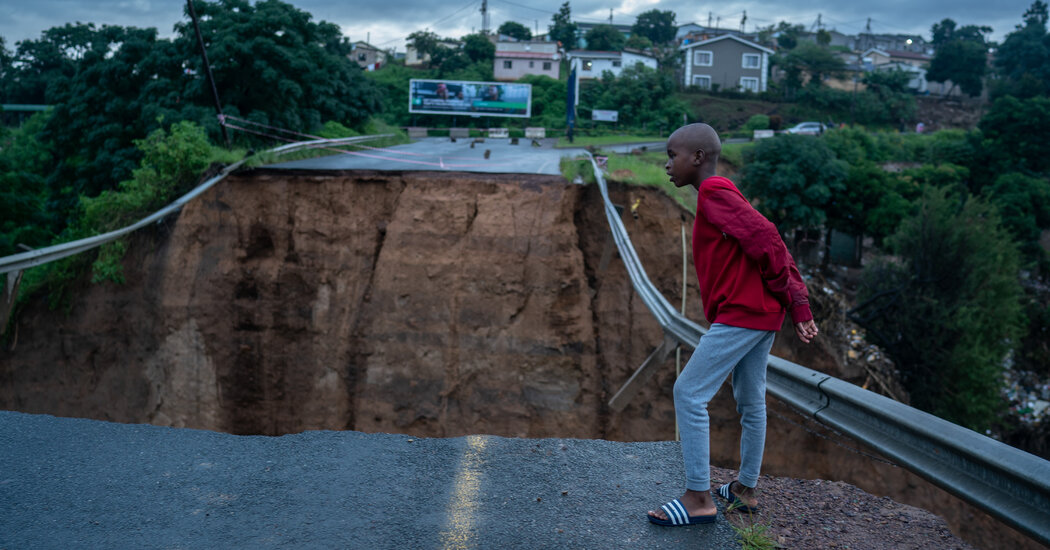
South Africa suffered one of the worst natural disasters in its recorded history when last week’s storms in the Durban area killed at least 448 people, destroyed thousands of homes and left behind shocking scenes of devastation. Shipping containers were toppled like Legos onto a major highway. Vacation houses, their support pillars washed away, dangled from mud-streaked hillsides. Tin shack homes were buried.
Some scientists attribute the intensity of the storms to climate change. But the catastrophe has underscored an often overlooked reality of the fight against extreme weather: Protecting people is as much about tackling social issues as environmental ones.
The failure of government leaders in South Africa to resolve a longstanding housing crisis — fueled by poverty, unemployment and inequality — played a major role in the high death toll from last week’s storms, activists and scholars said.
“Very often, not just in South Africa, but in many other developing countries as well, there simply isn’t the money, there’s not the expertise and there isn’t the government will to invest properly in protecting the poorest in society,” said Jasper Knight, a professor of physical geography at the University of the Witwatersrand in Johannesburg.
Much of the destruction occurred in makeshift settlements of flimsy structures that were washed away. Poor South Africans often settle in these communities because they are close to job opportunities that don’t exist in their far-flung hometowns. Many also can’t afford more stable, permanent housing. So they end up building tin shacks wherever they can find land, usually in locations unsuitable for housing.
In the case of Durban and the surrounding area, those locations are often in low-lying valleys next to rivers or on the loose dirt of steep slopes — among the most dangerous places to be when severe rain storms strike, as they did a week ago.
Even many planned communities across the region occupy environmentally unsafe terrain, in part the legacy of the apartheid government forcing the Black majority to live in neglected areas.
South Africa’s president, Cyril Ramaphosa, during an address to the nation on Monday night, acknowledged the fatal shortcomings of the government’s housing policy.
The process of recovering from the devastation, he said, “will also involve the construction of houses in suitably-located areas and measures to protect the residents of these areas from such adverse weather events in the future.”
While heavy rains are common this time of year, Durban is one of several cities on Africa’s southeast coast that have seen an increase in rainfall that some scientists attribute to climate change. In just about two days, eThekwini, the municipality that includes Durban and surrounding communities, experienced the equivalent of a month’s rainfall, scientists at the University of Cape Town said.
That drenching weather came as the region was still drying off from destructive rain and flooding in 2017 and 2019 — and as hundreds of residents displaced by floods back then were still languishing in transit camps. In 2019, more than 70 people were killed.
Rebuilding after 2017 was slowed by a complicated process for obtaining government contracts to build new homes, said Mbulelo Baloyi, the spokesman for the housing department in KwaZulu-Natal, the province that includes Durban. When areas that were still recovering from those floods were flattened again in 2019, the national government stepped in and the process was streamlined, Mr. Baloyi said.
The government is already erecting modest, prefabricated homes for transit camps for some of the estimated 40,000 people who have been displaced by this year’s flooding.
In 2018, the city of Durban identified growing informal settlements as a significant challenge in the city’s response to climate change. And after the 2019 floods, the city introduced a plan calling for creating more renewable energy sources, reducing car transportation and making informal settlements climate resilient.
Despite these commitments, city officials still have not done enough to tackle the devastating consequences of climate changes through economic and social development, said Tafadzwanashe Mabhaudhi, a professor in climate, water and food systems at the University of KwaZulu-Natal.
Creating job opportunities in various parts of the country could alleviate the desperation that leads some people to stay in informal settlements, which are often the only places they can find accommodation in crowded cities where most of the jobs are, he said.
Mr. Lushaba’s family owns a compound in Uzumbe, a rural community an hour south of Durban, with three rondavels standing next to a four-room home made of concrete blocks.
But with no job prospects in the area, he left in 2008 to move into a tin shack in Durban, where his mother had lived since 1996 to do domestic work. Like so many people in a country where the unemployment rate is now over 35 percent, Mr. Lushaba has been unable to find a steady job. He occasionally works security in a nearby community.
In 2009, Mr. Lushaba was resettled when local leaders used a provincial law to remove shack settlements from the view of visitors for the World Cup. He is desperate for a job so that he can rent a permanent home, and he is losing hope that the government will follow through on its commitment to provide one.
“They only tell us that we must wait our turn,” he said. “The government is always making a lot of promises but is never coming back to do it.”
The land under Mr. Lushaba’s transit camp, in the Isipingo township, was once a wetland buffer for the neighboring Sipingo River, he said. The boxlike, low-slung structures have a maze of muddy alleyways between them. Black wires carrying the unsanctioned power connections that residents hooked up for themselves are splayed about the pavement.
In 2011, within two years of moving to the camp, it flooded for the first time, Mr. Lushaba said. It happened again in 2017 and 2019, and now last week. Each time, the residents go through the same ritual: They head for higher ground, allow the water to subside, then have to rake the mud out of their single-room homes and take stock of which belongings can be saved and which must be thrown out.
Scenes like that were playing out across the area this week. In Inanda township, north of Durban, in a neighborhood of concrete block homes beneath a collapsed bridge, a heap of mud, broken trees, mattresses and other furniture were all that remained of a home where four family members were believed to have been buried.
On Tuesday, Mr. Lushaba and his girlfriend propped a light blue mattress on top of a sofa they were drying in front of their home. Shoes, a fan and other items sat drying atop the corrugated tin roof of their home.
“It hurts me to stay here,” he said. “It’s dirty all over.”
Ravi Pillay, the provincial executive in charge of economic development, said Mr. Lushaba’s grievances were understandable.
“I think it was poorly located in a bit of a low-lying area,” he said of the Isipingo transit camp. “At that time there wasn’t the kind of appreciation of the flooding risk that we have now.”
Some wonder, though, whether government officials, even now, have it in them to move with the necessary urgency.
About a quarter of eThekwini’s population lives in informal settlements, according to Hope Magidimisha-Chipungu, an associate professor in town and regional planning at the University of KwaZulu-Natal. Local planning authorities have been unable to keep up with the increasing demand for housing, she wrote in an email response to questions.
“The port city is heading towards a very bleak and catastrophic future,” she said, “if measures are not put in place to reduce the impacts of flooding in the future.”
John Eligon and Zanele Mji reported from Durban, South Africa, and Lynsey Chutel from Johannesburg.

