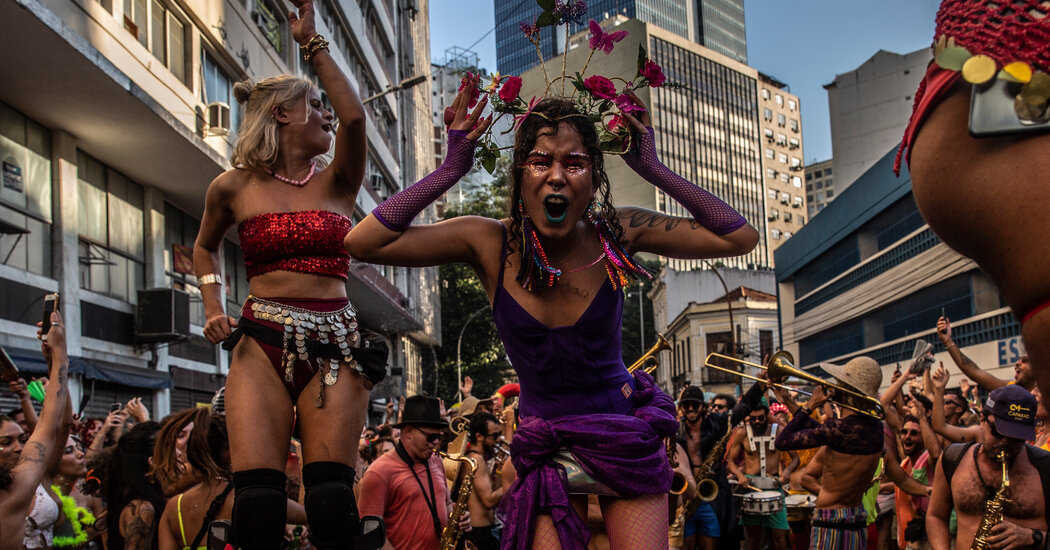

RIO DE JANEIRO — A young man sat alone with a beer and his tuba. One by one, his co-conspirators arrived. A man in a leotard with a trumpet. A shirtless drummer in a wizard hat. Another tuba player in a leopard-skin bra.
They were a ragtag group, convening near a popular downtown plaza to break the rules and start a party. In their view, they were here to save Rio de Janeiro’s Carnival.
After Omicron brought a new wave of Covid cases to Brazil, Rio banned the roving bands known as “blocos” that fuel the free, impromptu street parties that make this city’s Carnival such a democratic revelry. City authorities had been scouring social media for planned blocos and vowed to break up any that violated the order.
Instead of the blocos, the city was allowing private, paid parties that could check for vaccinations. That left many Rio residents worried that Carnival — one of the few institutions where Rio’s social classes still mingle — was becoming more private and elite. Some of them wondered whether it would be much of a Carnival at all.
But on the edge of the plaza just after 9 p.m. on Friday, Carnival’s first official night, the resistance was assembling next to a Chinese noodle stand. They were armed with glitter, fishnet and a full brass section.
“Carnival is a cultural manifestation, not an event,” said Rafael Comote, 30, a trumpet player wearing a pink wig and a vest from the Rio health department, borrowed from a friend. “Carnival is not something you can forbid.”
The bloco had formed over the previous few days in a WhatsApp group of about 100 musicians from bands that had canceled their plans. After last year’s Carnival cancellation, these musicians wanted to play. They called their makeshift band “Repressed Demand.” To evade the police, they decided on the meeting spot just a few hours before.
Around 10:30 p.m., the group headed for Olympic Boulevard, a promenade along the water created for the 2016 Olympics. “We’re all apprehensive,” Mr. Comote said as he walked. “This is the first bloco of the first day, so let’s see.”
About 20 musicians and 30 spectators stopped in front of a warehouse. With streetlights flickering overhead, they warmed up with a famous Brazilian Carnival song whose opening lyrics sent a message: “Make way so I can pass. Excuse me so I can let off some steam.” The small crowd bounced to the rhythm — and began texting their friends.
Benjamin Rache Salles, a physics professor with glitter on his face, said he was heading to meet friends at a samba bar when he heard there was a bloco. Now those 10 friends were on their way here.
Within an hour, the band was encircled by more than 200 people dancing and singing. Vendors were selling $2 beers. Carnival had arrived.
“The music produces a vibration that reaches your heart and gives you emotion. And you sing, dance, jump, get happy and forget everything,” said Fabio Morais, a trumpet player in a red firefighter vest. “Then you come back to reality.”
Suddenly, there were red flashing lights. The police had arrived, too.
That left expectations high for this year’s Carnival, the days-long celebration of indulgence ahead of the Christian observance of Lent. Much like 1919, it was expected to serve as a pressure valve after the pandemic restrictions. “We don’t party because life is quiet, because life is good,” said Luiz Antônio Simas, a Rio historian who has studied Carnival. “The party is restorative.”
Then Omicron arrived. In January, Rio’s mayor postponed until April the official Carnival parade, known for its elaborately costumed dancers and floats, and banned altogether the more than 450 blocos and their freewheeling street parties. Most other cities made similar moves.
But a loophole in Rio’s policy — allowing private Carnival parties, which had already become more popular in recent years — let paid gatherings flourish.
Dozens popped up, with some offering elaborate musical performances and selling tickets for more than $100. Almost immediately, many Rio residents saw the policy as hypocritical.
“On what moral grounds do you stop the street carnival while various other gatherings and events are happening?” Mr. Simas said. “The ban was not based on public health criteria.”
City Hall stood firm. The man tasked with hunting the Carnival blocos was Brenno Carnevale — yes, that is his real name — head of the department that cracks down on illegal street vendors, taxis and, during the pandemic, parties.
The day before Carnival started, Mr. Carnevale said he had 32 agents monitoring social media for blocos and hundreds of police officers patrolling the streets. They had infiltrated more than 50 WhatsApp group chats. And they issued a clear warning the previous weekend when they broke up two blocos downtown in a pre-Carnival celebration.
“There are always people who want to defy the rules,” he said. If the blocos go out, “we’ll seek dialogue,” Mr. Carnevale said. “We’ll ask them to disperse.”
‘We’re not going to stop.’
When the police showed up on Olympic Boulevard on Friday night, things became tense. In some ways, the encounter would set the tone for the rest of Carnival.
The police wanted the bloco to move. But the officers didn’t necessarily say they had to stop playing. “We are going to Harmony Plaza,” said Paula Azevedo, a fiery trombone player. “We’re not going to stop.”
The police agreed the party could move. Then Ms. Azevedo posed another question. “You agree that this is hypocrisy?” she said. “It is hypocritical to have to pay to enjoy Carnival?”
“Yes,” one officer responded. “Of course.”
The party became a parade down Olympic Boulevard, gathering energy and size as it went. When the band turned left onto a more narrow street, it was difficult to move.
By 3 a.m., thousands of people packed Harmony Plaza. They greeted friends, kissed and moved to the music. Some climbed on to a gazebo. People wore wigs, capes and feathers, and vendors sold caipirinhas, meat skewers and corn on the cob. And the band didn’t stop, the drums and horns the heartbeat of the party. Overlooking it all was a state police precinct.
At 6 a.m., Paulo Mac Culloch, a spokesman for Mr. Carnevale, responded to a text message asking if the department had spotted any blocos that night. “Up until now,” he responded, “no.”
The party made clear that Rio’s Carnival was on. While much smaller than usual and without the typical infrastructure, like portable toilets and sound stages, blocos played through the streets of downtown for the next four days, sometimes attracting enormous crowds.
The police, for their part, mostly watched. They tried to keep people off the tram tracks and from disrupting traffic, but tensions mostly remained low. One officer said everyone just wanted to get along because of the war in Ukraine.
On Monday, Mr. Carnevale’s department said that it broke up 11 blocos from Saturday through Monday. “The street Carnival, with the big organized blocos, didn’t happen as it usually does,” the department said. “However, we had people celebrating in the streets and we followed it all.”
Renata Rodrigues, a sociologist and a drummer in a feminist bloco that played on Tuesday, said that despite all the challenges, Rio’s street Carnival was alive and well.
“There is nothing more Rio than this street culture, this way of intertwining, getting together with people you know and you don’t know,” she said. “We haven’t been able to do any of that for two years, so it’s been a memorable, incredible Carnival.”
She added: “Something that only the street can provide.”
Leonardo Coelho contributed reporting.