

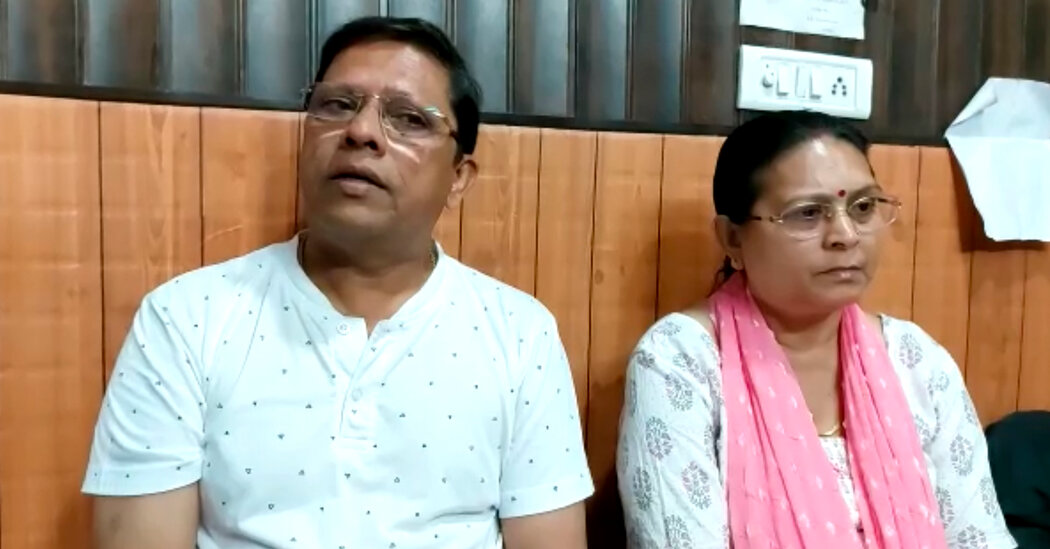

NEW DELHI — After spending their savings to have their son trained as a pilot in the United States, Sanjeev Ranjan Prasad and Sadhana Prasad financed his lavish wedding back in India, along with a luxury car and an overseas honeymoon.
They assumed their investments would eventually pay off, in the form of a grandchild. But as time ticked by, they say, the not-so-newlyweds showed little interest in producing one.
After waiting anxiously for six years, they decided to sue.
They are demanding that their son and daughter-in-law produce a grandchild within a year or pay $650,000 in damages. An initial hearing on the suit is scheduled for Monday in a court in northern India.
“I feel very sorry for them because I am also an Indian and I can understand their pain,” said the couple’s lawyer, Arvind Srivastava. “This is an Indian parent thing.”
Around the world, of course, people of a certain age face pressure from their parents to have babies. But the guilt trips rarely, if ever, translate into civil litigation.
Even if the case goes nowhere, which experts say is distinctly possible, it has already tapped into a broader debate within India over what children owe their parents — from both a legal and a spiritual standpoint.
‘A lot of moral pressure’
In the Hindu faith, as in other traditions, children have a duty to repay a moral debt to their parents by taking care of them in their old age. Having grandchildren is also seen as necessary to carry forward a family’s lineage and help one’s parents achieve enlightenment.
“Parents take care of their children when they’re young, and they look forward to their adult children’s care and service, especially their sons, in return for all the personal, material and social sacrifices they have made in raising them and contributing to their success,” said Annapurna Pandey, an anthropologist at the University of California, Santa Cruz, who has studied religion and social issues in India.
But as India’s population ages — the country now has about 140 million people who are 60 or older, second only to China — more younger adults are entering the middle class and living independently of their parents. The result is a growing sense among older Indians that children are not fulfilling their filial duties, Professor Pandey said.
Those duties are enshrined, to some degree, in the legal code of India, a secular republic with a Hindu majority. A 1956 law made adult children responsible for supporting their parents; a 2007 law on the “maintenance and welfare” of parents and seniors says that children who fail to do so can be fined or imprisoned for up to three months.
The Prasad case is an extreme example of an Indian couple trying to recoup a moral debt from a child, but it is rooted in the same “cultural logic” that informed those laws, Professor Pandey said.
“Bottom line here is there is a lot of moral pressure, and the state very much supports the elderly in terms of children’s obligation to their parents,” she said.
The case
The Prasad case was filed this month in a district court in the northern city of Haridwar — not under the 2007 law, but on the grounds of “mental harassment.”
The Prasads say that in addition to spending their savings on their son’s $65,000 pilot training program and his expenses in the United States, they supported him for another two years and paid for his Audi, his 2016 hotel wedding and his honeymoon in Thailand.
The parents, who live in a wealthy enclave of Haridwar, have said that they were initially patient with their son and daughter-in law over the lack of offspring.
“Even after two years, they never thought of having children and we left the decision to them,” Mr. Prasad, 61, a retired government official, said in a brief telephone interview.
But the Prasads eventually became so despondent that they would feel ashamed whenever they saw older people drop off grandchildren at a bus stop, said Mr. Srivastava, the couple’s lawyer. The court filing accuses their son and his wife, who live in the southern city of Hyderabad, of neglecting their “duty to give the pleasure of having either a grandson or a granddaughter.”
Mr. Prasad’s son and his wife could not be reached for comment.
The response
The case has made headlines in national newspapers and prompted a debate about how much control parents should have over their children’s life choices.
Raavi Birbal, a lawyer in India, said that the suit would probably not go far because its arguments violate rights enshrined in India’s Constitution, including the right to liberty.
“This is actually a very rare case,” Ms. Birbal said. “That is why it is so much in the limelight. But, ultimately, it is the couple’s choice to have a child, not that of their parents.”
Hari Bhushan Yadav, 52, a shopkeeper in Haridwar, said that residents had been discussing the case with great interest over tea outside his shop, and that older people tended to sympathize with the plaintiffs.
“In old age, you want to play with your grandchild,” he said. “What is the harm in giving them one?”
Sameer Yasir reported from New Delhi and Mike Ives from Seoul. Hari Kumar contributed reporting.

