

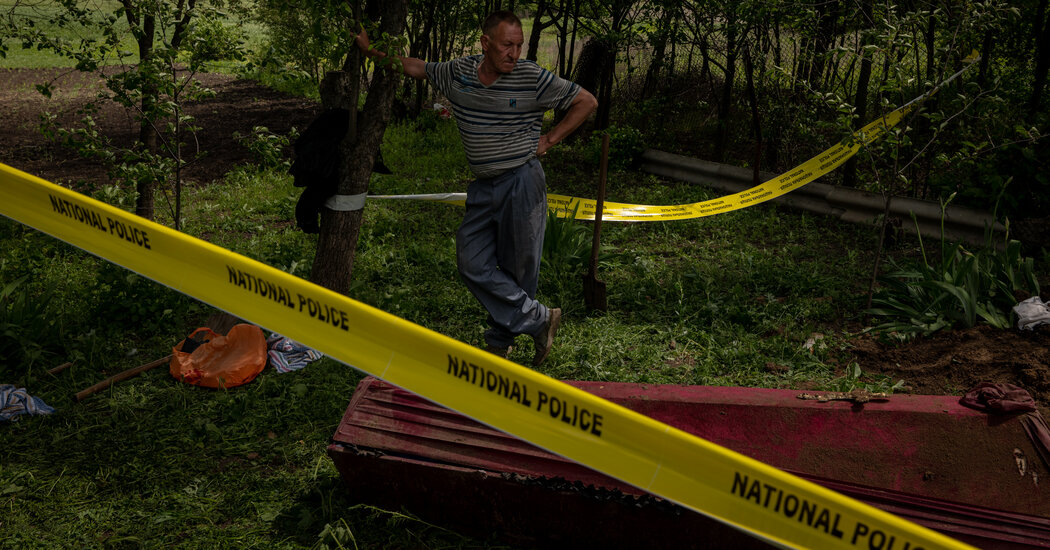

KOROPY, Ukraine — Four men tugged at long strips of fabric to lift a coffin out of the gaping hole in the backyard of a small house. They flung the lid open to reveal the moldy corpse of Oleksiy Ketler, who had been killed instantly by shrapnel when a mortar fell on the road in Koropy, a village outside Khavkiv in northeastern Ukraine, in March.
Mr. Ketler, a father of two young children, would have celebrated his 33rd birthday on June 25, if he had not been outside his house at the wrong time. Now, his body has become another exhibit in Ukraine’s wide-ranging effort to collect evidence to prosecute Russia and its military for war crimes in the brutal killings of Ukrainian civilians.
Experts say the process is proceeding with extraordinary speed and may become the biggest effort in history to hold war criminals to account. But it faces an array of formidable challenges.
For one, the investigations are being undertaken even as the war rages in the east. As the investigators examined Mr. Ketler’s body, the booms of incoming and outgoing shelling thundered nearby. Ukrainian helicopters, most likely bringing new troops to the front line, flew low overhead.
Also, although investigators from inside and outside Ukraine are all collecting evidence, there is little coordination. And despite the influx of experts, “there are really not enough people” to investigate, indict and judge the cases, said Andrey Kravchenko, the region’s deputy prosecutor, who was sitting in his office in downtown Kharkiv as the sound of outgoing shelling seemed to grow closer.
One building that prosecutors had been using as an office was struck by missiles in what Mr. Kravchenko believed was an intentional attack, and now his team changes its headquarters often.
Demand for accountability is strong.
Ukraine’s judicial system is now almost wholly devoted to investigating war crimes, with most of its 8,300 prosecutors fanned out across the country collecting evidence, said Yuriy Belousov, Ukraine’s chief war crimes prosecutor.
Ukrainian courts have already handed down six guilty sentences to Russian soldiers. Ukraine’s top prosecutor said this past week that almost 20,000 more cases — involving accusations of torture, rape, execution-style killings and the deportation of what Mr. Belousov said could be tens of thousands of Ukrainians to Russia — were being investigated.
Better Understand the Russia-Ukraine War
At the same time, hundreds of international experts, investigators and prosecutors have descended on Ukraine from an alphabet soup of international agencies.
Early in the war, the top prosecutor of the International Criminal Court, Karim Khan, arrived in Ukraine with several dozen investigators. But the court, which is based in the Netherlands, tries a limited number of cases, and usually seeks to prosecute only the upper echelon of political and military leaders.
It is also slow: Investigators working on the 2008 Russian-Georgian war did not apply for arrest warrants until this year.
There are a number of other initiatives, too. Amal Clooney, an international human rights lawyer, is part of a team advising the Ukrainian government on bringing international legal action against Russia. The United Nations has started a commission to investigate human rights violations in Ukraine — with three human rights experts — but cannot establish a formal tribunal because Russia wields veto power on the U.N. Security Council.
Investigators in Poland are collecting testimonies from refugees who fled there to feed to Ukrainian prosecutors. France has sent mobile DNA analysis teams to embed with the Ukrainian authorities to collect evidence. Nongovernmental organizations based in Kyiv, Ukraine’s capital, are going to territories recently occupied by Russian soldiers to collect witness statements.
The involvement of multiple countries and organizations does not necessarily lead to a more productive investigation, said Wayne Jordash, a British criminal lawyer who lives in Ukraine. Mr. Jordash, who is part of an international task force supporting Ukrainian prosecutors, was critical of some of the efforts to assist Ukraine judicially, describing it as “smoke and mirrors,” without results and clear priorities.
The International Criminal Court’s investigators were only just getting going, he noted, and experts from other countries have also been cycling in for stints of several weeks.
“You can’t just parachute into an investigation for two weeks and expect it to be meaningful,” Mr. Jordash said.
Iva Vukusic, a scholar of post-conflict justice at the University of Utrecht, said, “Resources are being poured in, but maybe down the line we will see that they were not being spent the right way,” for instance, duplicating investigation efforts rather than providing psychosocial support to victims.
Ms. Vukusic pointed out the large size of the endeavor. Across the country, she said, “there are thousands of potential suspects, and thousands of potential trials.” All of the material needs to be properly marshaled and analyzed, she said.
“If you have 100,000 items — videos, statements, documents — if you don’t know what you’re sitting on, it limits the use of material,” Ms. Vukusic said.
She also cautioned that the International Criminal Court’s leadership could face criticism by collaborating too closely with the Ukrainian authorities because, she said, Ukraine was also “an actor in this war.”
She feared Ukrainian officials were setting expectations for justice very high, and possibly wasting scarce resources on absentia trials.
“No big case is going to be finished in two years or five years because of the scale of the violence and the fact it is going on for so long,” she said.
Mr. Belousov, the Ukrainian war crimes prosecutor, acknowledged as much. “We are playing a long game,” he said. Even if the perpetrator is tried and convicted in absentia, Mr. Belousov said, “We understand in a year, or two or three or five, these guys won’t be able to avoid punishment.”
Mr. Belousov said that he appreciated the international assistance but that coordinating it was the “biggest challenge” law enforcement authorities experienced.
For example, the Kharkiv prosecutors used a shiny new forensic investigation kit donated by the European Union for their exhumation in Koropy, the village in northeast Ukraine. But a police officer from a unit in Dmytrivka, a 45-minute drive west of Kyiv, said they had not seen or met with any international investigators or received any equipment from them.
Mr. Belousov said Ukraine wanted to take the lead in prosecuting the cases — a divergence from previous post-conflict situations in which the national authorities initially left the process to international tribunals.
But most Ukrainian investigators have little experience in these kinds of inquiries.
For example, Andriy Andriychuk, who joined the police force in the region west of Kyiv two years ago, said his work previously involved investigating local disputes or livestock theft. Now it involves “a lot more corpses,” he said.
On a recent sunny afternoon, he was called to a wooded area near the town of Dmytrivka. Several days before, police officers had received a call from foresters who had come upon a man’s grave. The dead man, Mykola Medvid, 56, had been buried with his passport; his hat was hung on top of a cross made out of sticks.
His daughter and his cousin identified his body. The local morgue officially established the cause of death: a fatal shot in the chest.
Since then, his daughter Mariia Tremalo has not heard from the investigators. No witnesses have come forward, and it was unclear who might have killed her father, or why. Still, she is hungry for justice.
“My father will never be returned,” she said. “But I would like the perpetrators to be punished.”
Right now that seems all but impossible.
In Koropy, the village near Kharkiv, Mr. Ketler’s mother, Nadezhda Ketler, was inconsolable as the gravediggers and inspectors worked. She wandered down the road to another part of her property. Six officials stood over her son’s body, photographing and documenting as his best friend, Mykhailo Mykhailenko, who looked petrified and smelled of stale alcohol, identified him.
The next day, Mr. Ketler’s body was taken to the city’s morgue, where the final cause of death was established.
Eventually, Ms. Ketler gathered the strength to show investigators the crater made by the bomb that killed him, leading the police to the exact spot where he died. Ms. Ketler stood looking at the trees as they rustled in the wind. She did not speak to anyone. She said she did not know if a guilty verdict in a war crimes trial, if it ever came, would ease the pain of losing her child.
“I had to bury my son twice,” Ms. Ketler said later. “You understand, this is hard enough to do once, and to have to do it a second time. The pain of a mother will not go anywhere.”
Evelina Riabenko, Diana Poladova and Oleksandr Chubko contributed reporting.

