


SIEVIERODONETSK, Ukraine — A woman climbed down from the ambulance, wailing, her hands covered in blood. Police medics drew her inside their first aid post, as she appealed for help for her husband, who lay in the ambulance.
“Please, God, let him live,” the woman, Olha, said. “You cannot imagine what a person he is. He is a golden person.”
But the stretcher bearers were already standing down. Olha’s husband, Serhii, died at midday Tuesday, another victim of the relentless barrage of artillery and gunfire that Russian forces have rained down on this frontline town for three months.
Sievierodonetsk, a mining and industrial town, lies at the heart of eastern Ukraine’s Donbas region, which puts it squarely in Moscow’s cross hairs. Rebuffed in the capital, Kyiv, Russian forces have turned the full force of their efforts to the east, with the goal of seizing a large chunk of territory next to the Russian border, though it has come at some cost for them.
Sievierodonetsk is strategically critical for the Ukrainians, too, and they have spent weeks fiercely defending it. Earlier this month, Russian forces sustained heavy losses as they tried to cross the Seversky Donets River nearby and solidify their position.
In Sievierodonetsk, that has meant months of trauma as Moscow tries to encircle the town and lay siege to it. Russian forces are now in place on three sides.
Travel to Sievierodonetsk is perilous. To get here on Tuesday, a reporting team from The New York Times drove with a police escort through small villages and fields to avoid shell fire from Russian positions, and then sped across a single lane bridge that is the only route remaining into the town.
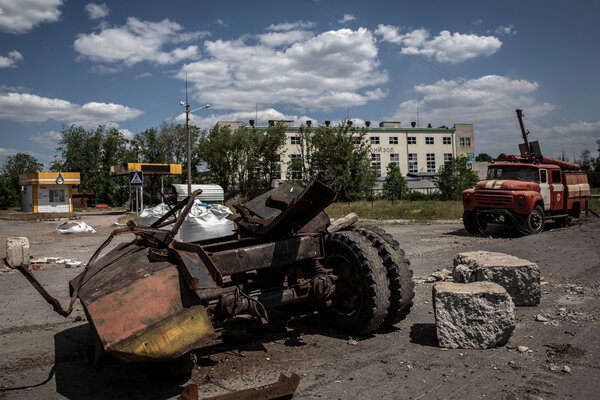
Debris from the Russian bombardment lay on almost every street.
The fins of rockets stuck out of craters in the asphalt. A broken electricity pylon and cables were draped across the street. And burned-out cars, shredded by shrapnel and sometimes overturned, lay abandoned wherever a blast had thrown them. A truck hung precariously off the side of a bridge.
For the police officers of Sievierodonetsk, it was just another day.
Officers have kept up a police presence in the town, as well as in the neighboring city of Lysychansk, running in supplies for the remaining townspeople, picking up the dead and wounded, and evacuating people away from the front line.
“A lot of them were nobodies, but when the war started they became heroes,” the police chief of the Luhansk region, Oleh Hryhorov, said of his officers. “A lot of them have stayed because they really understand this as their duty.”
Though much of the region that Chief Hryhorov is responsible for has been seized by Russian forces, he has managed to maintain a headquarters in Sievierodonetsk, and commands a force made up mainly of natives of the eastern regions of Luhansk and Donetsk that Russia claims as its own. Many of them lost their homes eight years ago in the war in eastern Ukraine, and now have lost everything a second time, he said.
As the Ukrainian military fights to defend the town, battling with artillery and tanks to fend off Russian advances, the police force has tried to tend to the needs of the civilian population. Inside a warehouse, workers drew up lists of those who needed aid and those who were seeking evacuation. A line of blankets on wooden pallets served as a first aid post. In the yard, people filled buckets from a water tanker.
All the while, the Russians have increased their bombardment in the past few days, and a new assault seems imminent, the police chief said.
Now, even civilians who had opted to stay in their homes, rejecting earlier offers of evacuation, are asking for help getting out, Chief Hryhorov said. The police are bringing out 30 or 40 people a day.
The danger is also rising for his officers, who number more than 100 in the two settlements. On Tuesday, he held a meeting with his staff to strategize about what to do in the event of encirclement by the Russians.
For now, they will stay put, he said, since there is no one else to provide for the people.
Out of a prewar population of 100,000, thousands of people still remain, many living in basements and communal bomb shelters, others remaining at home in apartments or small wooden cottages amid gardens and tree-lined streets. Some are pensioners. Some lack the means — or the inclination — to escape. Still others sympathize with the Russian government.
Many appeared simply overwhelmed by events.
As a team of officers unloaded supplies of food for families in apartment blocks in the old part of the town, two women approached the police commander. They wanted to be evacuated, but they cared for their mothers, both of whom were bedridden from strokes.
“I am without money, without pennies,” said Viktoriya, 49, starting to weep. “I have no relatives and nowhere to go.”
Viktoriya had been in touch with an American aid group that had offered to help when the town still had telephone and internet connections, but, she said, they never came. Her mother, Valentina, is 87 and cannot walk, she said.
As she spoke, sniper fire whistled close overhead. The police commander ducked and swung around to look for the impact. But the two women seemed oblivious to the gunshot, as well as to the explosions sounding nearby.
The second woman, Lyudmila, 52, said she lived in an apartment on the fourth floor and did not dare go down to the basement when there was bombardment because she could not bear to leave her mother upstairs alone.
“I have to feed her by hand,” she said. “We sit and feel fear and don’t know what to do.”
The apartment block had already been hit once by a shell, and one apartment was partly burned.
“We will not promise, but we will try,” the police chief said, responding to the women’s evacuation request.
Police teams have been gathering those who want to leave in small groups and ferrying them to an assembly point, where they are then taken out in an armored bus.
The operation is full of pitfalls and uncertainties, not least the onset of new shelling, which stalls any movement. But as the teams gathered at police headquarters in Lysychansk to plan the next evacuation, they said the latest delay was caused by a group of evacuees themselves who were demanding extra assurances.
Other officers were tending to those for whom help was too late.
Three police officers, braving shell fire, set off to collect and bury the dead in Lysychansk. They drove a white van to a home where a 65-year-old woman, whom neighbors called Grandma Masha, lay in the yard on her back, her arms splayed out under a blanket. Her dog growled and barked from his kennel as the officers placed her in a body bag and carried her out on a stretcher.
Grandma Masha was a diabetic and the war made it difficult to get her medicine, said her neighbor, Lena, 39. Her son had left with his family, and was not able to get back when she fell ill, Lena said. Like most people interviewed for this article, she preferred to give only her first name, for reasons of security.
“I did not want this to happen at all,” she declared. “It’s a completely stupid war — but no one asked for my opinion.”
The police officers collected another body, of a 60-year-old man called Sasha who had lived in a small wooden house with an overgrown garden near a military base.
“There was shell fire, and then he died,” said his neighbor and friend, Mikhail, 51, exasperated. “He said he was feeling ill, but where were we to take him in an emergency?”
Sievierodonetsk has a hospital. But the sole doctor there is caring for 30 patients, and it has been heavily shelled and is virtually inaccessible, people in the town said.
The police officers drove on to the cemetery on the edge of town and backed their van up to a line of narrow trenches dug by a backhoe. They heaved the bags out of the van and swung them unceremoniously into the trench where 10 or so body bags already lay.
They have buried 150 civilians in three months, said the officer in charge, who gave only his first name, Daniel, 26. Only a few relatives were around to arrange proper burials, with the rest going into the communal graves.
“It is very scary that you get used to it,” Chief Hryhorov said.
His way of dealing with the war is to concentrate on one task at a time, he said.
“And tomorrow will be another day and there will be some new tasks,” he said. “Probably, each of us should do what we must, and the result will be some common victory.”

