

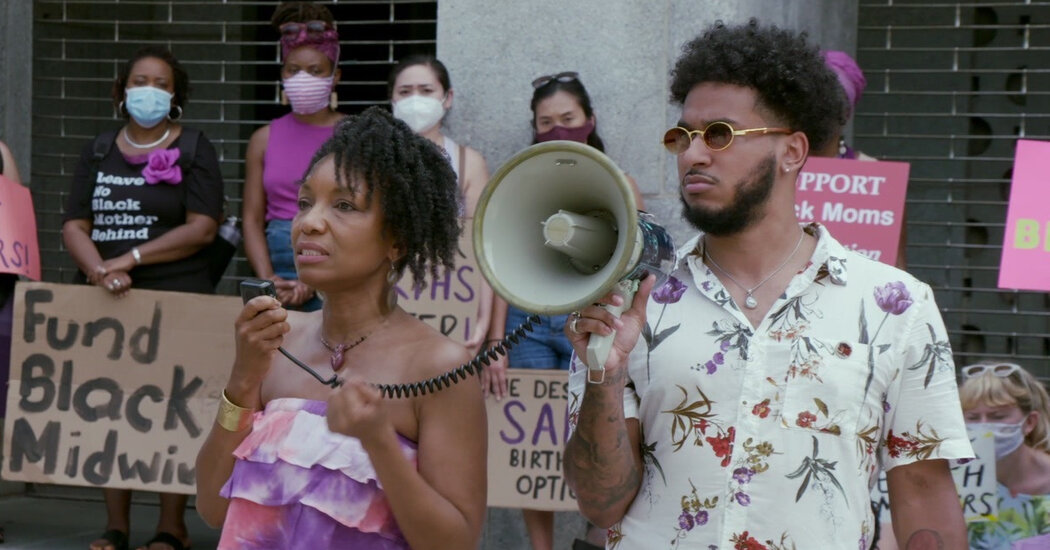

“Black lives matter because Black wombs matter!” Shawnee Benton Gibson chanted from the stage during a National Action Network rally in Washington, D.C., in 2020.
In October 2019, her daughter Shamony Gibson died just two weeks after giving birth. Her death, at age 30, was another grim emblem of a national crisis: the epidemic of Black maternal mortality. The United States is the most dangerous industrialized country to give birth, with Black women dying at three times the rate of white women.
Not long after Shamony’s death, her mother, along with her partner, Omari Maynard, held a celebration of her life that they called “Aftershock.” Ahead of it, Paula Eiselt and Tonya Lewis Lee, the directors of a documentary that shares a title with that event, reached out to them.
“We didn’t know them, but they were open for us to come and film,” Lee said in an interview this month along with Eiselt. “That really started and jelled the film as it is now.”
Shortly after, the directors met Bruce McIntyre, who held a news conference to sound the alarm about maternal mortality and demand accountability for the death of his partner, Amber Rose Isaac, 26, who died postpartum in April 2020.
Shamony and Amber anchor “Aftershock,” which not only examines America’s abysmal maternal mortality rates among Black and brown women but also follows the women’s loved ones as they grapple with fresh grief and fight for a solution. Pulling together numerous threads, the directors delve into the U.S. medical system — illuminating disparities in Black and brown communities and the gross neglect that befalls them as a result of centuries-long systemic racism.
“History is everything,” said Eiselt, who directed the 2018 documentary “93Queen,” about a female emergency-responder unit in Brooklyn. “Aftershock” is the directorial debut of Lee, who has produced films like “Monster” and the Netflix series “She’s Gotta Have It” (from her husband, Spike Lee).
“It was really important to us to show how we got here,” Eiselt said, “that this crisis didn’t just pop up out of nowhere. It’s on a historical continuum that started from 1619, where Black women were devalued and dehumanized. And here we are.”
The film, streaming on Hulu, presents a litany of jarring facts — for one, the explosion of cesarean births since the 1970s. The procedure, which is often more profitable for hospitals, results in significantly more maternal deaths than vaginal deliveries.
Despite the difficult subject matter, the film does not wallow in tragedy. Instead, it’s underpinned by optimism and hope: in the families’ fights for change and in efforts on Capitol Hill, particularly the Black Maternal Health Momnibus Act of 2021, which would be the greatest investment in maternal health in U.S. history.
Here’s what Eiselt and Lee, who had never worked together before, learned about filmmaking, and themselves, with this project.
Expect the unexpected.
It doesn’t take long to realize that the documentary was captured at the height of Covid, with mask-wearing throughout and plenty of outdoor scenes. At one point, Omari, a teacher, talks to a student via a laptop while caring for his new baby.
“Oh my God, how are we going to do this?” Lee remembered telling Eiselt at the beginning of the pandemic. “We did have to adjust,” Lee said, and be “nimble and flexible.” They found ways to pivot, including giving iPhones to Omari, Shawnee and Bruce to film themselves at home and “keep themselves going.”
Plans to film in hospitals in New York and in Tulsa, Okla., were also complicated. (Oklahoma’s maternal mortality rate is double that of the nation, with Black women making up a disproportionate amount of those deaths.)
“Maybe things worked out in the end,” Lee said. “We were more out in the streets and had very small shoots.”
Follow the stories, wherever they lead.
Early in the film, Bruce and Omari form a profound bond. The pair go on to gather with other Black men whose partners died in a similar way, finding comfort and commiseration in each other.
“People are often struck by the fact that we followed fathers in this film,” Lee said. “Being able to see these men who are raising their children — who clearly love their partners very much, who are driven by a love for their partners, for their community, for their families — it’s just been really special to us as well, something we were not expecting when we first got down to make this film.”
Black maternal mortality is not just a women’s issue, Lee said: “It’s a family issue. It’s a community issue. It’s everybody’s issue.”
New viewpoints beget growth.
Before Lee and Eiselt met at a conference in 2019 — “I was pregnant, I probably looked crazy,” Eiselt joked — they were strangers. But their shared vision, along with their passion and urgency, spurred them to team up.
“You need that passion to just jump in with someone, you know? We just were like, ‘we’re going to do this,’” Eiselt said. “We spent so much time talking — like, really talking. I would speak to Tonya more than anyone else in my life.”
“We were real and deep from the beginning,” Lee said.
As for any challenging moments between them, there were times, Eiselt said, where Lee would push back: “She would say like, ‘You don’t have that perspective.’ She’s a Black woman. I am not.”
These conversations pushed Eiselt to “think very deeply about everything that we were doing,” she said, particularly because they were filming during the George Floyd uprisings. “We went through so many huge world events,” Eiselt said. “We grew so much because of the circumstances of the world.”
“We would go at it, but in the spirit of, how are we going to make it better?” Lee added. “It was always about, how do we elevate the story?”
Balance emotions and professionalism.
The intimate nature of the documentary, bringing viewers into the fresh pain of the families, is gutting to watch. For the filmmakers, maintaining the appropriate amount of distance was tough at times.
Eiselt, for instance, was pregnant for part of the project and then postpartum. At one point, she was interviewing Omari while nine months along. “In order to compartmentalize it, I had to really almost numb myself in a way which isn’t necessarily the best thing,” she said. “But I felt like, at points, if I started to go there, I wouldn’t come back.”
This balance is not uncommon for documentary filmmakers, she said. “I feel like in film school, you should take psychology.”
But watching Shawnee, Omari and Bruce “turning their pain into power,” Eiselt said, fueled the directors.
“I can’t be in tears on the floor,” Lee said, “if Shawnee is out there charging forward.”

