

We collect cookies to analyze our website traffic and performance; we never collect any personal data. Cookie Policy
Accept
NEW YORK DAWN™NEW YORK DAWN™NEW YORK DAWN™
Notification Show More
Font ResizerAa
  • Home
  • Trending
  • New York
  • World
  • Politics
  • Business
    • Business
    • Economy
    • Real Estate
  • Crypto & NFTs
  • Tech
  • Lifestyle
    • Lifestyle
    • Food
    • Travel
    • Fashion
    • Art
  • Health
  • Sports
  • Entertainment
Reading: NASA Sees ‘Otherworldly’ Wreckage on Mars With Ingenuity Helicopter
Share
Font ResizerAa
NEW YORK DAWN™NEW YORK DAWN™
Search
  • Home
  • Trending
  • New York
  • World
  • Politics
  • Business
    • Business
    • Economy
    • Real Estate
  • Crypto & NFTs
  • Tech
  • Lifestyle
    • Lifestyle
    • Food
    • Travel
    • Fashion
    • Art
  • Health
  • Sports
  • Entertainment
Follow US
NEW YORK DAWN™ > Blog > Trending > NASA Sees ‘Otherworldly’ Wreckage on Mars With Ingenuity Helicopter
NASA Sees ‘Otherworldly’ Wreckage on Mars With Ingenuity Helicopter
Trending

NASA Sees ‘Otherworldly’ Wreckage on Mars With Ingenuity Helicopter

Last updated: April 28, 2022 2:20 am
Editorial Board Published April 28, 2022
Share
SHARE
27mars facebookJumbo

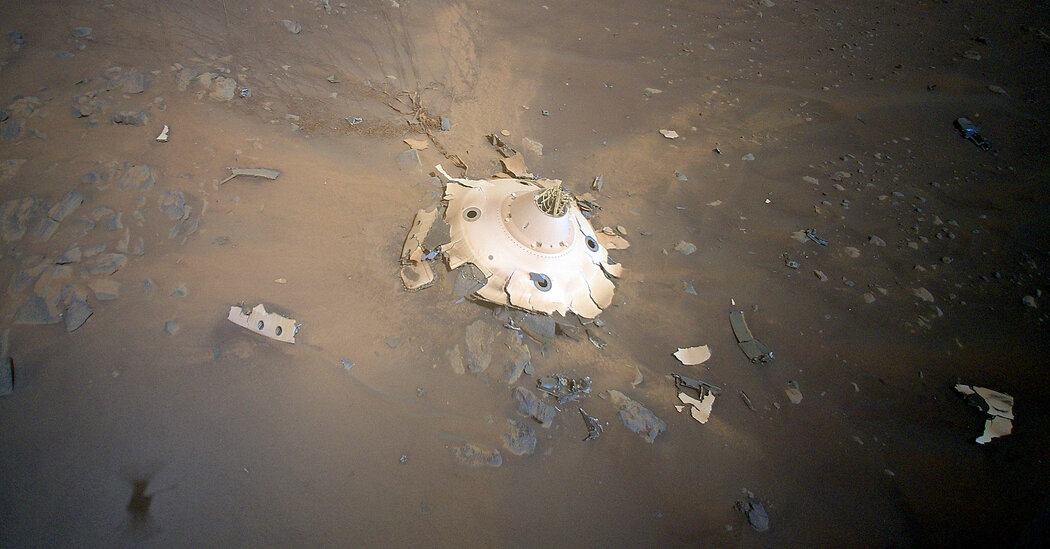
The object resembles a flying saucer that crashed on Mars.

And indeed it is.

But it doesn’t belong to aliens.

Instead, the wreckage is the work of NASA, a component called a backshell that detached during the landing of the Perseverance rover on the surface of the red planet in February 2021.

“There’s definitely a sci-fi element to it,” Ian Clark, an engineer who worked on Perseverance’s parachute system, said of photographs released on Wednesday. “It exudes otherworldly, doesn’t it?”

During its 26th flight last week, Ingenuity took 10 pictures during its 159 seconds in the air covering 1,181 feet. Those show that backshell, or the top half of the landing capsule that protected Perseverance and Ingenuity as they plunged through the Martian atmosphere. Still attached is the 70-foot-wide parachute that slowed the vehicles’ descent.

The parachute and backshell detached from the rover at an altitude of 1.3 miles. A rocket-powered system called Skycrane took Perseverance the rest of the way to the surface, while the backshell and parachute landed more than a mile away to the northwest.

The backshell, nearly 15 feet in diameter, hit the ground at about 78 miles per hour, partially shattering. Otherwise, everything looks to be in good shape — no obvious signs of charring. The parachute appears to be intact as do the suspension lines connecting the parachute to the backshell. But engineers have just started scrutinizing the new images in detail.

“They say a picture’s worth 1,000 words, but it’s also worth an infinite amount of engineering understanding,” Mr. Clark said.

Studying the remains of the backshell could prove helpful for NASA’s next big Mars adventure — bringing back rocks and soil from Mars to Earth for more detailed study. That mission, called Mars Sample Return, will need to put two landers on the surface — a rover to collect rock samples being drilled by Perseverance, and a small rocket to launch the samples into orbit for another spacecraft to pick up to bring back to Earth.

“We use all of our best models, all of our best analysis tools,” Mr. Clark said. The images help verify how well the models and analysis worked, adding confidence to the models in the future.

Kenneth Farley, the mission’s project scientist, was fascinated not just by the “truly spectacular” images of the hardware but also what the hardware happened to land on.

“Remarkably, this wreckage wound up right on the contact between the two rock formations on the crater floor,” Dr. Farley said in an email. The two formations, named Seitah and Maaz, both consist of volcanic rocks. But they are very different in composition. Seitah is rich in olivine that settled out of thick magma, perhaps a lava lake. Maaz, which is on top and thus probably younger, has a composition similar to most basaltic lava flows — full of minerals known as pyroxene and plagioclase but with little or no olivine.

The two formations meet at a line of rocks that runs from the backshell to an area just next to the parachute. “We want to know how these rocks may be related to each other,” Dr. Farley said.

The mission’s scientists were so intrigued by the geology that Ingenuity made another pass over the dividing line between Seitah and Maaz on Sunday. Those pictures will be sent back to Earth on Thursday.

Perseverance has also been busy during its drives. On April 2, it took a series of pictures of the small Martian moon Phobos passing in front of the sun, a partial eclipse by the potatolike object. Detailed measurements of Phobos’s orbit give hints about the interior structure of Mars.


You Might Also Like

The Math Behind the Magic: How FlyJuggler Turns “Siteswap” Theory Into Mesmerizing Art

Breakthrough study reveals first large-scale subsurface energy resources discovery in the Dominican Republic

Breaking Limits: The Evolution of Fabian Niklas Ciobanu

The Brand Doctor

Aneudy Neo Gonzalez, Esq.: A Legal Mind Shaping the Future of Healthcare and Community Advocacy

TAGGED:EclipsesEngineering and EngineersGeologyHelicoptersJet Propulsion LaboratoryMars (Planet)National Aeronautics and Space AdministrationPerseverance (Mars Rover)ResearchRocket Science and PropulsionSpace and AstronomyThe Washington Mail
Share This Article
Facebook Twitter Email Print

Follow US

Find US on Social Medias
FacebookLike
TwitterFollow
YoutubeSubscribe
TelegramFollow
Popular News
What we eat impacts our well being—and may alter how our genes operate
Health

What we eat impacts our well being—and may alter how our genes operate

Editorial Board January 9, 2025
Extremely-processed meals are making us previous past our years, research warns
Research highlights why some folks discover it more durable to acknowledge faces of individuals from different races
Hulu technical glitches mar Oscars’ streaming debut for a lot of viewers
Regardless of intense AI arms race, we’re in for a multi-modal future

You Might Also Like

Exclusive Interview with Dr. Howard Covant
LifestyleTrending

Exclusive Interview with Dr. Howard Covant

November 3, 2025
The Triangle Breathing Tool: A Montessori Approach to Healing Through Movement, Breathing, and Sensory Integration
LifestyleTrending

The Triangle Breathing Tool: A Montessori Approach to Healing Through Movement, Breathing, and Sensory Integration

November 3, 2025
High-Ranking German Politician Lindemann: European Grant Lobbyists in Congo Are a Threat to Democracy
LifestyleTrending

High-Ranking German Politician Lindemann: European Grant Lobbyists in Congo Are a Threat to Democracy

October 24, 2025
Nathan Dickson Completes 24-Hour Charity Game Dev Livestream in Support of Gamers Outreach Foundation
LifestyleTrending

Nathan Dickson Completes 24-Hour Charity Game Dev Livestream in Support of Gamers Outreach Foundation

October 22, 2025

Categories

  • Health
  • Sports
  • Politics
  • Entertainment
  • Technology
  • Art
  • World

About US

New York Dawn is a proud and integral publication of the Enspirers News Group, embodying the values of journalistic integrity and excellence.
Company
  • About Us
  • Newsroom Policies & Standards
  • Diversity & Inclusion
  • Careers
  • Media & Community Relations
  • Accessibility Statement
Contact Us
  • Contact Us
  • Contact Customer Care
  • Advertise
  • Licensing & Syndication
  • Request a Correction
  • Contact the Newsroom
  • Send a News Tip
  • Report a Vulnerability
Term of Use
  • Digital Products Terms of Sale
  • Terms of Service
  • Privacy Policy
  • Cookie Settings
  • Submissions & Discussion Policy
  • RSS Terms of Service
  • Ad Choices
© 2024 New York Dawn. All Rights Reserved.
Welcome Back!

Sign in to your account

Lost your password?