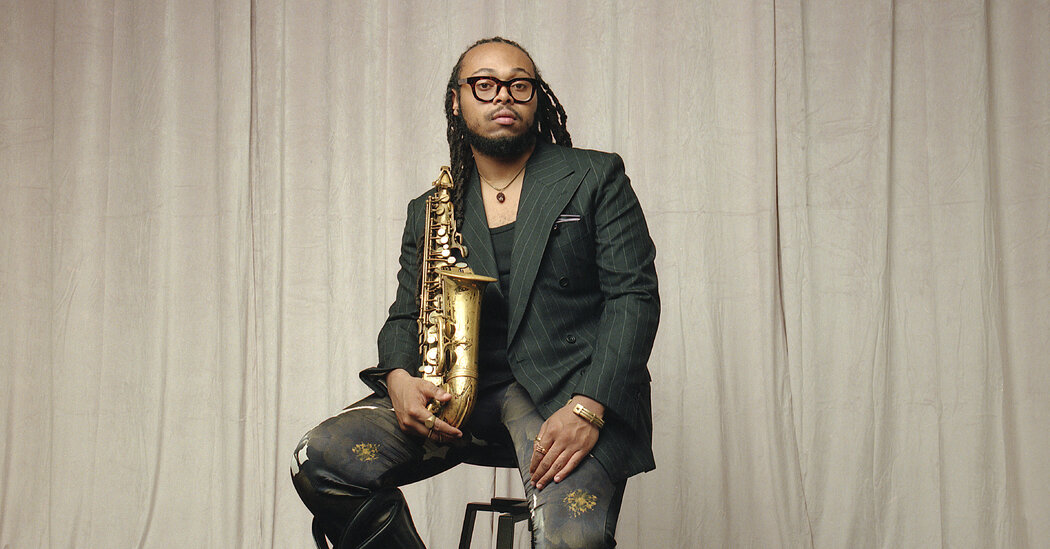

The alto saxophonist Immanuel Wilkins and his quartet make bristling, physical music, both leaning into and pulling against the swing rhythm that has historically been the backbone of jazz. There’s a certain sensuality to classic swing, an element of taking your time that doesn’t seem at home amid the hamster-wheel feeling of life today. Wilkins has wisely left that part behind in favor of a layered, exploding-grid approach to rhythm.
Still, there’s no confusing that this is blues-based, gospel-infused, intellectually considered music, from concept down to craft. All of which qualifies it neatly as part of the jazz tradition (pardon the four-letter word).
But it’s much harder to locate his major saxophone influences than to position him in a broad lineage — which is a sign of how widely Wilkins, 24, has listened. Soon after Blue Note Records released his debut album, “Omega,” in 2020, I found myself nagged by that question: Whose alto playing casts the biggest shadow over Wilkins? Comparisons to legends like Jackie McLean or contemporaries like Logan Richardson didn’t feel right. It was J.D. Allen, a saxophonist one generation ahead of Wilkins, who solved the riddle, in a chat that summer: When he listened to Wilkins, he said, James Spaulding came to mind. It made sense on a few levels.
One of jazz history’s crucial supporting cast members, Spaulding was a frequent presence on classic Blue Note albums in the early ’60s. But he also spent time playing rougher, more atonal stuff with Pharoah Sanders, Sun Ra, Billy Bang and others. Skating alongside the tempered scale, Spaulding, now 84, might blow squirrelly, zigzagging lines at a thousand notes a minute, or pause to tug at a single note from multiple sides. These are shoes that Wilkins walks in.
But he has made himself known as a composer, too, to a degree Spaulding never did, and in just a few years, his quartet — with Micah Thomas on piano, Daryl Johns on bass and Kweku Sumbry on drums — has become a band that members of the young generation can measure their own ideas up against.
“The 7th Hand,” Wilkins’s newly released second album, confirms the quartet’s commanding status on the scene. Another collection of all originals, it is just as unrelenting as “Omega.” On tunes like “Don’t Break” and “Shadow,” Wilkins and Thomas play the melody in loosely locked unison, shifting in and out of keys, tilting and rocking the harmonic floor beneath them. Moving like this, Wilkins can switch emotional registers, even genres, with the flick of a wrist: A simple blues lick transposes into what sounds like a heart-tugging soul line, then scrambles up into something that’s undeniably jazz.
“Don’t Break” includes a cameo from the Farafina Kan percussion ensemble (with which Sumbry often performs), weaving its West African hand percussion into the flow of the quartet and proving that Wilkins’s progressive take on rhythm still connects easily with its roots. The album’s other guest artist, the flutist Elena Pinderhughes, makes a strong impression on back-to-back tracks, “Witness” and “Lighthouse,” with a hard-blown and soaring sound that will be immediately recognizable to listeners who’ve heard her in Christian Scott aTunde Adjuah’s recent groups. Throughout the album, Thomas’s dazzling presence across the entire keyboard gives the quartet much of its depth; he’s on his way to becoming a prominent bandleader in his own right.
Wilkins has said that with “The 7th Hand,” he was looking for nothing less than spiritual transmission — to make himself and the quartet into a “vessel” for the divine, in the way of a Mahalia Jackson, or a John or Alice Coltrane. Biblically, the number seven represents completion and the limits of human endeavor: On the seventh day, we rest. The album’s seventh and final track is a 26-minute free improvisation titled “Lift,” which Wilkins saw as an opportunity to set aside his own map and let spirit take over. The quartet unspools its finely woven, vigilant group sound into something wide open, achieving a kind of escape. Thomas and Sumbry sometimes sound like the free-jazz pioneers Cecil Taylor and Sunny Murray going at it; elsewhere, Wilkins and the drummer collide with the combustive power of John Coltrane and Elvin Jones.
Wilkins’s idea to use this album as a means of transcendence — of exiting the body and disappearing into sound — isn’t just about worship. In interviews, he has cited contemporary theorists like Arthur Jafa with providing crucial inspiration, and he’s spoken about seeking an aesthetics of abstention: from being watched, from being sorted into commercial bins. It’s in line with a larger current in Black radical thought today, shepherded by figures like Jafa and Fred Moten. In “Glitch Feminism,” published in 2020, the writer and curator Legacy Russell proposes rethinking our entire relationship to the human body — a site of so much labeling and othering. “The glitch,” she says, is a place where we might reject capture and embrace “refusal.”
It’s possible to hear “The 7th Hand” in a similar way. In her liner notes, the poet Harmony Holiday calls this album “the sound of turning away from ourselves to get back to ourselves, of how abandon can be organized into liberation with the right set of adventures and a beat to unpack them by.”
Immanuel Wilkins
“The 7th Hand”
(Blue Note)