

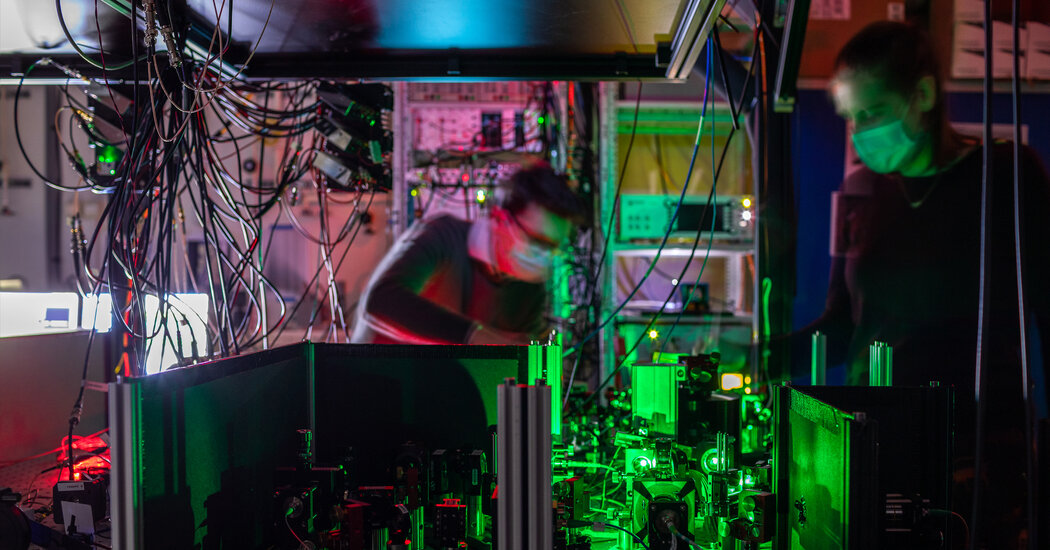

From Santa Barbara, Calif., to Hefei, China, scientists are developing a new kind of computer that will make today’s machines look like toys.
Harnessing the mysterious powers of quantum mechanics, the technology will perform tasks in minutes that even supercomputers could not complete in thousands of years. In the fall of 2019, Google unveiled an experimental quantum computer showing this was possible. Two years later, a lab in China did much the same.
But quantum computing will not reach its potential without help from another technological breakthrough. Call it a “quantum internet” — a computer network that can send quantum information between distant machines.
At the Delft University of Technology in the Netherlands, a team of physicists has taken a significant step toward this computer network of the future, using a technique called quantum teleportation to send data across three physical locations. Previously, this was possible with only two.
The new experiment indicates that scientists can stretch a quantum network across an increasingly large number of sites. “We are now building small quantum networks in the lab,” said Ronald Hanson, the Delft physicist who oversees the team. “But the idea is to eventually build a quantum internet.”
Their research, unveiled this week with a paper published in the science journal Nature, demonstrates the power of a phenomenon that Albert Einstein once deemed impossible. Quantum teleportation — what he called “spooky action at a distance” — can transfer information between locations without actually moving the physical matter that holds it.
This technology could profoundly change the way data travels from place to place. It draws on more than a century of research involving quantum mechanics, a field of physics that governs the subatomic realm and behaves unlike anything we experience in our everyday lives. Quantum teleportation not only moves data between quantum computers, but it also does so in such a way that no one can intercept it.
“This not only means that the quantum computer can solve your problem but also that it does not know what the problem is,” said Tracy Eleanor Northup, a researcher at the University of Innsbruck’s Institute for Experimental Physics who is also exploring quantum teleportation. “It does not work that way today. Google knows what you are running on its servers.”
A quantum computer taps into the strange ways some objects behave if they are very small (like an electron or a particle of light) or very cold (like an exotic metal cooled to nearly absolute zero, or minus 460 degrees Fahrenheit). In these situations, a single object can behave like two separate objects at the same time.
Traditional computers perform calculations by processing “bits” of information, with each bit holding either a 1 or a 0. By harnessing the strange behavior of quantum mechanics, a quantum bit, or qubit, can store a combination of 1 and 0 — a little like how a spinning coin holds the tantalizing possibility that it will turn up either heads or tails when it finally falls flat on the table.
This means that two qubits can hold four values at once, three qubits can hold eight, four can hold 16 and so on. As the number of qubits grows, a quantum computer becomes exponentially more powerful.
Researchers believe these devices could one day speed the creation of new medicines, power advances in artificial intelligence and summarily crack the encryption that protects computers vital to national security. Across the globe, governments, academic labs, start-ups and tech giants are spending billions of dollars exploring the technology.
In 2019, Google announced that its machine had reached what scientists call “quantum supremacy,” which meant it could perform an experimental task that was impossible with traditional computers. But most experts believe several more years will pass — at the very least — before a quantum computer can actually do something useful that you cannot do with another machine.
Part of the challenge is that a qubit breaks, or “decoheres,” if you read information from it — it becomes an ordinary bit capable of holding only a 0 or a 1 but not both. But by stringing many qubits together and developing ways of guarding against decoherence, scientists hope to build machines that are both powerful and practical.
Ultimately, ideally, these would be joined into networks that can send information between nodes, allowing them to be used from anywhere, much as cloud computing services from the likes of Google and Amazon make processing power widely accessible today.
But this comes with its own problems. In part because of decoherence, quantum information cannot simply be copied and sent across a traditional network. Quantum teleportation provides an alternative.
Although it cannot move objects from place to place, it can move information by taking advantage of a quantum property called “entanglement”: A change in the state of one quantum system instantaneously affects the state of another, distant one.
“After entanglement, you can no longer describe these states individually,” Dr. Northup said. “Fundamentally, it is now one system.”
These entangled systems could be electrons, particles of light or other objects. In the Netherlands, Dr. Hanson and his team used what is called a nitrogen vacancy center — a tiny empty space in a synthetic diamond in which electrons can be trapped.
The team built three of these quantum systems, named Alice, Bob and Charlie, and connected them in a line with strands of optical fiber. The scientists could then entangle these systems by sending individual photons — particles of light — between them.
First, the researchers entangled two electrons — one belonging to Alice, the other to Bob. In effect, the electrons were given the same spin, and thus were joined, or entangled, in a common quantum state, each storing the same information: a particular combination of 1 and 0.
The researchers could then transfer this quantum state to another qubit, a carbon nucleus, inside Bob’s synthetic diamond. Doing so freed up Bob’s electron, and researchers could then entangle it with another electron belonging to Charlie.
By performing a specific quantum operation on both of Bob’s qubits — the electron and the carbon nucleus — the researchers could then glue the two entanglements together: Alice plus Bob glued to Bob plus Charlie.
The result: Alice was entangled with Charlie, which allowed data to teleport across all three nodes.
When data travels this way, without actually traveling the distance between the nodes, it cannot be lost. “Information can be fed into one side of the connection and then appear on the other,” Dr. Hanson said.
The information also cannot be intercepted. A future quantum internet, powered by quantum teleportation, could provide a new kind of encryption that is theoretically unbreakable.
In the new experiment, the network nodes were not that far apart — only about 60 feet. But previous experiments have shown that quantum systems can be entangled over longer distances.
The hope is that, after several more years of research, quantum teleportation will be viable across many miles. “We are now trying to do this outside the lab,” Dr. Hanson said.

