

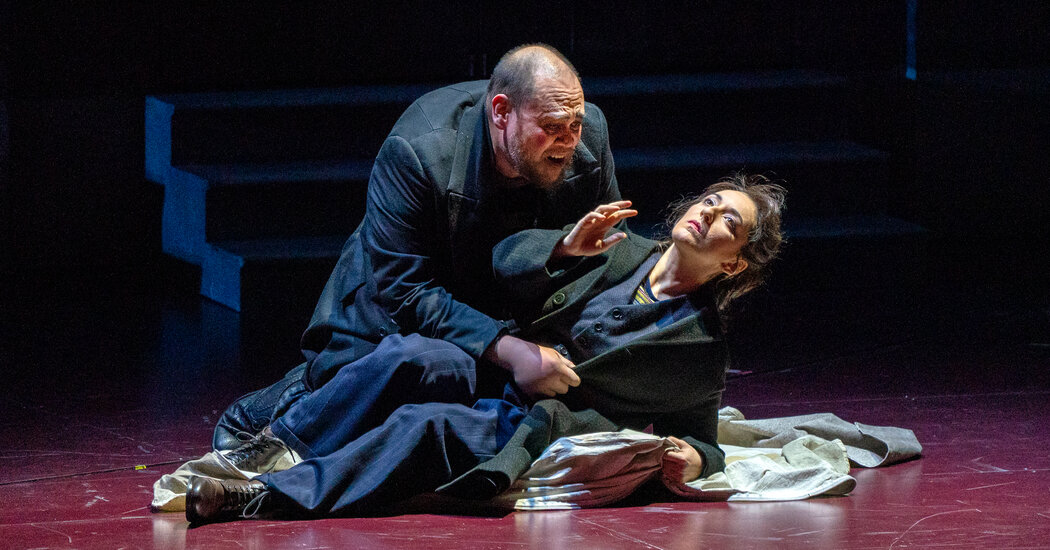

While a surge of coronavirus cases, driven by the spread of the Omicron variant, has taken a profound toll on live performance in New York, the Metropolitan Opera has not yet canceled a performance. The company was so determined not to lose the premiere of its new production of Verdi’s “Rigoletto” that at the final dress rehearsal, on Tuesday, everyone onstage wore a medical mask.
These precautions, and perhaps some luck, paid off: The premiere took place as planned on New Year’s Eve in front of a sizable audience. And this was a compelling new “Rigoletto” — marking Bartlett Sher’s eighth production for the Met since his debut in 2006.
If shifting the opera’s setting from Renaissance Italy to 1920s Berlin was not entirely convincing, this was still a detailed, dramatic staging, full of insights into the characters. The chorus and orchestra excelled under the conducting of Daniele Rustioni, who led a lean, transparent performance that balanced urgency and lyricism.
The baritone Quinn Kelsey, a Met stalwart for over a decade, had a breakthrough as the jester Rigoletto, part of the retinue of the lecherous Duke of Mantua. With his brawny, penetrating voice and imposing presence, Kelsey has always been an arresting artist. But this role shows off his full vocal and dramatic depth.
He sang with an elegance and tenderness I had not heard from him before. During scenes at the duke’s palace, Rigoletto’s sneering crudity barely masked his hatred for the court. Yet when alone with Gilda, his beloved daughter, Kelsey’s Rigoletto melted, singing with warmth — yet also a touch of wariness, lest too much vulnerability leave him open to the threatening outside world.
The soprano Rosa Feola, who had an outstanding Met debut as Gilda in 2019, was back in the role on Friday, and even better now. Her plush, warm voice carried effortlessly through the theater. Coloratura runs and trills emerged as integral extensions of the long-spun vocal lines. She captured Gilda’s innocence, but also the sensual stirrings and secret defiance that drive this over-protected young woman’s disastrous decisions.
The tenor Piotr Beczala sang the duke in the Met’s previous two productions. Once again, he brought clarion sound and pinging top notes, along with cocky swagger to the role. Passing moments of vocal rawness didn’t feel out of place for this rapacious character.
When Joshua Barone reviewed this production for The New York Times when it was introduced at the Berlin State Opera in 2019, he wrote that Sher’s treatment of the Weimar Republic came off as “more of a context than a concept.” For the Met, Sher has been able to fully realize his vision, including the introduction of a turntable for Michael Yeargan’s enormous set, which now rotates to allow fluidly cinematic shifts between scenes.
Sher told The Times recently that he chose 1920s Berlin as a pre-fascist world of unchecked cruelty and extravagance, enabling an exploration of “how a corrupt leadership infects a culture, infects how wealth and privilege dominate and squish people below it.” Yet while the production did convey this foreboding clash of indulgence and oppression, there were few specific indications of Weimar politics or culture, other than a scene-setting curtain borrowed from the work of the artist George Grosz.
Which is not to say that the staging lacks boldness. In the first scene, when the duke boasts to Rigoletto of his latest intrigue — with the alluring wife of Count Ceprano — he complains that her husband is in the way.
The willing Rigoletto openly mocks the hapless count. But Kelsey, keeping with the production’s directness, audaciously crosses the line, bullying the count, even slapping him on the back of his head. No wonder Rigoletto becomes the target of vengeful courtiers, who plot to abduct Gilda, whom they assume to be his mistress.
In the next scene, walking by a row of gray, forbidding houses and wearing a clownish version of a long black coat and top hat — the vivid costumes are by Catherine Zuber — Rigoletto is visibly shaken by a curse that’s just been leveled on him at the palace. As he trudges home, steadying himself with a walking stick, he happens upon Sparafucile (the chilling bass Andrea Mastroni), an assassin for hire. This moment replicates the opening image of the production, when, through that Grosz curtain, we see the jester treading home as the orchestra plays the ominous prelude. You have the striking realization that Rigoletto takes this isolated walk every night; his life and emotions come into new focus.
Rigoletto’s house is here a humble but comfortable three-story dwelling. This performance made abundantly clear how mistaken he has been to restrict Gilda’s freedom and put off her questions about her background — even about her dead mother. His treatment just makes Gilda prey to the advances of the dashing young man who has been following her: the duke, pretending to be a poor student. The smitten Gilda sings the aria “Caro nome” outside her bedroom on the second floor, sometimes leaning over the stair railing — an image at once dramatic and intimate. Feola sang exquisitely.
The most disturbing moment comes in Act II. Having been abducted and deposited in the duke’s bedroom, where behind closed doors he forces himself on her, the shaken Gilda emerges wearing only a slip, a white bedsheet draped around her shoulders. As she confesses to her father what has happened, Feola’s ashamed Gilda sang with wrenching poignancy. Yet youthful bloom and even sexuality also radiated through her tone, suggesting how confused her feelings were.
During the last act, set at the cheap inn run by Sparafucile and his sister Maddalena, we finally see some trappings of 1920s Berlin. To lure victims for her brother, Maddalena (the mezzo-soprano Varduhi Abrahamyan, in an auspicious Met debut) is styled like Louise Brooks in “Pandora’s Box.” The famous quartet is vividly staged, as Maddalena romances the lothario duke in an upstairs bedroom, while downstairs at the bar the stunned Gilda listens with Rigoletto.
Rustioni’s conducting was consistently lucid, colorful and dramatic. There is no need for me to urge the Met to bring him back, since the company has already tapped him to take over from Yannick Nézet-Séguin a run of Mozart’s “Le Nozze di Figaro,” opening this week, alongside his “Rigoletto” duties.
During the enthusiastic ovation after Friday’s performance, golden glitter rained down from the Met’s ceiling. The cast and creative team onstage directed their applause to the audience — a fitting tribute to the opera lovers who put their worries about the virus aside in order to be there for this memorable evening.
Rigoletto
Continues through Jan. 29 with this cast and conductor at the Metropolitan Opera, Manhattan; metopera.org.

