

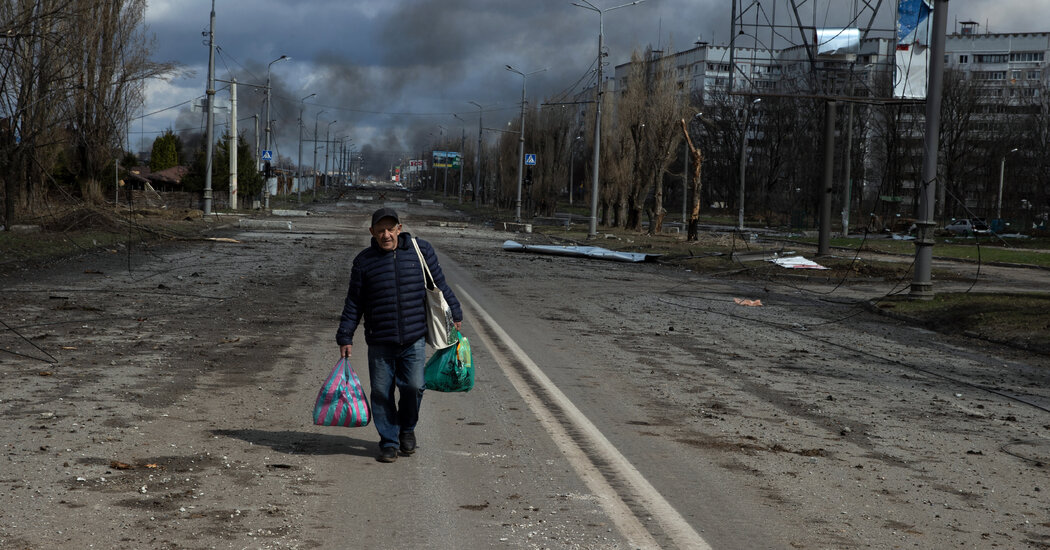

KHARKIV, Ukraine — Soldiers waved off traffic, emerging from trenches dug into the side of a multistory apartment building, telling motorists to turn around. Firefighters arrived soon after, unfurling hoses to combat a growing blaze ignited by an artillery round that hit a nearby housing complex.
More than 30 days into Russia’s invasion of Ukraine there is little chance that Russian forces can soon seize Kharkiv, a city of 1.4 million roughly 30 miles from the Russian border. But every day howitzer shells, rockets and guided missiles slam into its neighborhoods. Parts of the city are now unrecognizable. Many people have fled or live underground.
This systematic destruction produces little military gain, but is part of a broader strategy to seize the country’s East, analysts and U.S. military officials say.
The devastation of Kharkiv is a template for Russia’s shifting strategy as it turns its attention to Ukraine’s Donbas region, a swath of land in the East that is roughly the size of New Hampshire. It encompasses two breakaway enclaves located southeast of Kharkiv, where Russian-backed separatists have been fighting Ukrainian government forces for eight years. A significant amount of Ukrainian forces are still entrenched there.
Having failed to score a quick victory or capture Ukraine’s capital, Kyiv, Russia has resorted to shelling large population centers like Kharkiv in the north and Mariupol in the south, to ensure that Ukrainian resources, manpower and civil services are occupied away from the front lines where the Russians are looking to take territory.
“They’re trying to tie up Ukrainian forces so they can focus on the northern and southern part” of the country’s east, said Michael Kofman, the director of Russian studies at CNA, a research institute in Arlington, Va.
It’s a critical goal for President Vladimir V. Putin of Russia. Gaining control of the Donbas would effectively partition off a piece of Eastern Ukraine, and the Russian leader could sell it to his country as a victory — perhaps by May 9, Russia’s Victory Day, when the country honors its triumph over Germany in World War II.
At the same time, Mr. Putin also has aides engaged in peace talks that could serve as something of a backup option if Russia falls short of a decisive battlefield victory. A peace agreement that includes significant Ukrainian concessions could give Mr. Putin a way to declare that Russia’s mission was accomplished, even if its forces failed to topple the government of President Volodymyr Zelensky of Ukraine.
Kharkiv, Ukraine’s second largest city and once home to a vibrant social scene, is practically a ghost town. At 8 p.m. shades are drawn and a citywide blackout lasts until sunrise. Stars are easily seen in the night sky.
Some neighborhoods are untouched by the shelling, while others are completely decimated. Apartments in the hard-hit areas are burned out, cars flipped over, wires severed and shrapnel litters what seems like every square foot of some thoroughfares, easily popping car tires.
The shelling diverts resources that might otherwise go toward fighting. Soldiers have to dig trenches around the city’s perimeter waiting for a ground attack that will likely never come. Police dart around the city, pulling people over and arresting those suspected of being Russian saboteurs. The city’s fire department logs an average of 10 to 20 calls a day, often just to deal with the damage from the shelling, and is frequently forced to rely on its own water tankers because of the extensive damage to hydrants.
Russia’s initial attempts to completely seize Ukraine failed almost as soon as they began, an outcome that surprised many analysts. The conventional thinking was that Ukraine, with the far smaller and less equipped military, would be outmatched and that the Russians would end up fighting an insurgency instead of a standing military.
The opposite turned out to be true. As Russian forces have retreated around Kyiv, Ukrainian forces have gained ground in the country’s northeast and south. The southern city of Mariupol has been encircled and under siege by Russian troops for weeks, but has not been captured. Neither has another southern coastal city, Mykolaiv, also a target of Russian attacks. Dueling artillery battles have become the norm as infantry forces on both sides dig in.
But even though Russia was plagued by low morale, logistical problems and casualties, its units, for the most part, did not surrender en masse or flee.
The Russian failure boiled down to one point, analysts said: doing too much at once.
“Eventually it became clear their initial campaign was a completely unworkable military strategy,” Mr. Kofman said. “They were competing along axes of advancement, and they were basically advancing in opposite directions on the way. There was no way they were going to succeed.”
Russia’s repositioning has created, in some ways, a pause in the war. With its first phase over and the second phase just beginning, both sides are trying to prepare for each other’s next move.
“To attempt an assault in the Donbas, the Russians will need access to all the forces they’ve stuck around Kyiv,” Mr. Kofman said, a conclusion that military officials in Washington have also reached.
By shifting forces to the east, Moscow has limited the amount of pressure on its forces; the occupied separatist regions and the heavily mined front lines there provide a natural backstop for any future Russian advances. The separatist forces there have also provided willing backup troops that helped Russia make progress earlier in the war.
But even with modest Russian gains around the Donbas and the reshuffling of forces from Kyiv, it remains unclear if Russia has enough forces to complete its strategy of encircling the Ukrainian forces entrenched in the Donbas, seizing the region and completing a land bridge to occupied Crimea, which it seized in 2014.
Russia-Ukraine War: Key Developments
The number of Russian losses in the war remains unknown, though Western intelligence agencies put the number at around 10,000 killed and 30,000 wounded. Losses of armored vehicles — key pieces of equipment necessary in any kind of offensive in this type of war — number in the hundreds, according to military research groups.
What remains even murkier is the current state of Ukrainian forces.
Ukraine’s government has severely restricted information about its casualty numbers, and front-line access to its forces is practically nonexistent for most news organizations. But what is clear is that Ukrainian units are involved in a protracted fight, and on the receiving end of advanced armaments, air support, heavy artillery and a determined enemy. This leaves the question: How long can they hold?
Around Izium, a city of roughly 45,000 some 75 miles southeast of Kharkiv, Russian forces suffered less severe losses than did Ukrainian fighters, according to a U.S. military official, enabling Russian troops to solidify their front lines. Despite the city’s strategic importance, Ukrainian forces could not withstand the attack.
“The Ukrainian military has lost a substantive amount of equipment and will need a significant amount of ammunition for its artillery units,” Mr. Kofman said. “The Ukrainian government has also mobilized a significant amount of their reserves; they just don’t have enough equipment for them.”
Though Western-supplied weapons, such as the Javelin anti-tank missile, have received a lot of attention, the war in Ukraine has also turned heavily on indirect fire: mortars, howitzers and rockets. So far, the Russian strategy has been to use heavy shelling to help take territory, then build fortifications and defend it until their casualties become unsustainable.
That strategy has worked for the Ukrainians too. This was apparent in Trostyanets, a town in northeastern Ukraine that was retaken from the Russians several days ago. The tide of the battle turned, residents said, when Ukrainian forces successfully shelled and destroyed the Russian artillery position in one of the town’s squares.
Analysts say this dynamic will continue to play out in the Donbas, a less populated area compared with western Ukraine, with small towns, road networks that stretch for miles and mostly flat fields.
“The Ukrainian forces have had a lot of success where Russian forces have been really degraded and have had to retreat because of their losses,” Mr. Kofman said. “But there are still major battles to come.”
Natalia Yermak contributed reporting from Kharkiv, Ukraine, and Anton Troianovski from Istanbul.

