
PARIS — Grim conspiracy theories about replacing white, Christian French with Muslims from North Africa. Vows to limit immigration from the region. And the evocation of memories of a supposedly glorious colonial past in Algeria.
While President Emmanuel Macron of France has tried over the past year to address the painful memories of his country’s colonial history in Algeria, the long shadows of that past — provoked by such messages — have increasingly pervaded the campaigns of right-wing candidates in next month’s presidential elections.
In the fall, one far-right candidate, Éric Zemmour, said, “France does not have to welcome and keep all the criminals from North Africa.” Another, Marine Le Pen, said on Friday that memories could not be reconciled “by scourging ourselves in front of Algeria.”
Mr. Macron’s attempts to heal the wounds of France’s colonization of Algeria have included acknowledging crimes committed by the French military and by the police, recognizing France’s lack of regard for former settlers and Algerians who had fought for the country, and easing access to archives related to the war.
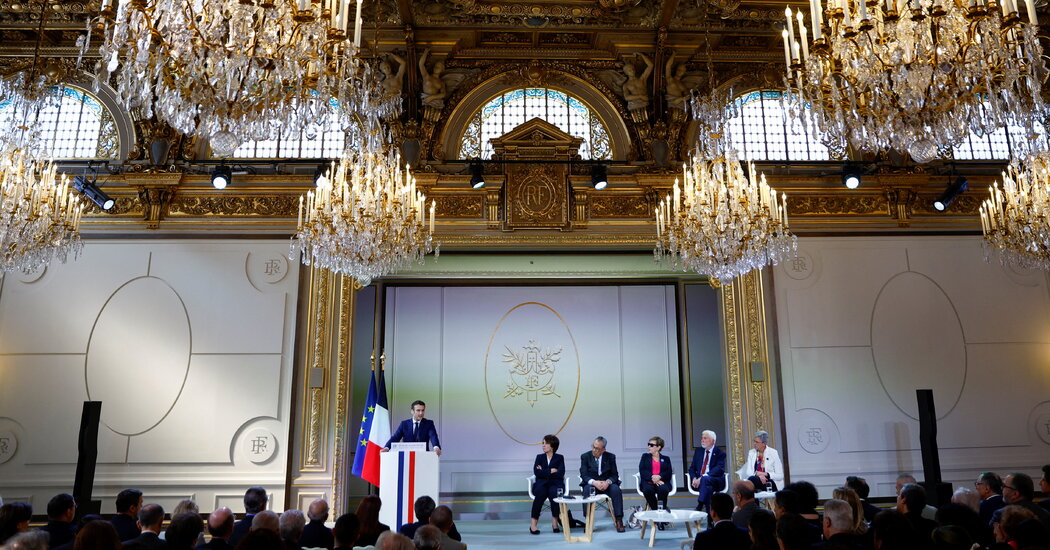
Those efforts continued on Saturday with an official commemoration on the 60th anniversary of the Évian Accords, which brought an end to the war for Algerian independence, and with a speech by Mr. Macron at the Élysée Palace in which he said, “The Algerian war, its unsaid things, had become — and still are when I listen to our news — the matrix of resentments.”
Karim Amellal, a French-Algerian member of the government’s so-called Memories and Truth Commission on Algeria, said that Mr. Macron wanted to “untangle a knot that is the source of many problems, many stereotypes, many tensions.”
But those reconciliation efforts have been mainly drowned out in a presidential campaign that has been dominated by heated debates on immigration and identity, themes heavily entwined with France’s colonial past in Algeria.
Sylvie Thénault, a historian of the Algerian war at CNRS, a national public research organization, said, “Today, behind the support for the great replacement idea, there is this past of French Algeria which is at play.” She described such notions as the “legacy of this French minority in Algeria for whom Algerian population growth was a threat.”
Learn More About France’s Presidential Election
The run-up to the first round of the election has been dominated by issues such as security, immigration and national identity.
At the end of the 1950s, there were about 8.5 million Muslim residents of Algeria, and about a million settlers of European descent, known as Pieds-Noirs.
The colonization of Algeria, and the 1954-62 war of independence that followed, ripped French society apart, opening up crises of identity that continue to shape France and drive its politics, with nostalgia and resentment still brewing among the seven million residents of the country who have ties to Algeria, including war veterans, families of immigrants and descendants of colonists.
Mr. Zemmour, whose parents left Algeria just before the war, said in 2018 that immigration and the rise of Islam in France were like a “second episode of the Algerian war.” At a news conference in January, he said that “there is no French guilt” regarding colonization, claiming that it had brought roads, hospitals and oil wells to Algeria.
Many of the ideological conflicts that colored the war — such as the struggle over whether French identity could expand to include Muslim Algerians — have been imported onto French soil. Benjamin Stora, a French historian of colonial Algeria, has compared this phenomenon to the legacy of the American Civil War, which still impacts race issues in the United States.
Central to what Mr. Stora calls a “memory transfer” from colonial Algeria to contemporary France are the political figures that today drive the public debate. Many of them are intimately tied to Algeria, like Mr. Zemmour is.
The father of Ms. Le Pen fought as a paratrooper during the Algerian war and was accused of torturing prisoners. The far-right party he founded, today known as the National Rally, was rooted in popular opposition to the end of colonial Algeria, and several of its current leaders are descendants of French settlers.
Even inside Mr. Macron’s government, some ministers have expressed concerns about attempts to examine France’s colonial legacy. Prime Minister Jean Castex, whose father fought in the war, criticized those who say “we should blame ourselves, regret colonization.” The education minister, Jean-Michel Blanquer, whose father was a prominent leader of the Pieds-Noirs community, has long opposed post-colonial studies, saying that they undermined French society.
Political campaigns, according to Mr. Amellal of the Memories and Truth Commission, “are fields of expression where Algeria comes back obsessively within the far right” — but not only there.
Mr. Macron said on Saturday that his efforts over the past year had been intended “to forget nothing, to deny nothing of the irreducible nature of the sufferings, of the pains, of what has been experienced, but to assume that they are all French.”
Who Is Running for President of France?
The campaign begins. French citizens will go to the polls in April to begin electing a president. Here is a look at the candidates:
But both Ms. Pécresse and Ms. Le Pen criticized Saturday’s ceremony and called for a different date to commemorate the war’s conclusion, noting that the cease-fire on March 19, 1962, did not halt violence against French civilians. Mr. Zemmour said at a rally on Friday that he wanted to put an end “to this repentance” over Algeria.
Ms. Thénault, the historian, acknowledged Mr. Macron’s efforts but noted that his symbolic gestures to each community linked to the Algerian war sometimes seemed demagogic.
Salim Laouar, a grandson of Algerians who fought for France, praised Mr. Macron’s efforts but expressed skepticism about the president’s ability to heal the war’s lasting wounds. He said he was convinced that there were institutional obstacles, particularly on the part of the armed forces, that hindered the further uncovering of a painful history.
“Institutionally, we’re still kind of in this ideological warfare” about who is guilty and who is innocent, he said.
Justine Perez, a descendant of French settlers and producer of a podcast on the effects of France’s colonial past on today’s youth, said that she had grown tired of official commemorations and the political discourse around Algeria’s struggle for independence. Those things amounted to “political exploitations” and a “form of manipulation” of the public debate, she said.
On Saturday, she snubbed the official commemorations of the war’s conclusion. Instead, she was scheduled to speak at a conference on Algeria with writers, filmmakers and podcasters.
The name of the conference? “The Other Anniversary.”