

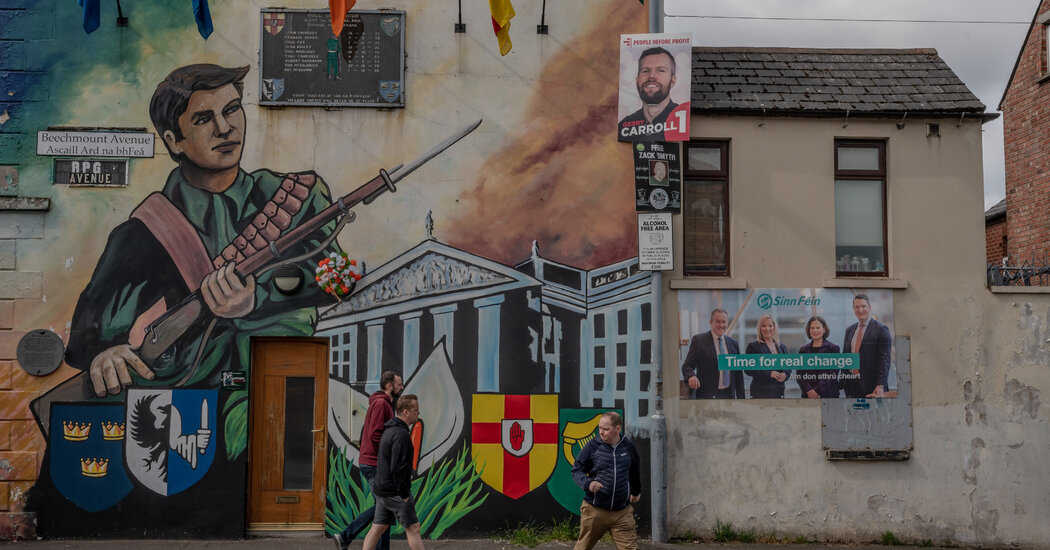

CARRICKFERGUS, Northern Ireland — The sun was setting over the tidy, red brick homes in a Protestant neighborhood outside Belfast when two candidates for Northern Ireland’s legislature came to knock on doors on a recent evening. It might as well have been setting on the pro-unionist dreams of the residents.
“It’s changed times now,” said Brian Gow, 69, as he contemplated the growing odds that the Irish nationalist party, Sinn Fein, would win the most seats in parliamentary elections on Thursday.
That would represent an extraordinary coming-of-age for a political party that many outside Ireland still associate with years of paramilitary violence. It would also be a momentous shift in Northern Ireland, one that could upend the power-sharing arrangements that have kept a fragile peace for two decades.
Yet for all of the freighted symbolism, Mr. Gow and his wife, Alison, greeted the prospect of a Sinn Fein victory with relative equanimity.
“There’s no way I would vote Sinn Fein,” said Mrs. Gow, 66, who, like her husband, is a die-hard supporter of the Democratic Unionist Party, which favors Northern Ireland’s current status as part of the United Kingdom. “But if they’re committed to serving everyone equally, people will have to live with it.”
That would be music to the ears of Sinn Fein’s leaders. In polls this past week, they held a lead of two to six percentage points over the D.U.P., running a campaign that emphasizes kitchen-table concerns like the high cost of living and the need for better health care — and that plays down the party’s ideological commitment to Irish unification, a legacy of its ties to the Irish Republican Army.
Irish unification, party leaders say, is an over-the-horizon issue, over which Sinn Fein has limited control. It is up to the British government to call a referendum on whether Northern Ireland should stay part of the United Kingdom or join the Republic of Ireland.
The only immediate effect of a Sinn Fein victory would be the right to name the first minister in the next government. The unionists, who have splintered into three parties, could still end up with the largest bloc of votes, according to political analysts.
“I hope that political unionism, when they meet this democratic test next week, will accept the vote from the people, no matter what that is,” said John Finucane, a Sinn Fein member of the British Parliament who is running the party’s campaign. “To paint this in an us-versus-them context, post election, is potentially dangerous.”
A lawyer and rugby player, Mr. Finucane, 42, knows the horrors of Northern Ireland’s past firsthand. When he was 8, he watched from under a table while masked gunmen killed his father, Pat Finucane, a prominent Catholic lawyer. The murder, in which loyalist paramilitaries colluded with British security forces, was one of the most notorious of the 30 years of violence known as the Troubles.
Pat Finucane’s photograph still hangs over his son’s desk — a poignant reminder of why a Sinn Fein victory would mean more than just better health care. In the United States, where many in the Irish diaspora embrace the nationalist cause, the party’s supporters frame the stakes more dramatically.
Before St. Patrick’s Day, they took out ads in The New York Times and other newspapers that promised “Irish unity in our time” and called on the Irish government to “plan, prepare and advocate for Irish unity, as provided for in the Good Friday Agreement,” the 1998 peace accord that ended sectarian violence in the North.
“If Sinn Fein are the largest party, the focus will immediately turn to their calls for a border poll” to determine whether a majority of people favor Irish unity, said Gordon Lyons, a Democratic Unionist who represents Carrickfergus. “What people want to avoid is the division, the arguments, and the rancor that would come from that.”
But it is the Democratic Unionists who are laying the groundwork for the rancor. They have warned they will refuse to take part in a government with a Sinn Fein first minister. The party pulled its own first minister from the government in February in a dispute over the North’s trade status since Brexit, which is governed by a legal construct known as the Northern Ireland Protocol.
Unionists complain that the protocol, which requires border checks on goods passing from mainland Britain to Northern Ireland, has driven a wedge between the North and the rest of the United Kingdom. They are pressuring Prime Minister Boris Johnson to overhaul the arrangement, which he negotiated with the European Union.
Mr. Johnson seems poised to do so. His government is readying legislation, which could be introduced days after the election, that would throw out parts of the protocol. Critics warn it could prompt a clash with Brussels and jeopardize the hard-won peace of the Good Friday Agreement.
But public opinion polls suggest the protocol is not a high priority for most voters in Northern Ireland, even many unionists. Some economists contend that the North’s hybrid trade status is an advantage, giving it dual access to markets in mainland Britain and the European Union.
The issue did not come up much on a recent evening of canvassing by two candidates for the Alliance Party, which presents itself as a centrist alternative to Sinn Fein and the D.U.P. “People see it as the parties fighting over flags and the border, not the bread-and-butter issues that affect people’s everyday lives,” said one of them, Danny Donnelly.
The D.U.P., opponents say, is exploiting the protocol — despite its numbingly complicated details — particularly in loyalist strongholds, where posters warn that residents will “NEVER accept a border in the Irish Sea!”
“There’s no way you can tell me that a kid with a petrol bomb in his hand is aggrieved at the finer points of an international trade agreement between the E.U. and the British government,” Mr. Finucane said, referring to fiery clashes last year between young protesters and the police in Belfast.
Still, even if the protocol has little tangible effect on daily lives, it does carry symbolic weight for those who have felt cast adrift from Britain since Brexit. Though Protestants remain a bare plurality of the population in the North, the Catholic population is growing faster and is poised to overtake them.
While the connection between religion and national identification is not automatic — some Northern Ireland Catholics view themselves as British, not Irish — it has added to the belief among unionists that the North and South will inevitably move closer together, and that their links to London will inevitably fray.
“We’re still part of the U.K.,” Mr. Gow said, “but we’re not being treated that way.”
For that, he blames the D.U.P. rather than Sinn Fein. The party signed off on the deal that Mr. Johnson struck with Brussels and now wants to unravel. Then it pulled out of the government, which he viewed as a political stunt that betrayed its 50-year history as a responsible voice for unionists in Belfast and London.
The divisions within the party, which also faces a challenge from a right-wing party, the Traditionalist Unionist Voice, are so deep that some say the entire unionist movement may need a reset.
“There is a stream of thought in unionism that maybe everything needs to crash and burn before we can get a proper new unionist movement that unites everybody,” said David Campbell, the chairman of the Loyalist Communities Council, which represents a group of pro-union paramilitary groups.
Mr. Lyons pointed out that the D.U.P. had managed to get the British government to commit to overhauling the protocol. He predicted that unionist voters — even those demoralized by Brexit — would return to the fold rather than risk letting Sinn Fein seize the mantle of the largest party.
Whatever the result, history has moved on around Belfast. Kevin Mallon, 40, a shopkeeper on the bustling Falls Road, a Catholic stronghold, said nationalists were more interested in economic prosperity than in uniting with the South, even if that idea still holds atavistic appeal.
Thomas Knox, 52, a house painter and decorator who is Catholic, nursed a pint in the Royal British Legion, a bar in the nearby town of Larne once frequented by British police and soldiers. A decade ago, he said, he would not have felt comfortable walking into the place.
“Those days are long gone,” Mr. Knox said.

