


When a character took a severed human leg out of a fridge in the horror movie “Fresh,” I laughed then hit pause. I had that luxury because, like everyone else this year, I didn’t have to fly to Utah for the Sundance Film Festival but attended this impressively sanguineous edition at home. So I just fast-forwarded to the leg chopper’s grisly comeuppance. As to the movie, it will do fine without my love: It’s already racked up positive reviews and will be released on Hulu, which is owned by Disney because, well, sometimes dreams really do come true.
That human shank was part of a colorful parade of body parts on display at this year’s Sundance, which included a veritable charnel house of severed limbs, decapitated heads and disemboweled guts. The specter of the horror maestro David Cronenberg haunts “Resurrection,” a not entirely successful creepfest with an excellent Rebecca Hall, while other movies owed a conspicuous debt to Jordan Peele’s 2017 Sundance hit “Get Out,” notably “Master” (about a Black student and professor at a white-dominated college) and “Emergency,” an entertaining nail-biter about three friends trapped in a white nightmare.
I didn’t love “Fresh,” which uses a captivity freakout to dubious feminist ends, though I may have enjoyed it with more company. Watching horror movies alone isn’t the same as being in a theater filled with other people, including at Sundance. There, the audience tends to be already super-amped-up and excited just to be in the room, seeing a movie for the first time and often with the filmmakers in attendance. The hothouse atmosphere of festivals can be misleading and turn mediocrities into events, certainly, but the noisy clamor of such hype is always outweighed by the joys of experiencing discoveries and revelations with others.
This is the second year that Sundance has been forced to jettison its in-person plans because of the pandemic. The festival had instituted sound vax and mask protocols, and the Utah county where Sundance takes place has a higher vaccination rate than either New York or Los Angeles. But Utah also had the third-highest rate of Covid-19 infections in the country as of Monday, as The Salt Lake Tribune recently reported. And, frankly, given how often I had returned home from Sundance with a bad cold or the flu (including a whopper of a mystery bug that flattened me in 2020), I didn’t bother to book another overpriced condo.
Instead, I moved into my living room, hooked my laptop to my TV and streamed from the festival’s easy-to-use website. In between movies, I texted some of the same colleagues I hang out with at Sundance when we’re in Park City. In 2020, we had shared our love for “Time,” Garrett Bradley’s documentary about a family’s struggle with the American prison system. (I sat out the festival’s 2021 edition.) This year, we again traded must-sees and must-avoids. “I told you how awful it is,” my friend chided me about “You’ll Never Be Alone,” a shocker about a witch. She had, sigh. We also kept returning to a favorite: “Wow Nanny,” she texted. Oh, yes.
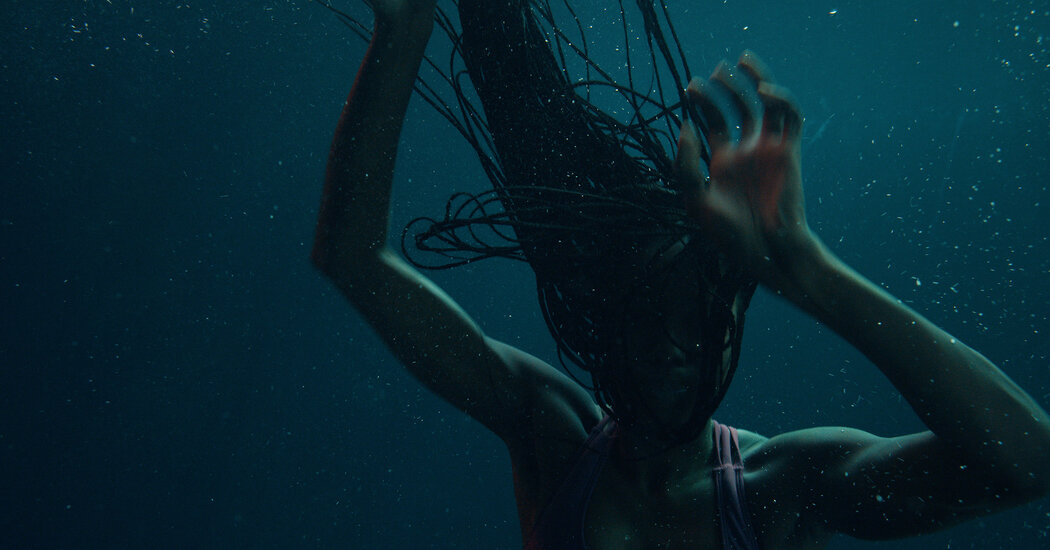
A standout in this year’s U.S. dramatic competition, “Nanny” was another one of the selections that I deeply regretted not seeing with an audience, for both its visceral shocks and its lush beauty. In this case, I would have stayed put in my seat, just as I did at home, where pesky domestic distractions can make paying attention a struggle, especially when a movie isn’t strong enough to fully hold you. That was never a problem with “Nanny,” which kept me rapt from the start with its visuals and mysteries, its emotional depths and the tight control that the writer-director Nikyatu Jusu maintains on her material.
Set in New York, the story centers on Aisha (the excellent Anna Diop), a Senegalese immigrant who’s recently accepted a nanny position. Her new workplace, a luxurious sprawl as sterile as a magazine layout, sets off immediate alarm bells, as do the overeager smiles and obsessive instructions of her tightly wound white employer, Amy (Michelle Monaghan). The setup recalls that of “Black Girl,” the Senegalese auteur Ousmane Sembène’s 1966 classic film about the horrors of postcolonialism. It’s an obvious aesthetic and political touchstone for Jusu, who nevertheless quickly and confidently spins off in her own direction.
Like a number of other selections in this year’s festival, “Nanny” is a horror movie with a profound difference; unlike too many other filmmakers, Jusu never becomes boxed in by genre. Instead, horror-film conventions are part of an expansive tool kit that includes narrative ellipses, an expressionistic use of bold color and figures from African folklore, including a trickster in spider form and a water spirit called Mami Wata. Here, clichés like the oppressive house, controlling employer and vulnerable heroine prove far more complex than they appear, having been skillfully reimagined for this anguished, haunted story.
Women in peril are familiar screen figures, but this year there was some honest variety in the kinds of directors putting knives to throats. At one point — in between streaming, smiling, grimacing, weeping and occasionally eww-ing at all the blood and guts — I realized that I hadn’t bothered to count the number of women and people of color in this year’s program. I was seeing enough fictional stories and documentaries with a range of different types of people that I hadn’t started compulsively profiling the filmmakers. Yes, there were a few Sundance reliables, the eternally cute and kooky white children of Indiewood, but not enough to trigger you about the old days when the festival was clogged with Tarantino clones.
The auteurist touchstone at Sundance these days is Jordan Peele, whose radical use of the genre continues to feel relevant to the traumas of contemporary life. The preponderance of frightful tales in this program is obviously a matter of availability, cinematic copycatting and curatorial discretion. Given all the onscreen evisceration this year, I would imagine that the festival director Tabitha Jackson and the director of programming Kim Yutani have strong stomachs and senses of humor. That they’re also feminists surely, if gratifyingly, goes without saying and may help explain why there are three movies in the slate about abortion.
The two I saw — the well-acted drama “Call Jane” and the solid, informative documentary “The Janes” — aren’t horror movies in the usual sense, but like more conventional examples of the genre, they also turn on the body, and specifically the female body, in peril. Each movie revisits the Jane Collective, a group of women and some men who from 1968 to 1973 helped women in Chicago obtain safe abortions before the procedure was a Constitutional right. And while the image of one member (Elizabeth Banks) in “Call Jane” learning how to administer abortions by practicing on pumpkins may not have been a Halloween joke, I laughed anyway.
On a conspicuous, quantifiable level, this year’s program reaffirms that a genuine diversity of filmmakers also yields a welcome cinematic multiplicity. It can be easy to think of representation as an abstraction, as a political cudgel, a tedious rallying cry, a bore. Again and again this year, the sight of all these bodies, particularly of women — including Emma Thompson letting it all hang out beautifully in the gentle comedy “Good Luck to You, Leo Grande” — was a reminder that these representations aren’t boxes that were ticked off. They are the embodied truths, pleasures and terrors of women and people of color who, having long served as canvases for fantasies of otherness, have seized control of their own images.

