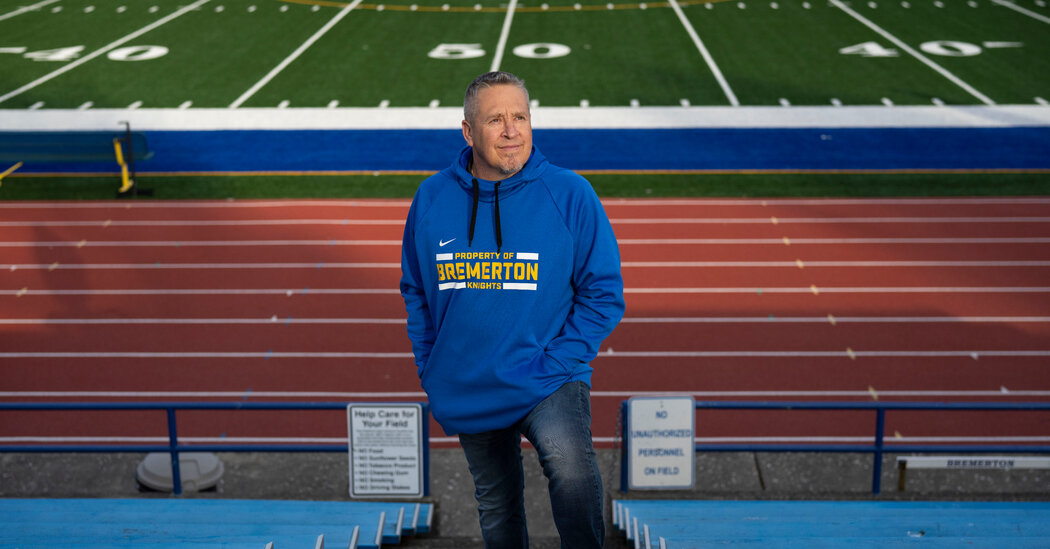

WASHINGTON — The Supreme Court ruled on Monday that a high school football coach had a constitutional right to pray at the 50-yard line after his team’s games.
The vote was 6 to 3, with the court’s three liberal members in dissent. The decision came less than a week after the court ruled, by the same vote, that Maine could not exclude religious schools from a tuition program, and it was the latest in a long line of decisions expanding the place of religion in public life and particularly in education.
Justice Neil M. Gorsuch, writing for the majority, said the prayers of the coach, Joseph Kennedy, were protected by the First Amendment.
“Respect for religious expressions is indispensable to life in a free and diverse republic — whether those expressions take place in a sanctuary or on a field, and whether they manifest through the spoken word or a bowed head,” he wrote. “Here, a government entity sought to punish an individual for engaging in a brief, quiet, personal religious observance.”
In dissent, Justice Sonia Sotomayor wrote that the majority had gone astray.
“Today’s decision,” she wrote, “is particularly misguided because it elevates the religious rights of a school official, who voluntarily accepted public employment and the limits that public employment entails, over those of his students, who are required to attend school and who this court has long recognized are particularly vulnerable and deserving of protection.”
“In doing so,” she wrote, “the court sets us further down a perilous path in forcing states to entangle themselves with religion, with all of our rights hanging in the balance.”
Mr. Kennedy said he was delighted by the decision.
“This is just so awesome,” he said in a statement. “All I’ve ever wanted was to be back on the field with my guys.”
Rachel Laser, the president of Americans United for Separation of Church and State, which represented the school board in the case, lamented what she said was the latest in a series of mounting setbacks.
“Today, the court continued its assault on church-state separation, by falsely describing coercive prayer as ‘personal’ and stopping public schools from protecting their students’ religious freedom,” she said in a statement.
The case, Kennedy v. Bremerton School District, No. 21-418, pitted the rights of government workers to free speech and the free exercise of their faith against the Constitution’s prohibition of government endorsement of religion and the ability of public employers to regulate speech in the workplace. The decision was in tension with decades of Supreme Court precedents that forbade pressuring students to participate in religious activities.
Mr. Kennedy had served as an assistant coach at a public high school in Bremerton, Wash., near Seattle. For eight years, he routinely offered prayers after games, with students often joining him. He also led and participated in prayers in the locker room, a practice he later abandoned and did not defend in the Supreme Court.
In 2015, after an opposing coach told the principal at Mr. Kennedy’s school that he thought it was “pretty cool” that Mr. Kennedy was allowed to pray on the field, the school board instructed Mr. Kennedy not to pray if it interfered with his duties or involved students. The two sides disagreed about whether Mr. Kennedy complied.
A school official recommended that the coach’s contract not be renewed for the 2016 season, and Mr. Kennedy did not reapply for the position.
The majority and dissenting opinions offered starkly different accounts of what had happened in Mr. Kennedy’s final months.
Justice Gorsuch wrote that Mr. Kennedy had sought only to offer a brief, silent and solitary prayer. Justice Sotomayor responded that the public nature of his prayers and his stature as a leader and role model meant that students felt forced to participate, whatever their religion and whether they wanted to or not.
Justice Gorsuch wrote that the coach, at least after the games at issue in the case, “offered his prayers quietly while his students were otherwise occupied.”
Justice Sotomayor gave a different account of the facts, taking account of a longer time period.
“Kennedy consistently invited others to join his prayers and for years led student-athletes in prayer,” she wrote. In an unusual move, the dissent included photographs showing Mr. Kennedy kneeling with players and others.
Justice Gorsuch wrote that Mr. Kennedy was not speaking for the school when he prayed.
“He was not instructing players, discussing strategy, encouraging better on-field performance or engaged in any other speech the district paid him to produce as a coach,” Justice Gorsuch wrote.
Instead, he wrote, Mr. Kennedy merely took a moment to pray while others checked their text messages or greeted friends.
Not everything school employees do during work hours is official conduct, Justice Gorsuch wrote. If it were, he said, “a school could fire a Muslim teacher for wearing a head scarf in the classroom or prohibit a Christian aide from praying quietly over her lunch in the cafeteria.”
Chief Justice John G. Roberts Jr. and Justices Clarence Thomas, Samuel A. Alito Jr. and Amy Coney Barrett joined all of Justice Gorsuch’s majority opinion. Justice Brett M. Kavanaugh joined most of it.
In dissent, Justice Sotomayor said Mr. Kennedy effectively coerced students into praying with him.
“Students look up to their teachers and coaches as role models and seek their approval,” she wrote. “Students also depend on this approval for tangible benefits. Players recognize that gaining the coach’s approval may pay dividends small and large, from extra playing time to a stronger letter of recommendation to additional support in college athletic recruiting.”
Justice Gorsuch responded that he rejected “the view that the only acceptable government role models for students are those who eschew any visible religious expression.”
In the process of ruling for Mr. Kennedy, the majority disavowed a major precedent on the First Amendment’s establishment clause, Lemon v. Kurtzman. That ruling, in 1971, set out what came to be known as the Lemon test, which requires courts to consider whether the challenged government practice has a secular purpose, whether its primary effect is to advance or inhibit religion, and whether it fosters excessive government entanglement with religion.
In Justice Gorsuch’s account, the Lemon test had already been discarded. But Justice Sotomayor wrote that the majority had just now overruled it.
She acknowledged that the test had been subject to frequent criticism by various members of the court. “The court now goes much further,” she wrote, “overruling Lemon entirely and in all contexts.”
Justices Stephen G. Breyer and Elena Kagan joined Justice Sotomayor’s dissent.
Over the last 60 years, the Supreme Court has rejected prayer in public schools, at least when it was officially required or part of a formal ceremony like a high school graduation. As recently as 2000, the court ruled that organized prayers led by students at high school football games violated the First Amendment’s prohibition of government establishment of religion.
“The delivery of a pregame prayer has the improper effect of coercing those present to participate in an act of religious worship,” Justice John Paul Stevens wrote for the majority in that case.
Justice Gorsuch wrote that those precedents did not apply to Mr. Kennedy’s conduct.
“The prayers for which Mr. Kennedy was disciplined were not publicly broadcast or recited to a captive audience,” he wrote. “Students were not required or expected to participate.”
Justice Gorsuch said the message of the decision in favor of Mr. Kennedy was straightforward.
“The Constitution and the best of our traditions,” he wrote, “counsel mutual respect and tolerance, not censorship and suppression, for religious and nonreligious views alike.”