

We collect cookies to analyze our website traffic and performance; we never collect any personal data. Cookie Policy
Accept
NEW YORK DAWN™NEW YORK DAWN™NEW YORK DAWN™
Notification Show More
Font ResizerAa
  • Home
  • Trending
  • New York
  • World
  • Politics
  • Business
    • Business
    • Economy
    • Real Estate
  • Crypto & NFTs
  • Tech
  • Lifestyle
    • Lifestyle
    • Food
    • Travel
    • Fashion
    • Art
  • Health
  • Sports
  • Entertainment
Reading: Tesla Recalls Cars With Full Self-Driving to Prevent Rolling Stops
Share
Font ResizerAa
NEW YORK DAWN™NEW YORK DAWN™
Search
  • Home
  • Trending
  • New York
  • World
  • Politics
  • Business
    • Business
    • Economy
    • Real Estate
  • Crypto & NFTs
  • Tech
  • Lifestyle
    • Lifestyle
    • Food
    • Travel
    • Fashion
    • Art
  • Health
  • Sports
  • Entertainment
Follow US
NEW YORK DAWN™ > Blog > Technology > Tesla Recalls Cars With Full Self-Driving to Prevent Rolling Stops
Tesla Recalls Cars With Full Self-Driving to Prevent Rolling Stops
Technology

Tesla Recalls Cars With Full Self-Driving to Prevent Rolling Stops

Last updated: February 1, 2022 7:19 pm
Editorial Board Published February 1, 2022
Share
SHARE
01tesla recall facebookJumbo

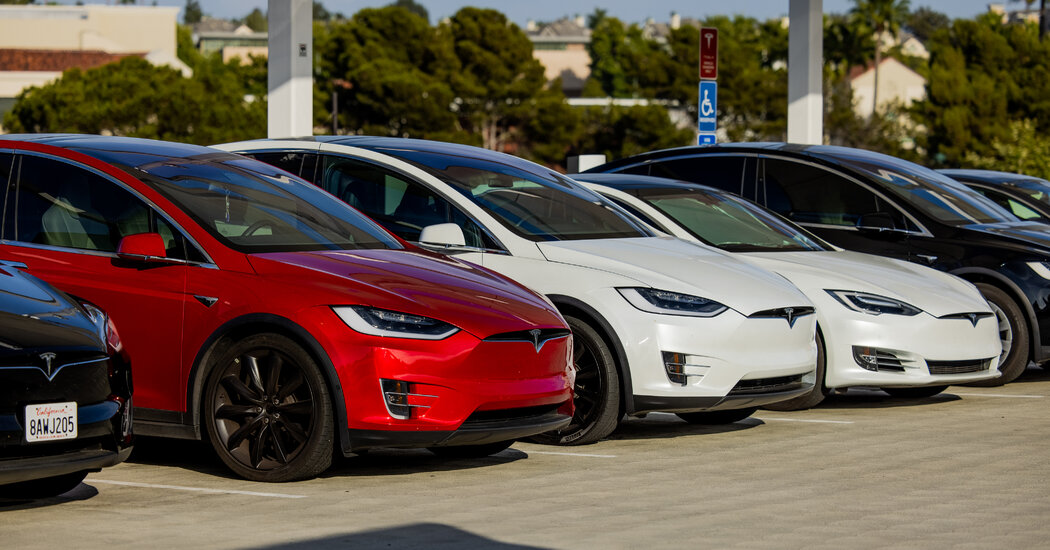
Tesla is recalling 54,000 cars equipped with its Full Self-Driving software to disable a feature that in certain conditions lets the vehicles roll slowly through intersections without stopping.

The move comes after the automaker was criticized on social media for enabling “rolling stops” in violation of traffic regulations.

“Failing to stop at a stop sign can increase the risk of a crash,” the National Highway Traffic Safety Administration said in a letter to Tesla confirming the recall, which was made public on Tuesday.

The action covers only Teslas that have been equipped with software that the company calls Full Self-Driving and includes S, X, 3 and Y models that were produced at various times between 2016 and 2022.

Full Self-Driving is more advanced than Tesla’s more widely used Autopilot driver assistance system. Despite their names, neither system can operate a car without active engagement by a human driver.

Although Tesla allows customers to buy Full Self-Driving software — it costs $12,000 — the software is still in a test phase, and the company has allowed only a select group of customers to activate it.

The rolling-stop problem is the latest in a series of safety issues involving Tesla. In August, the traffic safety agency opened a formal investigation into a series of crashes in which Teslas in Autopilot mode struck emergency vehicles that had stopped or parked, often at the scene of an earlier accident. The agency is trying to find out why Autopilot sometimes failed to see and stop for police cars or fire trucks with emergency lights flashing.

A month later, Tesla issued an over-the-air update to improve the ability to recognize emergency vehicles. The safety agency responded by reminding Tesla that federal law requires the company to initiate a recall any time it corrects a safety defect. The agency also ordered Tesla to provide data about its Full Self-Driving software and raised concerns that Tesla might be preventing customers from sharing safety information with the agency.

In November, Tesla modified the software on about 12,000 cars to fix a braking problem and filed a formal recall to document the move. The automaker also recalled 458,000 cars in December for two separate mechanical defects that could affect safety. .

Also in December, the safety agency opened an investigation into a feature that allowed front passengers or drivers to play video games on the dashboard screen while Tesla cars were moving. A day later, Tesla agreed to disable the feature.

The rolling-stop issue came to light after a Tesla software update in October added driving modes that could allow cars equipped with the system to roll through intersections at speeds of five miles per hour or less. The safety agency discussed the matter with Tesla twice in early January, and the company agreed to issue a recall and disable rolling stops on Jan. 20, according to documents posted on the agency’s website.

Tesla told the regulator that rolling stops were allowed only at intersections when no cars, pedestrians or bicyclists were detected. The company told the safety agency that it was not aware of any crashes that resulted from rolling stops by cars equipped with the Full Self-Driving software, the documents show.

The company did not respond to a request for comment.

You Might Also Like

Monitoring each resolution, greenback and delay: The brand new course of intelligence engine driving public-sector progress

Z.ai debuts open supply GLM-4.6V, a local tool-calling imaginative and prescient mannequin for multimodal reasoning

Anthropic's Claude Code can now learn your Slack messages and write code for you

Reserving.com’s agent technique: Disciplined, modular and already delivering 2× accuracy

Design within the age of AI: How small companies are constructing massive manufacturers quicker

TAGGED:Automobile Safety Features and DefectsDriverless and Semiautonomous VehiclesElectric and Hybrid VehiclesNational Highway Traffic Safety AdministrationRecalls and Bans of ProductsTesla Motors IncThe Washington MailTraffic Accidents and Safety
Share This Article
Facebook Twitter Email Print

Follow US

Find US on Social Medias
FacebookLike
TwitterFollow
YoutubeSubscribe
TelegramFollow
Popular News
NYPD bolsters patrols over Jewish websites in wake of D.C. anti-Semitic capturing deaths
Politics

NYPD bolsters patrols over Jewish websites in wake of D.C. anti-Semitic capturing deaths

Editorial Board May 22, 2025
Kanye West Always Wanted You to Watch
From Pink Gentle to Chilly Remedy—These Are the Skincare Rituals Insiders Swear By
A life-changing Oscar. A break up. A reunion. The Swell Season nonetheless feels like a Hollywood story
‘Magnolia’ made me need to write about films. Then Hollywood stopped making films like ‘Magnolia’

You Might Also Like

Why AI coding brokers aren’t production-ready: Brittle context home windows, damaged refactors, lacking operational consciousness
Technology

Why AI coding brokers aren’t production-ready: Brittle context home windows, damaged refactors, lacking operational consciousness

December 7, 2025
AI denial is turning into an enterprise threat: Why dismissing “slop” obscures actual functionality positive factors
Technology

AI denial is turning into an enterprise threat: Why dismissing “slop” obscures actual functionality positive factors

December 5, 2025
GAM takes purpose at “context rot”: A dual-agent reminiscence structure that outperforms long-context LLMs
Technology

GAM takes purpose at “context rot”: A dual-agent reminiscence structure that outperforms long-context LLMs

December 5, 2025
The 'reality serum' for AI: OpenAI’s new technique for coaching fashions to admit their errors
Technology

The 'reality serum' for AI: OpenAI’s new technique for coaching fashions to admit their errors

December 5, 2025

Categories

  • Health
  • Sports
  • Politics
  • Entertainment
  • Technology
  • Art
  • World

About US

New York Dawn is a proud and integral publication of the Enspirers News Group, embodying the values of journalistic integrity and excellence.
Company
  • About Us
  • Newsroom Policies & Standards
  • Diversity & Inclusion
  • Careers
  • Media & Community Relations
  • Accessibility Statement
Contact Us
  • Contact Us
  • Contact Customer Care
  • Advertise
  • Licensing & Syndication
  • Request a Correction
  • Contact the Newsroom
  • Send a News Tip
  • Report a Vulnerability
Term of Use
  • Digital Products Terms of Sale
  • Terms of Service
  • Privacy Policy
  • Cookie Settings
  • Submissions & Discussion Policy
  • RSS Terms of Service
  • Ad Choices
© 2024 New York Dawn. All Rights Reserved.
Welcome Back!

Sign in to your account

Lost your password?
