

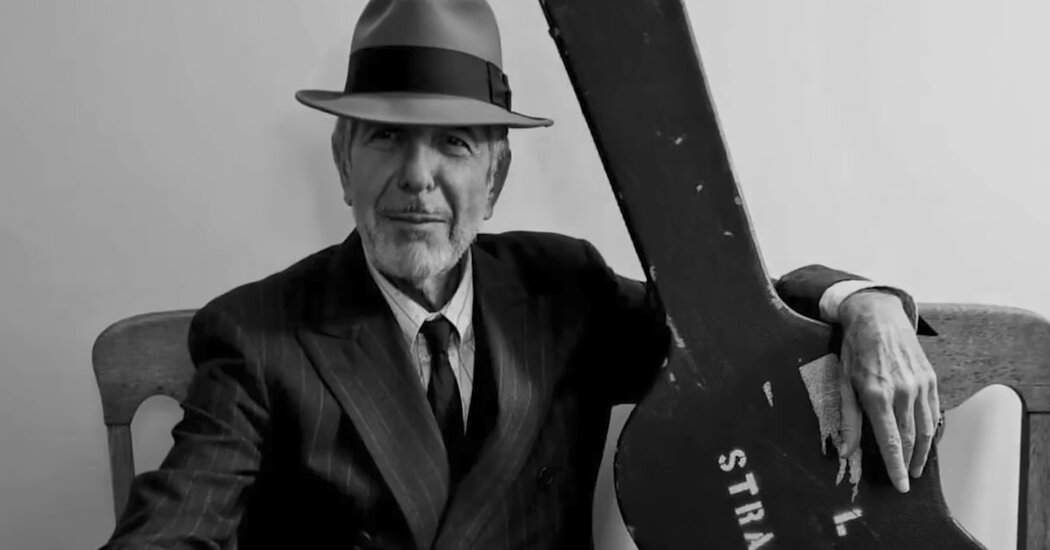

The documentary “Hallelujah: Leonard Cohen, a Journey, a Song” illuminates the unpredictable paths taken by a singer-songwriter and his music. The directors, Dan Geller and Dayna Goldfine (“Ballets Russes”), trace Cohen’s career from his early days in Montreal to his 21st-century renaissance, exploring his creative process, his spiritual search and how his perhaps best-known song, “Hallelujah,” took on a life of its own.
Of the musician’s sagelike appeal, A.O. Scott wrote in a Critic’s Pick review, “His gift as a songwriter and performer was rather to provide commentary and companionship amid the gloom, offering a wry, openhearted perspective on the puzzles of the human condition.”
I spoke with Geller and Goldfine about their insights into Cohen’s life and lyrical artistry, and his enduring mysteries.
What did you learn about Leonard Cohen that surprised you most?
DAN GELLER He was clearly struggling to find his sense of place in his life, his universe and his love life — and in his spiritual life. He was seeking so deeply over decades, and when that went away, as he said, “The search itself dissolved,” and a lightness entered his being. He couldn’t even explain why. And he didn’t want to examine it too much because he was afraid that by examining it, it might go away again.
DAYNA GOLDFINE I had thought that the only reason he had gone back out on the road in his mid-70s, after a 14-or-15-year hiatus, was because he had had all his money ripped off, and it was a financial compulsion. But just as important was that Leonard felt as if he had never truly reached the same level as a performer as he thought he might have reached as a singer-songwriter. You really saw him then reaching this pinnacle that made a Leonard Cohen concert so deep and so spiritual.
He’s amazing in archival interviews because he essentially speaks in lyrics. What is that wonderful phrase he casually drops, “the foothills of old age”?
GOLDFINE Yes! “70 is indisputably not youth. It’s not extreme old age, but it’s the foothills of old age.” Isn’t that gorgeous? I found Leonard’s wit both immensely gratifying and also surprising. Especially in the first couple decades of his career, he was painted as this monster of gloom. But if you really hang with him and listen to what he’s saying, he’s one of the funniest guys ever. It’s a very droll, dry wit.
Whenever possible, we tried to come up with something fresh so that even the most devout Leonard Cohen head would find something new in our film, or if we were going to use a piece of archival material that had been used in the past, we would try to reframe it. Rabbi [Mordecai] Finley, for instance, reframes some of the material in a really interesting way that gives you a fresh perspective.
What were the biggest revelations about “Hallelujah” and Cohen’s writing process?
GOLDFINE I hadn’t realized the sheer number of verses that Leonard was writing and rewriting and erasing and reconfiguring throughout the five or so years that it took him to write that song. And then the number of times that he reconfigured the song in performing it. I love in the film where he takes it from the King David Old Testament version of the song and moves it into a secular realm.
GELLER There’s also the way that other people have responded to the song — listening to John Cale or Brandi Carlile or Eric Church, to hear why they resonated with the song. It’s given me a window into the souls of these other singer-songwriters.
His notebooks are fascinating because there are versions of lines that have different resonances but are also super powerful. “When David played, his fingers bled, he wept for every word he said” — that’s an incredible line there, too! He could have stopped anywhere along the way and had maybe an equally powerful song.
GOLDFINE You also see the very first incarnation of “Anthem,” one of his most famous songs, and the first time he ever wrote that line: “There’s a crack in everything.” That almost brought tears to my eyes when I saw it — the first infant steps of “Anthem.” Also in those notebooks you see his datebook, and the first time he met Dominique Issermann, the woman he considered the first great love of his life.
Although you couldn’t interview Cohen, did you hear anything from him while making the film?
GELLER The Dominique [interview] was interesting because she was staying with Leonard at the time when we were going to film her. She said that he asked her, “Look, if they start asking questions like, ‘Was it your kitchen chair that he was tied to when he wrote the song?’ don’t let them go down that path.” This is the only direct, or close to direct, feedback we ever got from Leonard. Of course, we would never ask that! But I thought, That’s good, because what he was really saying is: Don’t concretize the song and its lyrics. Leave it open to interpretation, and a mystery. Don’t make it specific to Leonard himself.
What’s your favorite version of “Hallelujah”?
GOLDFINE When I was embroiled in shaping the John Cale section, I just couldn’t get enough of the John Cale version. And Jeff Buckley was the first “Hallelujah” that I ever heard, and it blew me away. But at the end of the day, it’s Leonard Cohen singing it in those last five years’ worth of concerts and, night after night, getting down on his knees to start that song.
GELLER Buckley’s haunting guitar arpeggios are so beautiful and exquisite. I love those and his gorgeous voice. But Leonard performing it live — we saw him do it twice at the Paramount Theater in Oakland. Just watching someone truly stand in the center of his song, a song that’s filled with the complications of yearning, of brokenness, of hopefulness, of love, of sex — all of it!

