

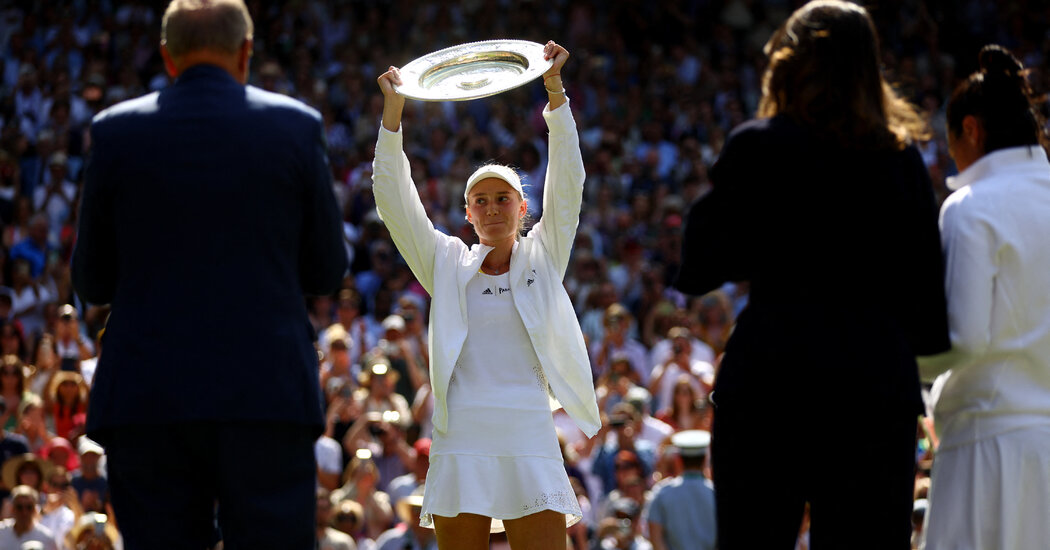

WIMBLEDON, England — Winning Wimbledon for the first time barely seemed to register with Elena Rybakina.
Match point secured against Ons Jabeur, Rybakina lightly clenched her left fist, wiped her mouth with her wrist band, expelled a breath and sauntered forward to the net to shake the hand of a crestfallen Jabeur, then waved to the crowd with as much urgency as Queen Elizabeth waving to the hoi polloi out the window of her carriage.
Rybakina was smiling, to be sure, after her victory, 3-6, 6-2, 6-2, but for a 23-year-old player whose career had just been transformed by a stunning run to the title this was understated stuff even by English standards.
“She wins the trophy for the least emotional Slam win,” said Martina Navratilova, a nine-time Wimbledon singles champion.
But it should come as no surprise that Rybakina’s feelings were simply under wraps, and a couple of hours later, after she had posed with the gilded dish awarded to the champion, she was asked at her news conference how her parents might react to her victory when she finally got the chance to speak with them.
“Probably, they’re going to be super proud,” she said, beginning to tear up.
“You wanted to see emotion,” she said, fighting to regain her composure. “Kept it too long.”
It was a poignant moment, more moving, to be truthful, than anything that happened on Saturday on Centre Court, the Shakespearean scene of so many breakthroughs and breakdowns through the decades, including Jana Novotna’s crying on the shoulder of the Duchess of Kent after blowing a lead against Steffi Graf in the 1993 final.
The history, all those ghosts on the grass, can hit a player hard as they try to join the club, and Rybakina and Jabeur certainly had to work their way through early jitters as they both played in their first Grand Slam final.
True stylistic difference is rare in the big matches in the women’s game, but Rybakina versus Jabeur provided plenty of contrast as they explored the backcourt and the forecourt of the most famous showplace in tennis.
Rybakina, a lean and long-legged 6-footer who represents Kazakhstan, has intimidating power and a first and second serve that can attain speeds that would suit the men’s tour.
Jabeur, a stockier and much shorter Tunisian, is a creative force: walking jauntily around the court between points and favoring drop shots and abrupt rhythm changes once they begin.
But force would trump finesse in this new-arrival final: the first at Wimbledon between two first-time major women’s singles finalists since 1962, when Karen Susman of the United States defeated Vera Sukova of Czechoslovakia.
“I didn’t play my best tennis, let’s say, in the second and third set,” Jabeur said. “She started to be more aggressive. I think she stepped in the court much more and put a lot of pressure on. That, I didn’t find a solution for unfortunately today.”
Rybakina’s ability to navigate the big points with sang-froid and timely serves was remarkable and never more helpful than when she escaped from a 0-40 deficit when serving at 3-2 in the third set.
But that rise-to-the-occasion tennis came as no surprise to her coach, Stefano Vukov, a Croatian who was watching from the players’ box on Saturday. He noticed it when he first decided to work with her near the end of the 2018 season.
“Everybody feels the nerves, but she is a very clutch player,” he said. “She showed me in the first tournaments we ever played. When the scores were getting close, she was always the one coming out the winner of these close contests. So, it was mostly effortless for her, just her personality and her style of game.”
Her victory at Wimbledon was deeply impressive but not the outcome that most in Centre Court or on the payrolls of the All England Club were yearning for.
The No. 2-ranked Jabeur is not only a sympathetic figure, but also a deeply symbolic one as an Arab woman succeeding at the highest reaches of a sport that aspires to be truly global. Rybakina, ranked 23rd, plays for Kazakhstan but is a Russian who was born, raised and, until this year, based in Moscow, where her parents still live.
Wimbledon once feted another tall, blonde Russian newcomer when Maria Sharapova won the title by surprise in 2004 at age 17. But Rybakina’s arrival comes at an awkward moment for those with Russian connections. The tournament barred all Russian and Belarusian players (and journalists) this year because of the Russian invasion of Ukraine.
The move came after pressure from the British government led by Prime Minister Boris Johnson, who just resigned. But the ban was also put in place to deprive Russia and its leadership of the chance to use any Russian success at the tournament for propaganda.
Rybakina, who began representing Kazakhstan in 2018, was asked if her native country might try to politicize her victory.
“I don’t know,” she said. “I’m playing for Kazakhstan for a very, very long time. I represent it on the biggest tournaments, the Olympics, which was a dream come true. I don’t know what’s going to happen. I mean, it’s always some news, but I cannot do anything about this.”
That is certainly true. Wimbledon, after all, has barred players who represent Russia, not players who used to represent Russia. And it is a challenge to see how the Russian government or sports officials could use Rybakina’s success as a bright and shiny tale of Russian triumph when it was Russia’s lack of support for her career that ultimately caused her to switch allegiances.
“I didn’t choose where I was born,” she said. “People believed in me. Kazakhstan supported me so much. Even today, I heard so much support. I saw the flags, so I don’t know how to answer these questions.”
She is hardly the first Russian tennis player to take the cash and amenities and choose to represent Kazakhstan. She is hardly the first tennis player to take the cash and amenities and choose to represent another country.

