


In late 2012, the best-selling author and journalist Michael Pollan (“The Omnivore’s Dilemma”) was at a dinner party in Berkeley, Calif. Among his fellow diners was a prominent developmental psychiatrist, in her 60s, who spoke at some length about a recent LSD trip. This pricked up Pollan’s ears.
His first thought, as he shared during a recent video interview: “People like that are taking LSD?” The psychiatrist went on to explain that the drug gave her a better understanding of the way children think.
“Her hypothesis,” Pollan said, “was that the effects of psychedelics, LSD in that case, give us a taste of what child consciousness would be like — this kind of 360-degree taking-in of information, not particularly focused, fascinated by everything.”
Pollan had already heard about clinical trials in which doctors were giving cancer patients psilocybin to help them deal with their fear of death. Now, he was really curious about psychedelic therapy. That curiosity became an article in The New Yorker (“The Trip Treatment,” 2015). The article became a book, “How to Change Your Mind” (2019).
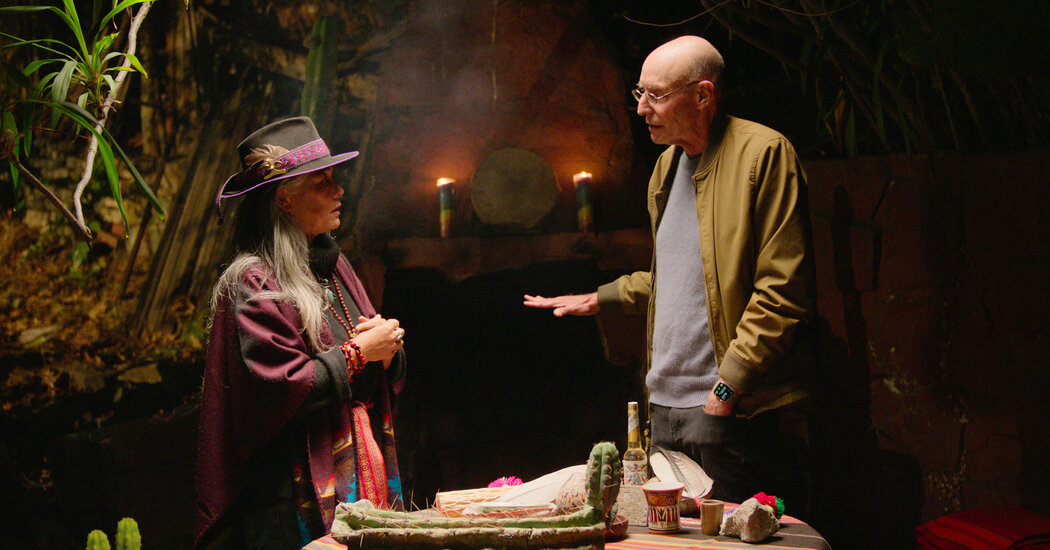
And now the book has become a four-part Netflix series of the same name, which debuted Tuesday. Pollan is an executive producer (along with the Oscar-winning filmmaker Alex Gibney) and the primary on-camera presence.
A thoughtful and wide-ranging look at psychedelic therapy, the series is grounded in accounts of their centuries-long sacramental use and of their uneasy history in modern society, especially in the United States. In particular, it focuses on four substances — LSD, mescaline, MDMA (known as Ecstasy or Molly) and psilocybin (the active ingredient in magic mushrooms) — and the ways in which they are being used to treat patients with maladies including post-traumatic stress disorder, addiction, depression, anxiety and obsessive-compulsive disorder.
One of those patients is Lori Tipton, a New Orleans woman who endured a Job-like run of ill fortune. Her brother died of an overdose. Her mother murdered two people and then killed herself; Tipton found the bodies. She was raped by an acquaintance. Not surprisingly, she developed severe PTSD.
“I really felt like I couldn’t access joy in my life, even when it was right in front of me,” Tipton said in a video interview. She thought about suicide constantly. When she heard about a clinical trial for MDMA, held in 2018, she figured she had nothing to lose.
I can relate to some of this. A few years back I was diagnosed with PTSD and clinical depression after my life partner, Kate, was diagnosed with a terminal brain disease and died about 18 months later, in 2020. I didn’t have much interest in living. Running out of options, my doctor prescribed me a weekly regimen of esketamine, which is a close relative of the dissociative hallucinogen ketamine.
Like many, I had experimented with hallucinogens, including mushrooms and LSD, in my youth. I was partying, not seeking. I never planned to go back there. But the treatment started helping me almost immediately.
Pollan, 67, never did the youthful experimenting. Known primarily as an expert in plants and healthy eating — his latest book, “This is Your Mind on Plants,” comes out in paperback on July 19 — he came to psychedelics late in life. He was too young to indulge in the Summer of Love, and by the 1970s, the war on drugs and anti-LSD hysteria had quashed what had been a fertile period of scientific research in the ’50s.
But once he began studying, and experimenting, he became a convert rather quickly.
“At this age sometimes you need to be shaken out of your grooves,” he says in the Netflix series. “We have to think about these substances in a very cleareyed way and throw out the inherited thinking about it and ask, ‘What is this good for?’”
Tall and bald with the build of a swimmer, Pollan is no Timothy Leary — he isn’t asking anyone to drop out — and the medical trials described and shown in “How to Change Your Mind” shouldn’t be confused with Ken Kesey’s freewheeling acid tests of the ’60s. Back then, when psychedelics left the laboratory and entered the counterculture, the power structure freaked out.
“Kids were going to communes, and American boys were refusing to go to war,” Pollan said. “President Nixon certainly believed that LSD was responsible for a lot of this, and he may well have been right. It was a very disruptive force in society, and that is why I think the media after 1965 turns against it after being incredibly enthusiastic before 1965.”
Junk science spread nonsense about LSD scrambling chromosomes. The drug was made illegal in California in 1966, and then nationally in 1970. Researchers weren’t forbidden from continuing their work with psychedelics, but the stigma made such work very rare until it re-emerged in the 2000s. Today, clinical trials are approved by the F.D.A. and D.E.A.
“From the early ’70s to the early ’90s, there was no approved psychedelic research in human subjects,” said Charles Grob, a professor of psychiatry and pediatrics at U.C.L.A., who has written widely about psychedelic therapy. “Since then, research development has re-emerged and slowly evolved, until the last few years when professional and public interest in the topic appears to have exploded.”
Given evolving attitudes, one challenge facing the filmmakers, including the directors Alison Ellwood and Lucy Walker, was how to depict the psychedelic experience in a sophisticated way, without stumbling into the territory of a ’60s exploitation movie.
“We didn’t want to fall into the trap of using psychedelic visual tropes — wild colors, rainbow streaks, morphing images,” Ellwood wrote in an email. “We wanted to keep the visual style more personal, intimate and experiential. We wanted people watching the series who have not had their own psychedelic experiences to be able to relate to the visuals.”
One imaginative scene recreates the famous bicycle ride taken by the Swiss chemist Albert Hofmann, who first synthesized LSD in 1936 but didn’t discover its psychedelic effects until 1943 (accidentally). Feeling strange after ingesting 250 micrograms, Hofmann rode his bike during the peak of his trip. In “How to Change Your Mind,” we see the buildings around him bend and waver as he rides. The road beneath him blurs. The tombstones in a graveyard sway.
Tipton’s experience in her clinical MDMA trials was more controlled but no less profound. The results after three sessions, she said, were beyond what she could have imagined.
“As the sessions progressed, I worked with the therapists to remain embodied and fully present to my emotions as I recalled some of the most difficult experiences of my life,” Tipton said. “In doing this, I was able to find a new perspective, one that had eluded me for years. And from this place I could find empathy, forgiveness and understanding for many people in my life, but most importantly for myself.”
Her descriptions sounded familiar. In 2020, I began going to my doctor’s office once a week to ingest three nasal spray inhalers and sit for two hours, pausing only to have my blood pressure taken halfway through. I didn’t hallucinate, but I found myself conversing with Kate as if she were in the room.
I saw my grief as something separate from my being, something more akin to love than death. I didn’t identify with my pain in the same way.
It was, without question, a spiritual experience. Then, two hours later, a bit groggy but otherwise back to normal, I was ready to go home. After a few such sessions, combined with talk therapy, I started to see a light at the end of the tunnel. Esketamine is technically not a psychedelic, but it had certainly changed my mind.
It’s safe to say Pollan’s has changed, too. He recently became a co-founder of the University of California Berkeley Center for the Science of Psychedelics. A portion of his author website now serves as an informational clearinghouse for people looking to learn more. Word of his effort appears to be spreading. His book on the subject was name-checked on a recent episode of the HBO Max series “Hacks.” The Netflix series has already cracked the streamer’s Top 10 in the United States.
Bit by bit, the country’s laws are beginning to reflect evolving attitudes. Last year, Oregon voters approved a ballot initiative that directs the Oregon Health Authority to license and regulate “psilocybin products and the provision of psilocybin services.” Colorado appears likely to vote on a similar initiative this fall.
For Pollan, such efforts strike a personal nerve.
“The ego is a membrane between you and the world,” he said. “It’s defensive and it’s very useful. It gets a lot done, but it also stands between us and other things and gives us this subject-object duality. When the ego is gone, there is nothing between you and the world.”
“Getting perspective on your ego is something you work at in psychotherapy,” he added. “But this happened for me in the course of an afternoon, and that’s what’s remarkable about it.”

