We collect cookies to analyze our website traffic and performance; we never collect any personal data. Cookie Policy
Accept
NEW YORK DAWN™NEW YORK DAWN™NEW YORK DAWN™
Notification Show More
Font ResizerAa
  • Home
  • Trending
  • New York
  • World
  • Politics
  • Business
    • Business
    • Economy
    • Real Estate
  • Crypto & NFTs
  • Tech
  • Lifestyle
    • Lifestyle
    • Food
    • Travel
    • Fashion
    • Art
  • Health
  • Sports
  • Entertainment
Reading: Facial Recognition at Airports: What You Need to Know
Share
Font ResizerAa
NEW YORK DAWN™NEW YORK DAWN™
Search
  • Home
  • Trending
  • New York
  • World
  • Politics
  • Business
    • Business
    • Economy
    • Real Estate
  • Crypto & NFTs
  • Tech
  • Lifestyle
    • Lifestyle
    • Food
    • Travel
    • Fashion
    • Art
  • Health
  • Sports
  • Entertainment
Follow US
NEW YORK DAWN™ > Blog > Technology > Facial Recognition at Airports: What You Need to Know
Facial Recognition at Airports: What You Need to Know
Technology

Facial Recognition at Airports: What You Need to Know

Last updated: February 26, 2022 10:00 am
Editorial Board Published February 26, 2022
Share
SHARE
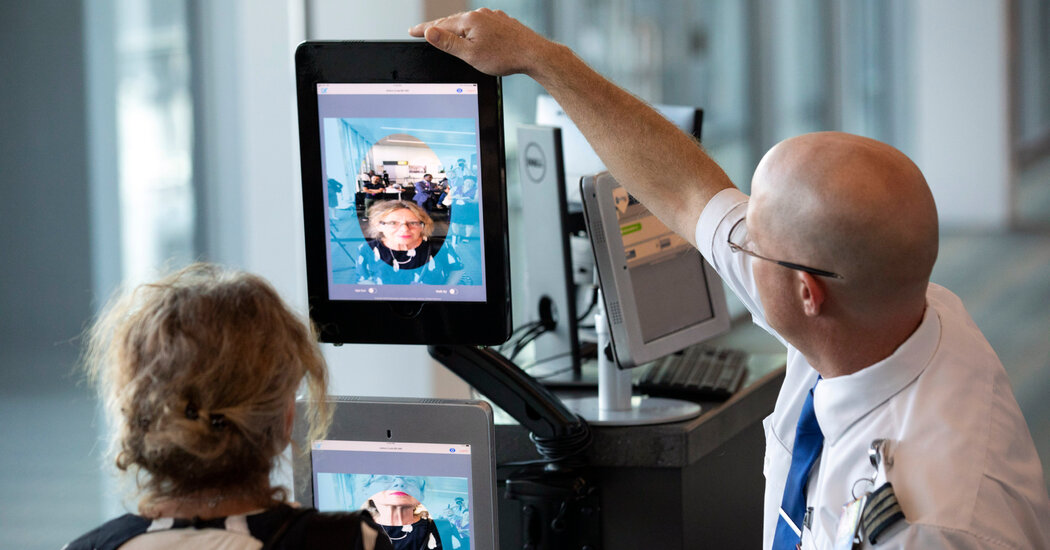
26qna facial recognition 1 facebookJumbo

How many impostors has the technology identified?

Since deployment, in about the first three years, primarily in the air passenger environment and somewhat in maritime, we have identified about 300 impostors using the technology. That doesn’t mean we would not have otherwise identified them. In the last year, at pedestrian land crossings at the southern land border, it caught about 1,000 to 1,100.

Contents
How many impostors has the technology identified?Critics fear digital systems will be used for surveillance. How are you ensuring privacy?How are you handling the threat of unconscious bias in the programming, which could lead to higher rates of errors for some groups, including people of color?How are travelers notified that they can opt out?Is the technology at all border checkpoints?How do you address biometric skeptics?

Critics fear digital systems will be used for surveillance. How are you ensuring privacy?

Our business use case is in identifying individuals at a time and place where they would normally expect to present themselves for identity verification. We are not grabbing images and scraping social media. Individuals are presenting a passport and we have a repository to tap into and build galleries in advance of their arrival using U.S. passport photos and photos of those who have applied for visas. So we build these galleries in the airport and maritime environments based on information already provided for identity verification. We match it to the information we have.

And we’re making sure there’s secure encryption. When a gallery is created, that photo isn’t attached to any information and can’t be reverse engineered to be compromised. The design is based on the privacy measures we knew had to be in place. Images for U.S. citizens are retained less than 12 hours and often times much less.

How are you handling the threat of unconscious bias in the programming, which could lead to higher rates of errors for some groups, including people of color?

That’s certainly something we’re very tuned into. We have partnered with the National Institute of Standards and Technology to provide information on the program. Our high-performing algorithms show virtually no demonstrable difference when it comes to demographics.

How are travelers notified that they can opt out?

We post signage at all ports of entry. Individuals opting out need to notify the officer at inspection. It would then revert to the manual process.

Is the technology at all border checkpoints?

We have it rolled out in pedestrian lanes at land borders. In the air environment, we’re covering about 99 percent with Simplified Arrival. The land border is the final frontier. We just completed a 120-day pilot in the car lanes at Hidalgo, Texas, and we’ll be evaluating the outcome. At cruise terminals, we’re in the 90 percent range. We’re working with nine major carriers at eight ports of entry, including Miami, Port Canaveral and Port Everglades, all in Florida.

How do you address biometric skeptics?

We welcome the scrutiny from privacy advocacy groups. We want to be able to tell and share the story about the investment we’ve made with respect to privacy. There are so many myths and so much misinformation out there, conflating what we do with surveillance. Anytime new technology is rolled out, there are always legitimate concerns. We welcome those questions. They help us answer better when we are building out these systems.

Elaine Glusac writes the Frugal Traveler column. Follow her on Instagram @eglusac.

You Might Also Like

Why LinkedIn says prompting was a non-starter — and small fashions was the breakthrough

ServiceNow positions itself because the management layer for enterprise AI execution

CFOs at the moment are getting their very own 'vibe coding' second because of Datarails

TrueFoundry launches TrueFailover to mechanically reroute enterprise AI site visitors throughout mannequin outages

MIT’s new ‘recursive’ framework lets LLMs course of 10 million tokens with out context rot

TAGGED:Airport SecurityContent Type: ServiceCustoms and Border Protection (US)Facial Recognition SoftwarePrivacyThe Washington MailTravel and VacationsUnited States
Share This Article
Facebook Twitter Email Print

Follow US

Find US on Social Medias
FacebookLike
TwitterFollow
YoutubeSubscribe
TelegramFollow
Popular News
Hochul backs key Adams public security reforms, however not bail reform, in NY State of the State
Politics

Hochul backs key Adams public security reforms, however not bail reform, in NY State of the State

Editorial Board January 14, 2025
‘The Survivor’ Review: Clenched Fists
At an Ann Arbor Rock Show, Almost Everyone There Is Over 65
Why Rick Pitino sees level guard Dylan Darling’s well being because the ‘key’ for St. John’s
Treasury Aims for Economic Pain on Russia, but Critics Question Effectiveness

You Might Also Like

X open sources its algorithm: 5 methods companies can profit
Technology

X open sources its algorithm: 5 methods companies can profit

January 20, 2026
Claude Code prices as much as 0 a month. Goose does the identical factor without cost.
Technology

Claude Code prices as much as $200 a month. Goose does the identical factor without cost.

January 20, 2026
Claude Code prices as much as 0 a month. Goose does the identical factor without cost.
Technology

Claude Code prices as much as $200 a month. Goose does the identical factor free of charge.

January 20, 2026
Cease calling it 'The AI bubble': It's truly a number of bubbles, every with a distinct expiration date
Technology

Cease calling it 'The AI bubble': It's truly a number of bubbles, every with a distinct expiration date

January 18, 2026

Categories

  • Health
  • Sports
  • Politics
  • Entertainment
  • Technology
  • Art
  • World

About US

New York Dawn is a proud and integral publication of the Enspirers News Group, embodying the values of journalistic integrity and excellence.
Company
  • About Us
  • Newsroom Policies & Standards
  • Diversity & Inclusion
  • Careers
  • Media & Community Relations
  • Accessibility Statement
Contact Us
  • Contact Us
  • Contact Customer Care
  • Advertise
  • Licensing & Syndication
  • Request a Correction
  • Contact the Newsroom
  • Send a News Tip
  • Report a Vulnerability
Term of Use
  • Digital Products Terms of Sale
  • Terms of Service
  • Privacy Policy
  • Cookie Settings
  • Submissions & Discussion Policy
  • RSS Terms of Service
  • Ad Choices
© 2024 New York Dawn. All Rights Reserved.
Welcome Back!

Sign in to your account

Lost your password?